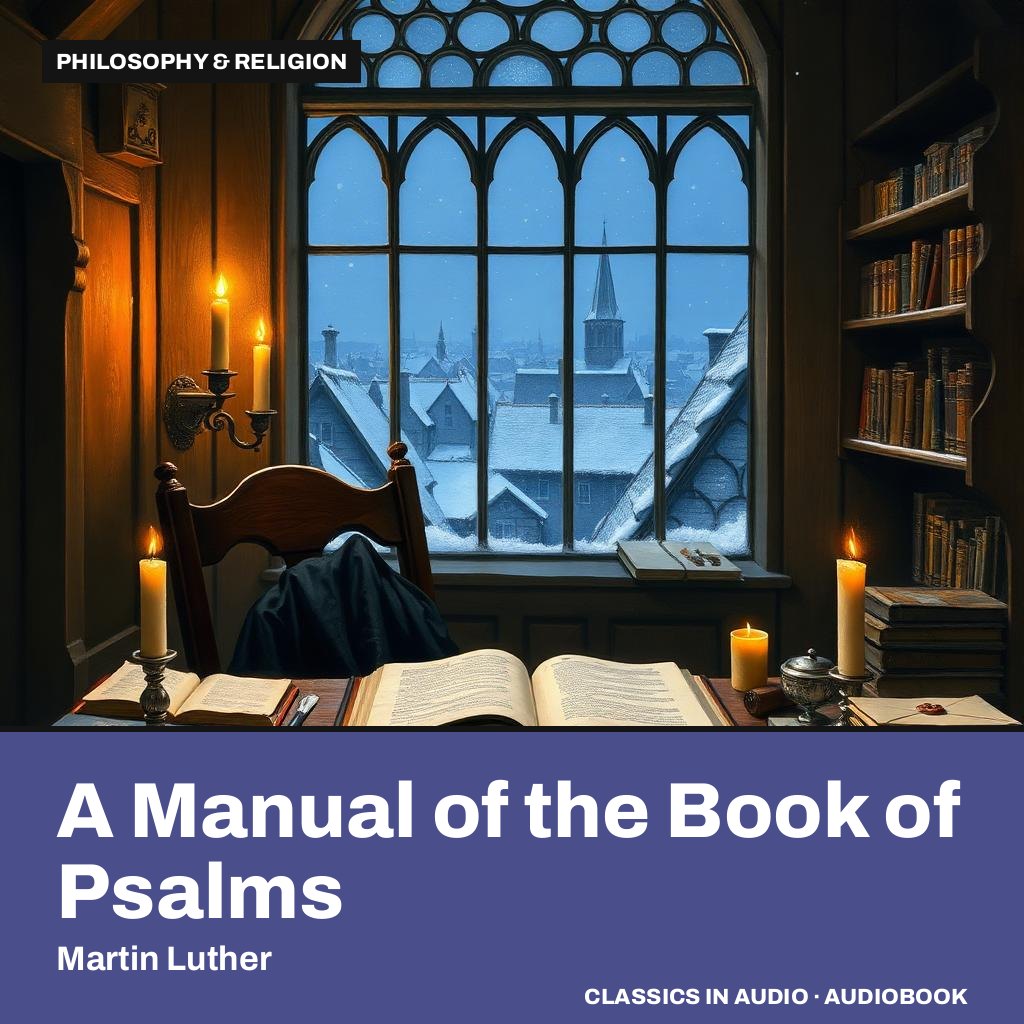
A Manual of the Book of Psalms
Or, The Subject-contents of All the Psalms
by Martin Luther (1483–1546)
Unabridged audiobook · about 9 hr 24 min · English · read by a synthetic voice · MP3, no DRM
€4.90
Buy 2 audiobooks or more: −10%. Buy 5 or more: −20%.
Secure payment by Stripe. Your download link is e-mailed to you at once: the first 30 minutes are usually ready within a few minutes, and the rest follows while you listen. Listen online or download the MP3.
This is a guide to the Book of Psalms by Martin Luther, the German reformer, who sets out the main subject of each psalm in turn. It is a work of Protestant biblical commentary, drawn from his lectures and writings on the Psalter and gathered into a manual for ordinary readers. Henry Cole, an English clergyman, translated it, and his preface is dated from Islington in June 1837.
Luther returns to a few themes again and again: the hostility that faithful believers meet from the wicked and from hypocrites in religion, the conviction that salvation rests on trust in Christ alone, and the idea that a nation prospers when its rulers uphold true worship. He also describes what he takes the true church to be: not the proud or secure, but poor, anxious and afflicted people who depend daily on God's mercy.
The opening pages include a letter Luther wrote from Wittenberg in 1521. He admits his commentaries on the Psalms were written in stolen moments, between two sermons a day, replies to his enemies and attacks on papal bulls. The book gives a view of the Reformation as he lived it, with the psalms as his daily companion under pressure. Readers interested in Christian history or in how the Psalms have been read will find a clear, direct guide.
Text: Project Gutenberg edition no. 75892, read without its licence notices.
More by Martin Luther
 Commentary on the Epistle to the GalatiansMartin Luther7 hr 46 min€4.90
 Concerning Christian LibertyMartin Luther1 hr 39 min€3.90
 A Treatise on Good WorksMartin Luther3 hr 37 min€3.90
 The Smalcald ArticlesMartin Luther1 hr 14 min€3.90
 Martin Luther's Large Catechism, Translated by Bente and DauMartin Luther4 hr 28 min€3.90
 The Epistles of St. Peter and St. Jude Preached and ExplainedMartin Luther7 hr 43 min€4.90





