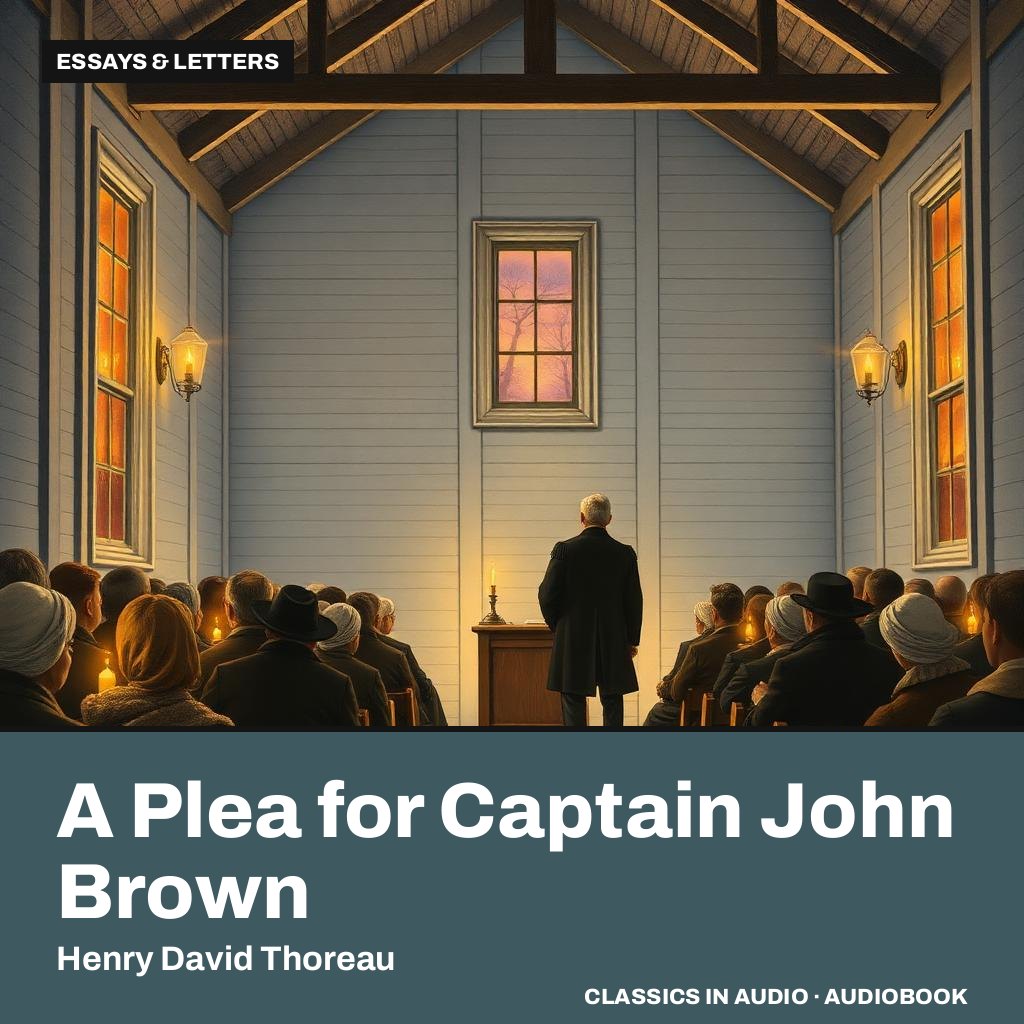
A Plea for Captain John Brown
Read to the Citizens of Concord, Massachusetts on Sunday Evening, October Thirtieth, Eighteen Fifty-nine
by Henry David Thoreau (1817–1862)
Unabridged audiobook · about 50 min · English · read by a synthetic voice · MP3, no DRM
€3.90
Buy 2 audiobooks or more: −10%. Buy 5 or more: −20%.
Secure payment by Stripe. Your download link is e-mailed to you at once: the first 30 minutes are usually ready within a few minutes, and the rest follows while you listen. Listen online or download the MP3.
On the evening of Sunday, October 30, 1859, Henry David Thoreau stood before his neighbours in Concord, Massachusetts, and spoke in defence of a man most of the country was condemning. John Brown had led a raid on the federal arsenal at Harpers Ferry, Virginia, and was awaiting trial and execution. Thoreau, the author of Walden and of the essay on civil disobedience, had little patience for the newspapers that called Brown a madman, and this address is his answer to them.
The speech is part biography, part argument. Thoreau sketches Brown's life as a farmer's son, surveyor and wool agent, his distaste for soldiering, and his years of fighting in Kansas against the spread of slavery. He pictures Brown as a Puritan who would have fitted into Cromwell's army, a man who allowed no swearing in camp and trusted a dozen principled followers over a hundred bullies. He then turns on the government and the press, asking who is truly lawless when a nation protects slavery.
The address is short, sharp and sometimes sarcastic, and it shows how an essayist known for quiet woods could speak with fury. It remains a pointed look at conscience, law and violence in the final months before the Civil War.
Text: Project Gutenberg edition no. 2567, read without its licence notices.
More by Henry David Thoreau
 Walden, and On The Duty Of Civil DisobedienceHenry David Thoreau9 hr 35 min€4.90
 On the Duty of Civil DisobedienceHenry David Thoreau51 min€3.90
 WalkingHenry David Thoreau1 hr 07 min€3.90
 A Week on the Concord and Merrimack RiversHenry David Thoreau10 hr 37 min€5.90
 ExcursionsHenry David Thoreau6 hr 35 min€4.90
 Cape CodHenry David Thoreau7 hr 06 min€4.90
More essays & letters
 Essays of Michel de MontaigneMichel de Montaigne48 hr 35 min€9.90
 De ProfundisOscar Wilde1 hr 32 min€3.90
 Essays by Ralph Waldo EmersonRalph Waldo Emerson8 hr 40 min€4.90
 EssaysRalph Waldo Emerson6 hr 43 min€4.90
 The Notebooks of Leonardo Da VinciLeonardo da Vinci21 hr 55 min€7.90
 The Will to Believe, and Other Essays in Popular PhilosophyWilliam James9 hr 32 min€4.90