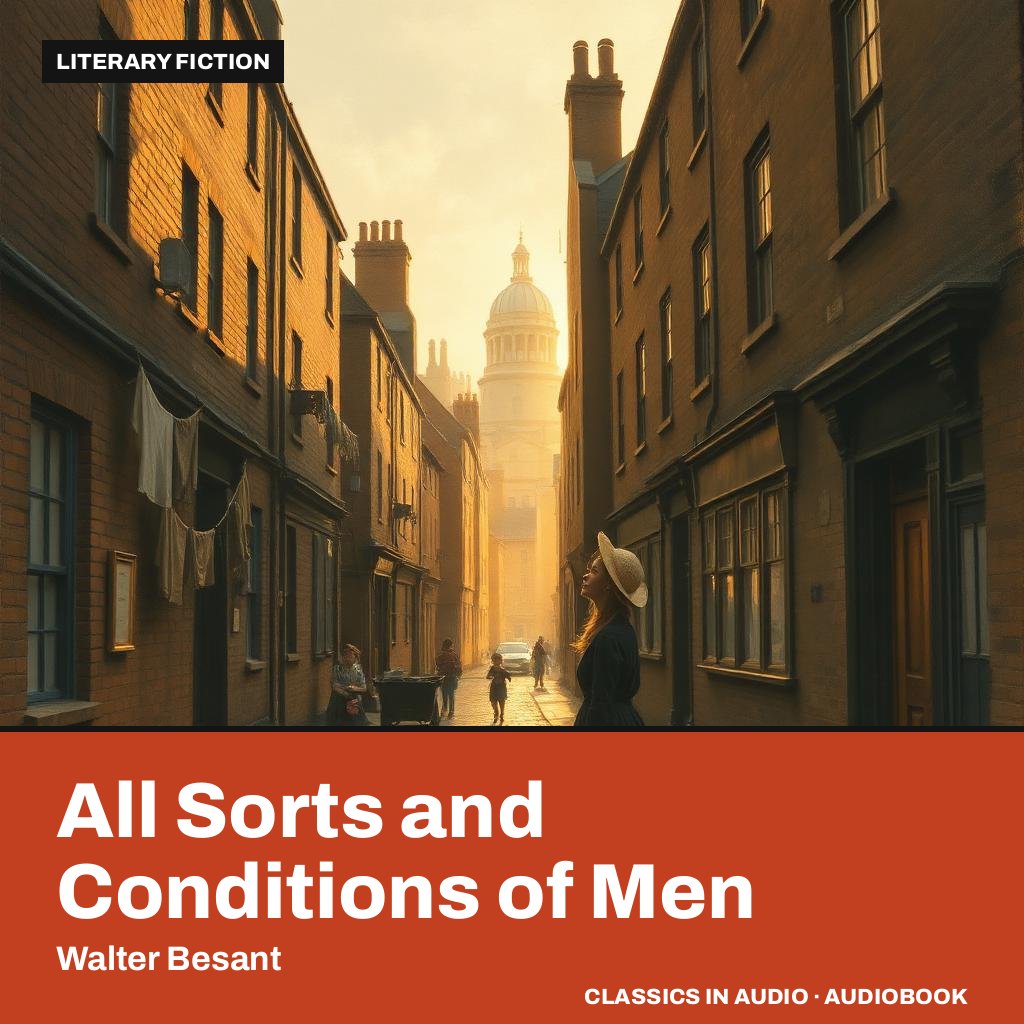
All Sorts and Conditions of Men
An Impossible Story
by Walter Besant (1836–1901)
Unabridged audiobook · about 14 hr 51 min · English · read by a synthetic voice · MP3, no DRM
€5.90
Buy 2 audiobooks or more: −10%. Buy 5 or more: −20%.
Secure payment by Stripe. Your download link is e-mailed to you at once: the first 30 minutes are usually ready within a few minutes, and the rest follows while you listen. Listen online or download the MP3.
Walter Besant's novel begins at Cambridge in early June, where two Newnham students sit by the river and talk about what to do with the one life each of them has been given. One of them, Angela, is an heiress. Her choice takes her from the college lawns to the crowded streets of London's East End, which Besant calls a great and marvellous unknown country. The book follows her there: a dressmaker's workroom, an almshouse for old sailors, a Sunday among the poor, and an ambitious plan to bring some brightness into lives of drudgery.
Besant published it in 1882 and subtitled it An Impossible Story, daring readers to say why. In his preface he describes walking through Stepney, Whitechapel, Poplar, Limehouse and Rotherhithe to gather material, and he finished the book alone after the death of his writing partner James Rice. That legwork shows in the detail of streets, trades and talk. The chapter titles hint at a mix of romance, family secrets, a lawsuit and a mystery over identity, which I will leave unexplained.
The novel is worth hearing today for its picture of Victorian London's poor districts and for the questions it raises about wealth, charity and what the comfortable owe their neighbours. Besant's idea of the People's Palace is surprisingly practical.
Text: Project Gutenberg edition no. 47098, read without its licence notices.
More by Walter Besant
 The History of LondonWalter Besant6 hr 16 min€4.90
 Holborn and BloomsburyWalter Besant2 hr 19 min€3.90
 London CityWalter Besant22 hr 59 min€7.90
 South LondonWalter Besant8 hr 31 min€4.90
 Early LondonWalter Besant14 hr 28 min€5.90
 For Faith and FreedomWalter Besant14 hr 22 min€5.90