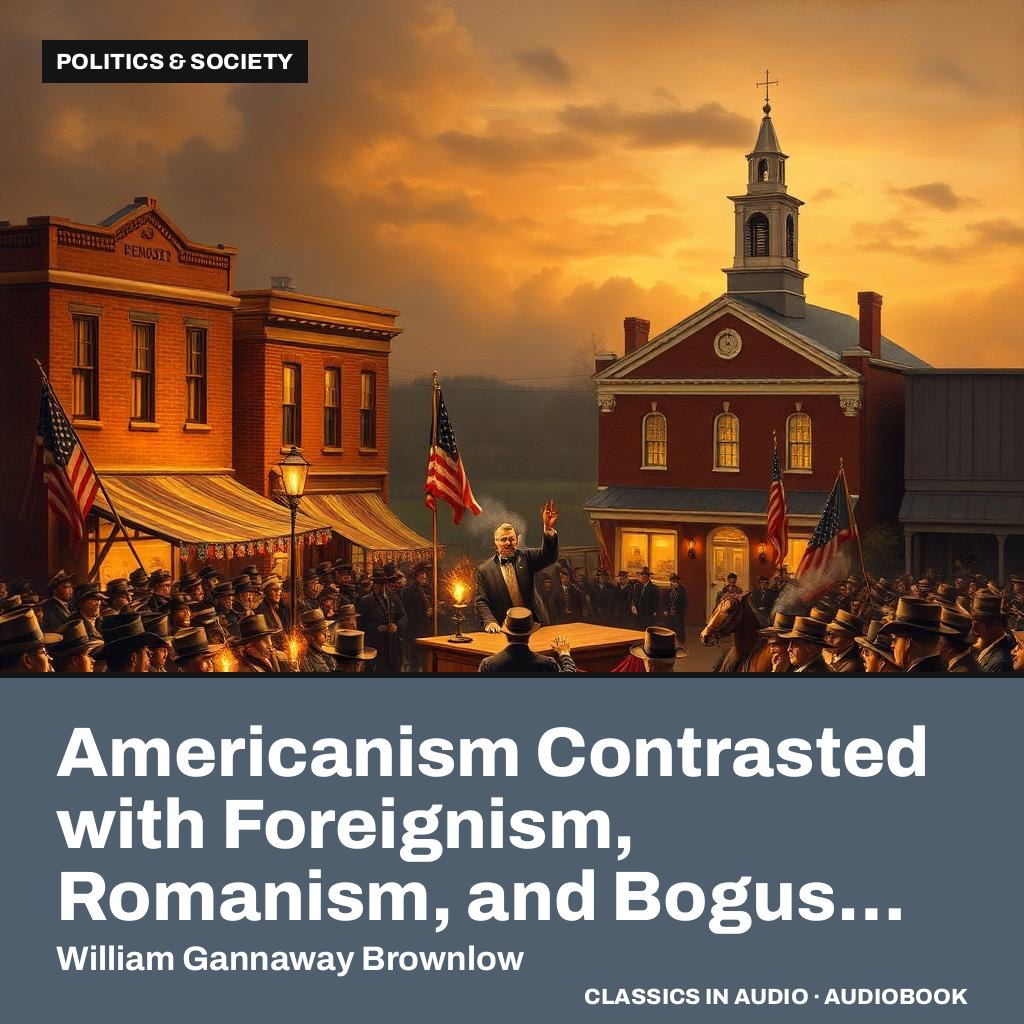
Americanism Contrasted with Foreignism, Romanism, and Bogus Democracy in the Light of Reason, History, and Scripture
In Which Certain Demagogues in Tennessee, and Elsewhere: Are Shown Up in Their True Colors
by William Gannaway Brownlow (1805–1877)
Unabridged audiobook · about 9 hr 14 min · English · read by a synthetic voice · MP3, no DRM
€4.90
Buy 2 audiobooks or more: −10%. Buy 5 or more: −20%.
Secure payment by Stripe. Your download link is e-mailed to you at once: the first 30 minutes are usually ready within a few minutes, and the rest follows while you listen. Listen online or download the MP3.
This is a campaign tract from the 1856 presidential season, written to rally voters behind the American Party, the movement nicknamed the Know-Nothings. William Gannaway Brownlow, a Methodist preacher turned East Tennessee newspaper editor, aims it at the young men of America, whom he calls the deciding vote in a national crisis. He sets out to argue that the Catholic Church and the waves of foreign-born voters arriving in the 1850s endanger American liberty, and he accuses the Democratic Party of courting those voters for its own gain.
The book is openly partisan, and it is a bitter one. It draws on history, scripture and quotations from Catholic newspapers and bishops to build what the preface calls an indictment, with the Church placed on trial before public opinion. The setting is Tennessee and the wider South and West, where the author says Catholic institutions were taking root and where he had been fighting them in print for years.
Brownlow later became a Unionist Republican and governor of Tennessee, and his sharp, combative style is on full display here. Today the text is worth hearing as primary evidence of nativist anger, religious prejudice and the collapsing party system that led up to the Civil War. It shows how those fears were argued in the open, and how persuasive they sounded to many Americans at the time.
Text: Project Gutenberg edition no. 28328, read without its licence notices.
More politics & society
 The PrinceNiccolò Machiavelli4 hr 37 min€3.90
 LeviathanThomas Hobbes19 hr 44 min€6.90
 Second Treatise of GovernmentJohn Locke5 hr 07 min€4.90
 An Inquiry into the Nature and Causes of the Wealth of NationsAdam Smith36 hr 32 min€9.90
 The Eclipse of RussiaEmile Joseph Dillon14 hr 56 min€5.90
 Democracy—false or True?Sir William Blake Richmond5 hr 18 min€4.90