An Egyptian Oasis
An Account of the Oasis of Kharga in the Libyan Desert, with Special Reference to Its History, Physical Geography, and Water-supply
by H. J. L. Beadnell (1874–1944)
Unabridged audiobook · about 6 hr 06 min · English · read by a synthetic voice · MP3, no DRM
€4.90
Buy 2 audiobooks or more: −10%. Buy 5 or more: −20%.
Secure payment by Stripe. Your download link is e-mailed to you at once: the first 30 minutes are usually ready within a few minutes, and the rest follows while you listen. Listen online or download the MP3.
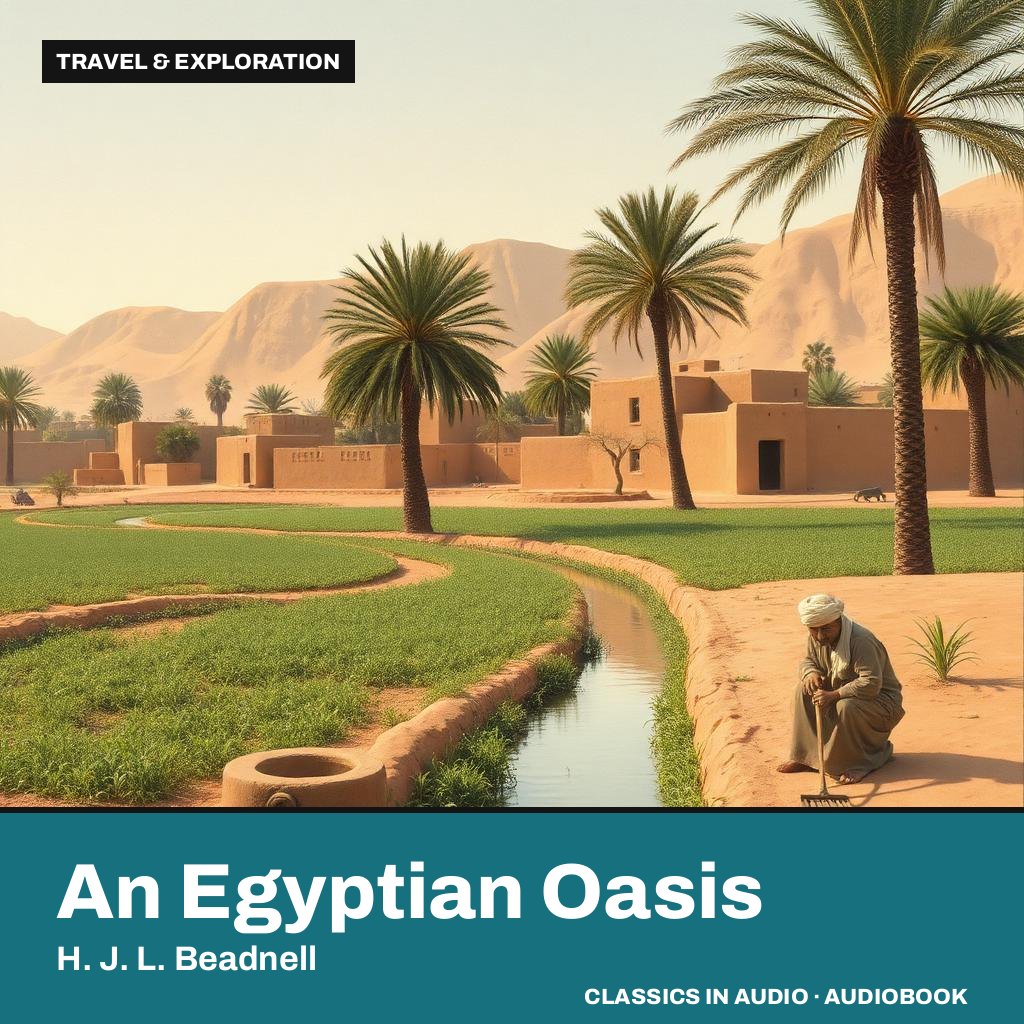
Kharga is a depression in the Libyan Desert, far to the west of the Nile, where walled villages sit among date and doum palms and where no rain falls and no river runs. This 1909 memoir describes it from the ground. Its author, H. J. L. Beadnell, spent nearly nine years surveying the Egyptian deserts for the Geological Survey of Egypt, then three more directing well-boring and land reclamation in Kharga itself.
The book moves from caravan roads and geology to village life and long history. Kharga belonged to the ancient Great Oasis and was ruled in turn by Pharaohs, Persian kings and Roman emperors. It holds the temple of Hibis, the chief Persian monument in Egypt, and an early Christian necropolis. Bishop Nestorius was banished here in A.D. 434. Beadnell also describes the dry lake beds that once covered the valley floor, and the long tunnels the Romans cut to draw water from under the rock.
The second half turns to water. He sets out how deep artesian wells are bored, how ancient and modern methods compare, and how drifting dunes keep burying the fields that people have won from the desert. It is a firsthand record of a place where survival has always depended on the supply underground.
Text: Project Gutenberg edition no. 70461, read without its licence notices.