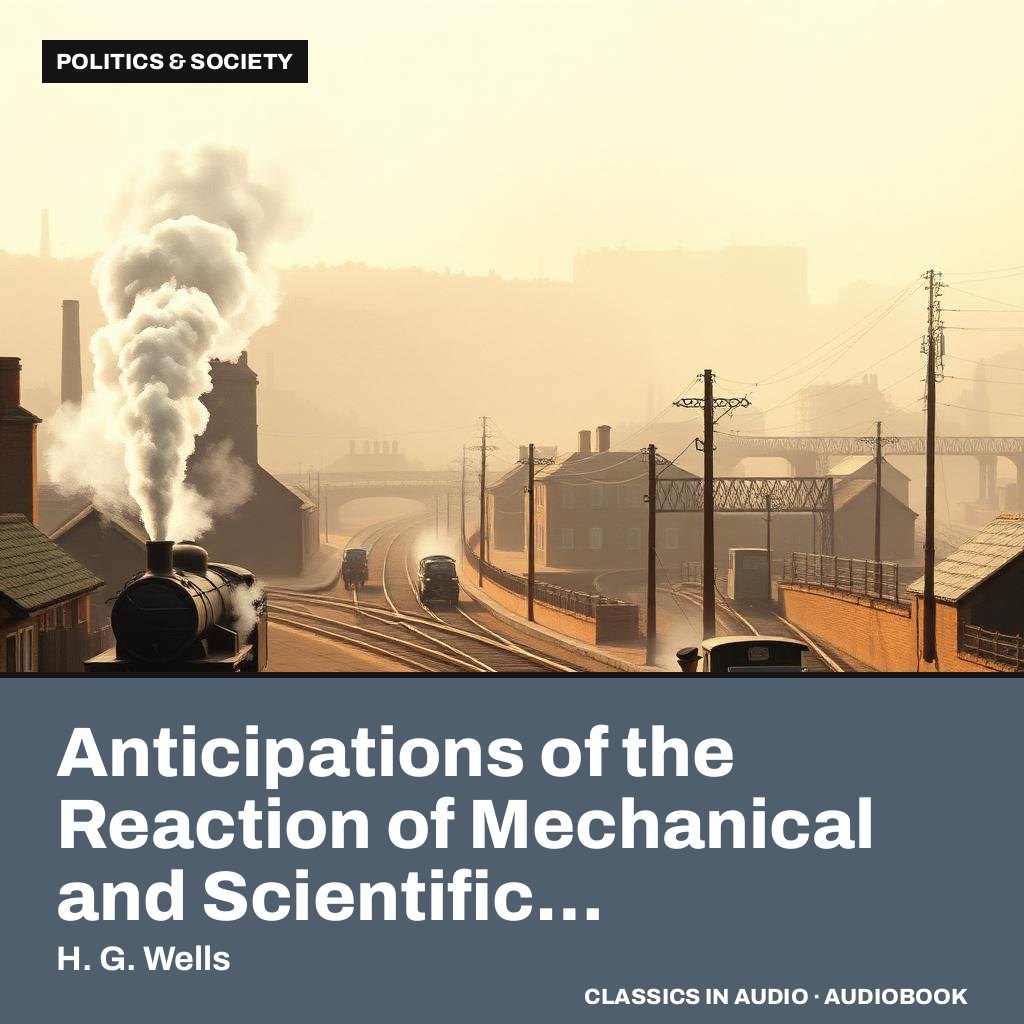
Anticipations of the Reaction of Mechanical and Scientific Progress Upon Human Life and Thought
by H. G. Wells (1866–1946)
Unabridged audiobook · about 7 hr 56 min · English · read by a synthetic voice · MP3, no DRM
€4.90
Buy 2 audiobooks or more: −10%. Buy 5 or more: −20%.
Secure payment by Stripe. Your download link is e-mailed to you at once: the first 30 minutes are usually ready within a few minutes, and the rest follows while you listen. Listen online or download the MP3.
Anticipations is H. G. Wells's first major work of non-fiction, published in 1901 as the new century began. Wells had already made his name with The Time Machine and The War of the Worlds, but here he drops the story form entirely. He sets out a sober forecast of how machines and science will reshape ordinary life, calling it a rough prospectus for the years ahead.
He starts with transport. Before predicting anything, he looks back at the railway and asks why the steam locomotive arrived when it did and not centuries earlier, given that steam had been known since antiquity. His answer is that the railway grew from tinkering by practical men, not from grand theory, and that it then remade cities, migration, empire and war. From that base he turns to what roads, motors and new habits of travel might do next.
The book is worth hearing for its mixture of sharp guesses and confident errors, and for how clearly it shows an Edwardian mind reasoning about change. Wells, who trained as a science teacher, argues like a man weighing evidence, with dry humour and a good deal of nerve. Listeners will find it useful to compare his century with the one that actually followed.
Text: Project Gutenberg edition no. 19229, read without its licence notices.
More by H. G. Wells
 The Time MachineH. G. Wells2 hr 58 min€3.90
 The War of the WorldsH. G. Wells5 hr 31 min€4.90
 Ann Veronica_ A Modern Love StoryH. G. Wells8 hr 56 min€4.90
 The Invisible ManH. G. Wells4 hr 41 min€3.90
 The Island of Doctor MoreauH. G. Wells3 hr 58 min€3.90
 The Country of the Blind, and Other StoriesH. G. Wells14 hr 44 min€5.90
More politics & society
 The PrinceNiccolò Machiavelli4 hr 37 min€3.90
 LeviathanThomas Hobbes19 hr 44 min€6.90
 Second Treatise of GovernmentJohn Locke5 hr 07 min€4.90
 An Inquiry into the Nature and Causes of the Wealth of NationsAdam Smith36 hr 32 min€9.90
 The Eclipse of RussiaEmile Joseph Dillon14 hr 56 min€5.90
 Democracy—false or True?Sir William Blake Richmond5 hr 18 min€4.90