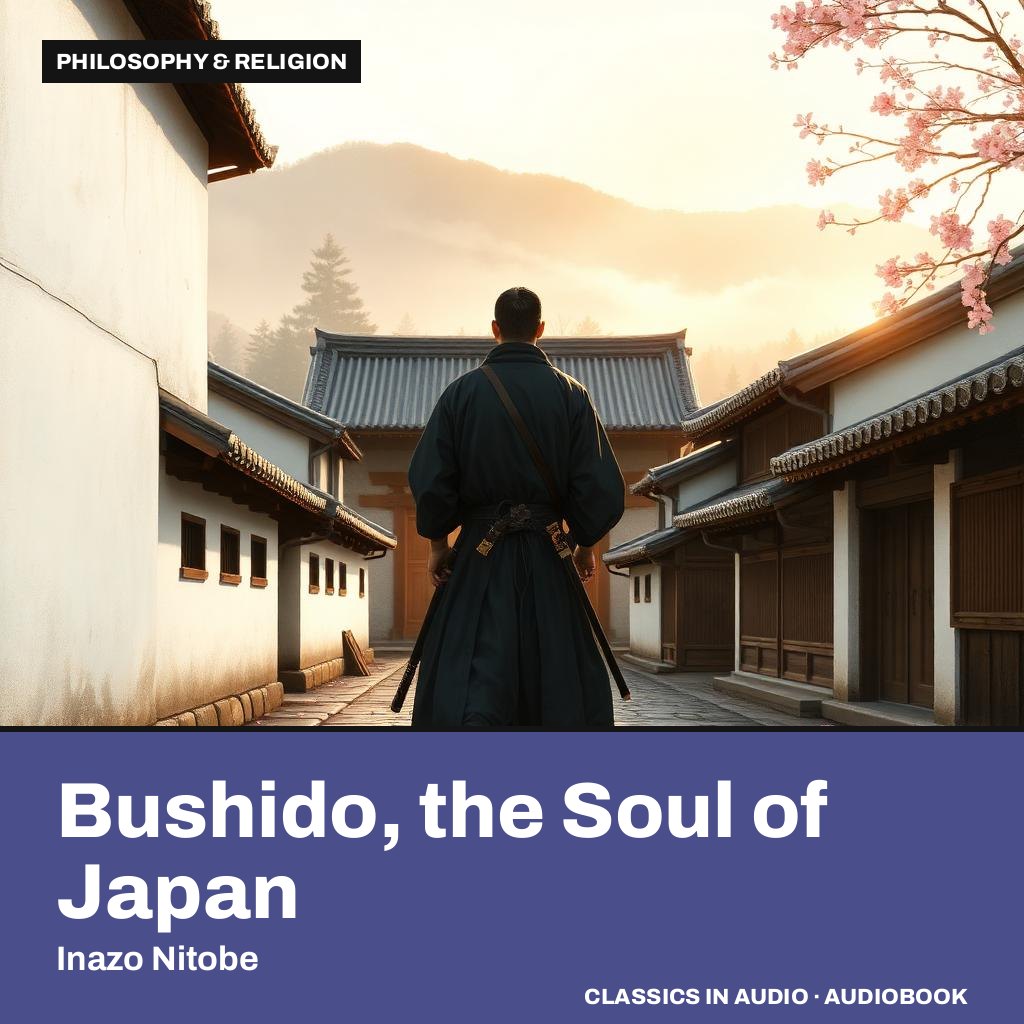
Bushido, the Soul of Japan
by Inazo Nitobe (1862–1933)
Unabridged audiobook · about 3 hr 10 min · English · read by a synthetic voice · MP3, no DRM
€3.90
Buy 2 audiobooks or more: −10%. Buy 5 or more: −20%.
Secure payment by Stripe. Your download link is e-mailed to you at once: the first 30 minutes are usually ready within a few minutes, and the rest follows while you listen. Listen online or download the MP3.
Bushido, the Soul of Japan is a short work of cultural and moral history that explains the ethical code of the samurai class and how it shaped the Japanese outlook. Inazo Nitobe wrote it in English in 1899, while recovering from a long illness in Pennsylvania. It began with two questions: a Belgian jurist who asked how Japanese children received a moral education without religious instruction in school, and his wife, who wanted to know why certain customs held in Japan.
Nitobe, a Japanese educator and diplomat who had studied in the United States and Europe, takes up the virtues of the warrior tradition one by one, including rectitude, courage, benevolence, politeness, honor and loyalty. He sets each beside parallels from European chivalry, Greek and Roman writers, and the Bible, so that a Western reader can follow the comparison. His starting point is the feudal Japan of his own boyhood, just before the country opened to the wider world.
The book is an argument as much as a survey, written by a man defending his country's moral inheritance to outsiders. It remains worth hearing for its picture of Meiji-era Japan trying to explain itself, and for the way it shaped Western ideas of the samurai.
Text: Project Gutenberg edition no. 12096, read without its licence notices.





