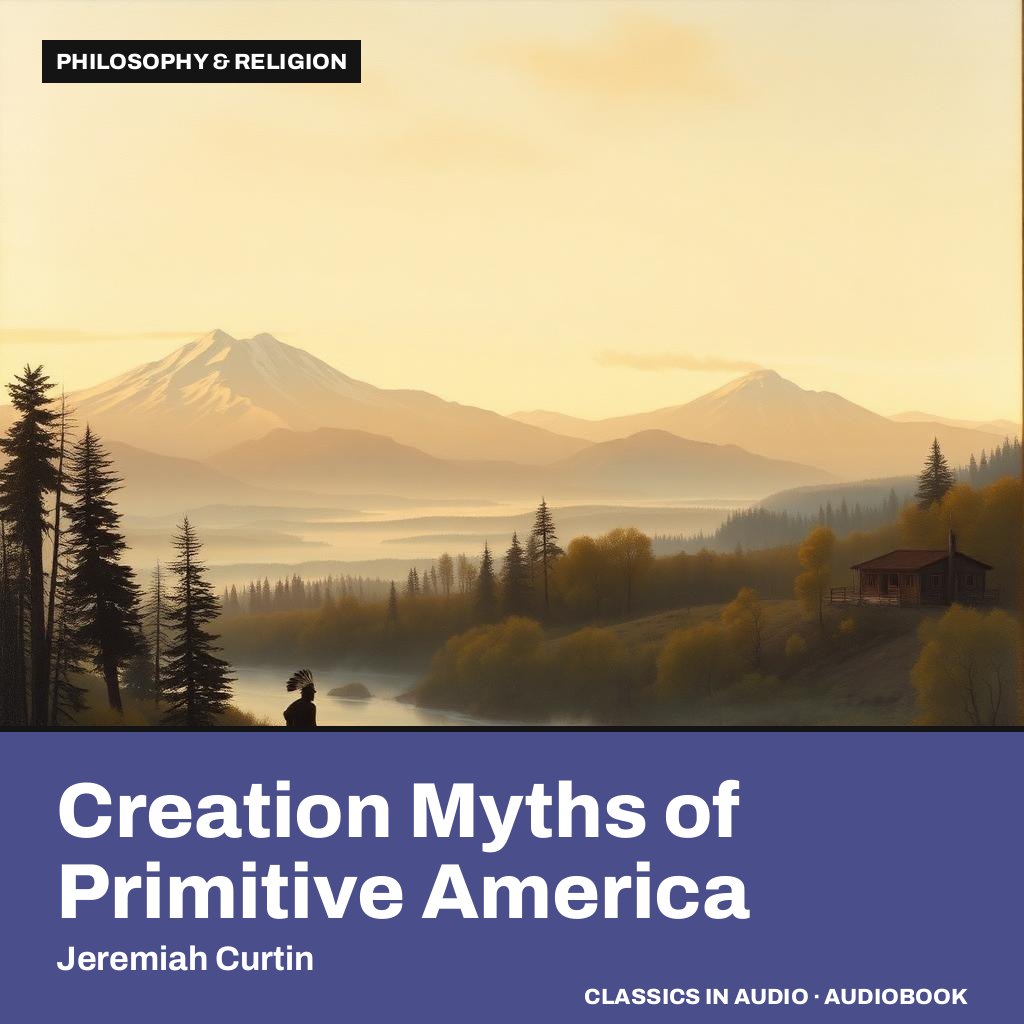
Creation Myths of Primitive America
In Relation to the Religious History and Mental Development of Mankind
by Jeremiah Curtin (1835–1906)
Unabridged audiobook · about 12 hr 02 min · English · read by a synthetic voice · MP3, no DRM
€5.90
Buy 2 audiobooks or more: −10%. Buy 5 or more: −20%.
Secure payment by Stripe. Your download link is e-mailed to you at once: the first 30 minutes are usually ready within a few minutes, and the rest follows while you listen. Listen online or download the MP3.
Creation Myths of Primitive America gathers the origin stories of several Native American peoples of California and the Pacific Northwest, among them the Wintu, Yana and Modoc, as they were told to the collector in the late nineteenth century. The tales describe an earlier world inhabited by the first people, beings beyond counting who lived in harmony for ages. Then quarrels broke out. Out of that long conflict came the animals, birds, fish, trees, rocks and mountains of the present earth, while a few of the first people left peacefully for the west or the sky.
Jeremiah Curtin, born in 1835, was a linguist and folklorist who had already gathered tales in Ireland and among Russians and Slavs. He later worked for the Bureau of Ethnology under Major John Wesley Powell, and he took these stories down from tellers in their own territories. Individual chapters follow figures such as Olelbis, Norwan and Hawt through journeys, rivalries and the stealing of fire.
Curtin's introduction also sets out a larger argument about how early human thought shaped belief. The book offers a direct look at a mythology told as a connected system, with the odd logic and grand scale of stories that served as a people's account of how the world came to be.
Text: Project Gutenberg edition no. 39106, read without its licence notices.
More by Jeremiah Curtin
 The Mongols in RussiaJeremiah Curtin18 hr 19 min€6.90
 Myths and Folk-tales of the Russians, Western Slavs, and MagyarsJeremiah Curtin12 hr 20 min€5.90
 The MongolsJeremiah Curtin15 hr 46 min€6.90
 Myths and Folk Tales of IrelandJeremiah Curtin6 hr 01 min€4.90





