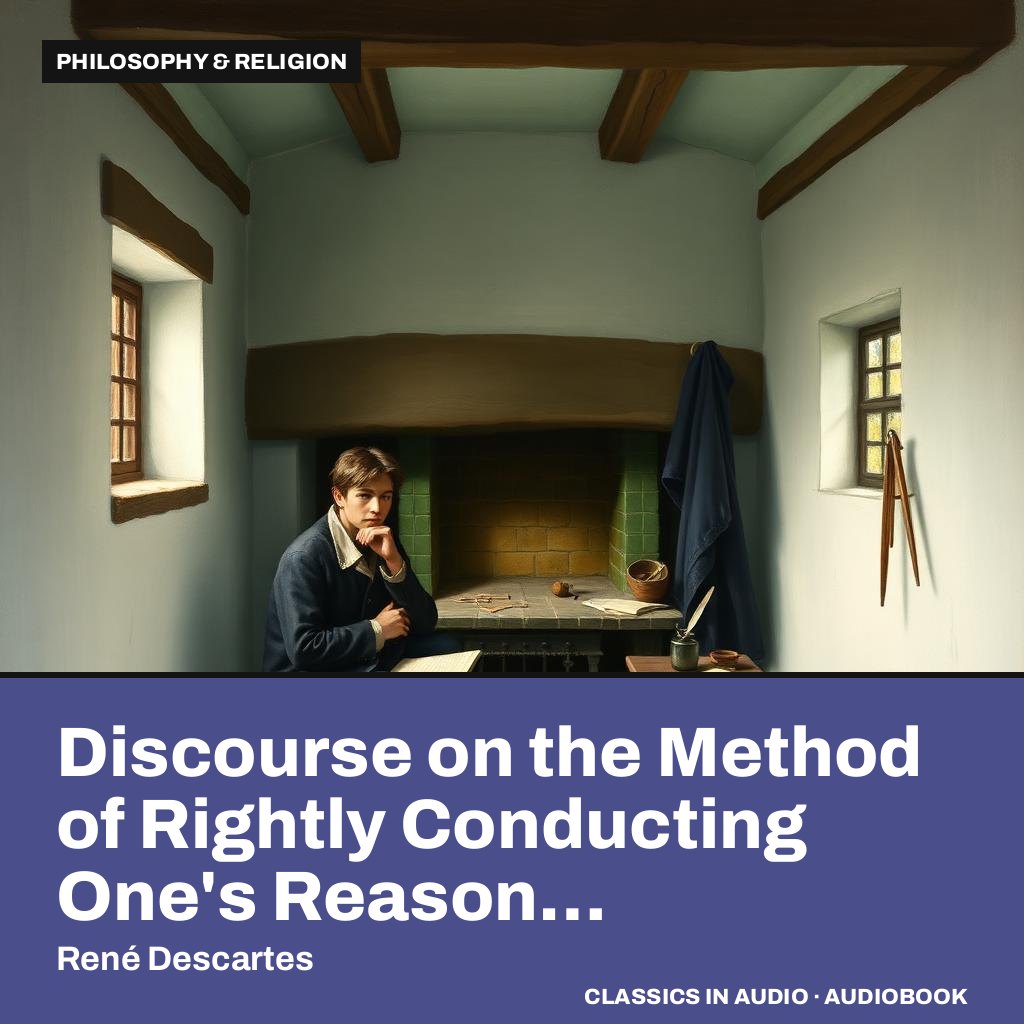
Discourse on the Method of Rightly Conducting One's Reason and of Seeking Truth in the Sciences
by René Descartes (1596–1650)
Unabridged audiobook · about 2 hr 18 min · English · read by a synthetic voice · MP3, no DRM
€3.90
Buy 2 audiobooks or more: −10%. Buy 5 or more: −20%.
Secure payment by Stripe. Your download link is e-mailed to you at once: the first 30 minutes are usually ready within a few minutes, and the rest follows while you listen. Listen online or download the MP3.
In 1637 René Descartes published this short treatise in French rather than Latin, so that readers outside the universities could follow it. It is part memoir, part philosophical argument. He tells how he left a celebrated Jesuit school, probably La Flèche, convinced that his long education had mostly taught him how much he did not know, and how he then set out to build knowledge on firmer ground.
The book is told in six parts. Descartes describes his years of travel and soldiering in the Europe of the Thirty Years' War, and the winter day he spent alone in a heated room thinking over his own mind. From these thoughts come a small set of rules for reasoning: accept nothing as true until it is clear, divide hard problems into parts, proceed from simple things to complex ones, and review the whole. He then tests doubt as far as it will go and arrives at the famous sentence "I think, therefore I am." Later sections touch on the body, the soul and the study of nature.
Descartes was also a mathematician who helped link algebra and geometry. Listeners today will find a plain, personal voice asking how anyone should decide what to believe, a question that still matters.
Text: Project Gutenberg edition no. 59, read without its licence notices.
More by René Descartes
 Six Metaphysical MeditationsRené Descartes3 hr 02 min€3.90
 Selections from the Principles of PhilosophyRené Descartes2 hr 55 min€3.90
 A Discourse of a Method for the Well Guiding of ReasonRené Descartes1 hr 59 min€3.90





