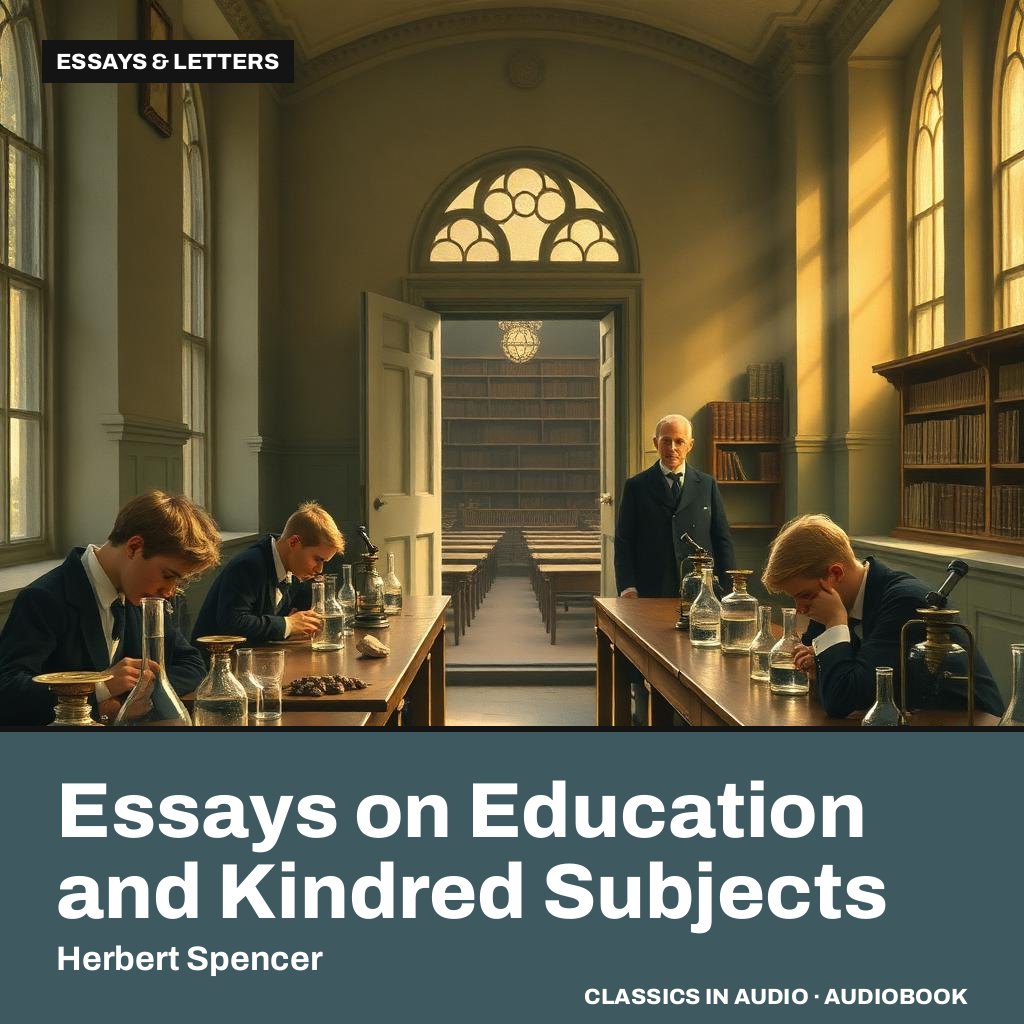
Essays on Education and Kindred Subjects
by Herbert Spencer (1820–1903)
Unabridged audiobook · about 14 hr 30 min · English · read by a synthetic voice · MP3, no DRM
€5.90
Buy 2 audiobooks or more: −10%. Buy 5 or more: −20%.
Secure payment by Stripe. Your download link is e-mailed to you at once: the first 30 minutes are usually ready within a few minutes, and the rest follows while you listen. Listen online or download the MP3.
Herbert Spencer's essays on education, collected in one volume with an introduction by the American university president Charles William Eliot, argue for a sweeping change in what children are taught and how. They were first published in the middle of the nineteenth century, when Latin, Greek and mathematics were the settled core of an English schooling meant to prepare boys for the professions, public life and polite society.
Spencer, a Victorian philosopher best known for applying ideas of evolution to society and thought, took aim at that habit. His best-known essay, "What Knowledge is of Most Worth?", sorts human activity into health, livelihood, parenthood, citizenship and leisure, and asks which studies serve each. His answer is science. Elsewhere he challenges the belief that teaching means telling, that education must be imposed without regard to a child's own inclinations, and that old methods are justified simply because they produced the people now using them.
Eliot's introduction sets the essays in context, noting where Spencer drew on earlier thinkers and how far schools later followed him, and where they held back. Readers curious about classrooms, laboratories and the long argument over what a curriculum is for will find the questions still open.
Text: Project Gutenberg edition no. 16510, read without its licence notices.
More by Herbert Spencer
 First PrinciplesHerbert Spencer16 hr 53 min€6.90
 The Data of EthicsHerbert Spencer9 hr 24 min€4.90
 Illustrations of Universal ProgressHerbert Spencer14 hr 52 min€5.90
More essays & letters
 Walden, and On The Duty Of Civil DisobedienceHenry David Thoreau9 hr 35 min€4.90
 Essays of Michel de MontaigneMichel de Montaigne48 hr 35 min€9.90
 De ProfundisOscar Wilde1 hr 32 min€3.90
 Essays by Ralph Waldo EmersonRalph Waldo Emerson8 hr 40 min€4.90
 EssaysRalph Waldo Emerson6 hr 43 min€4.90
 The Notebooks of Leonardo Da VinciLeonardo da Vinci21 hr 55 min€7.90