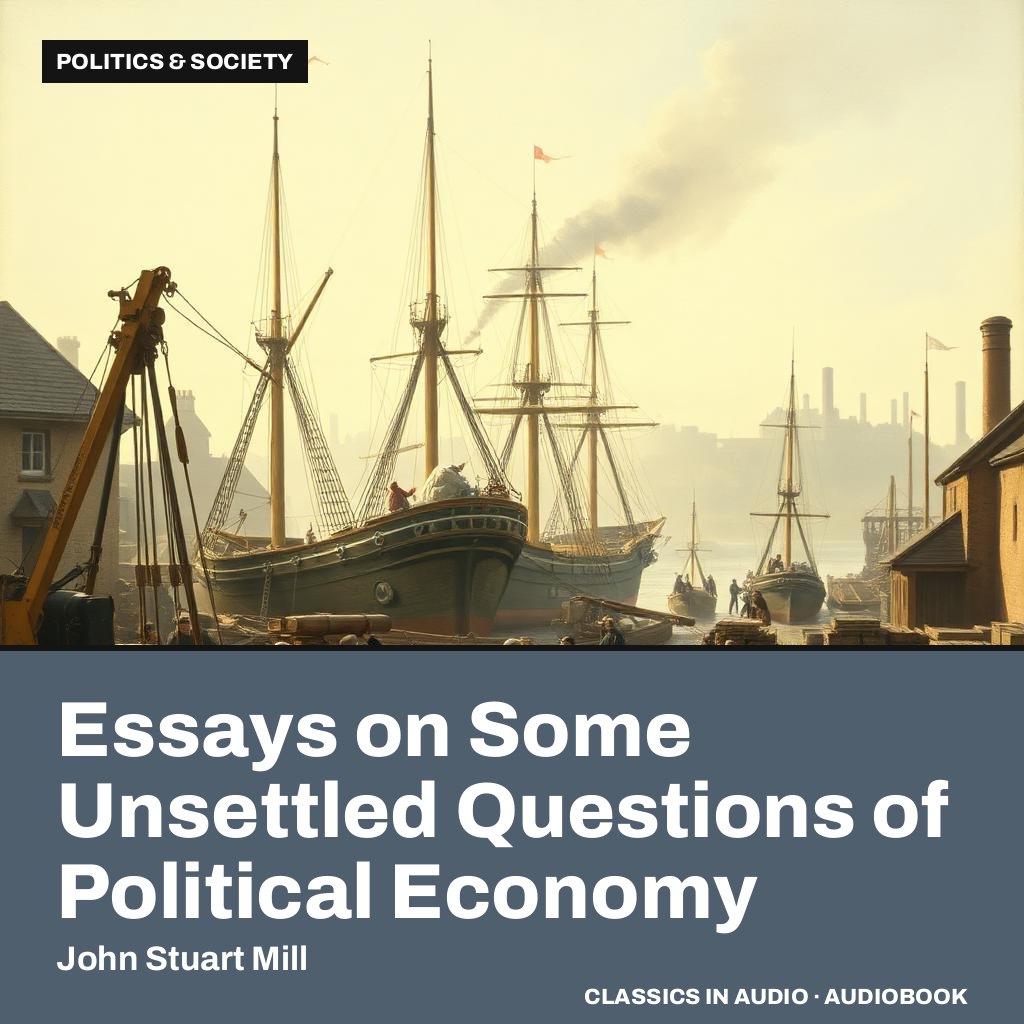
Essays on Some Unsettled Questions of Political Economy
by John Stuart Mill (1806–1873)
Unabridged audiobook · about 4 hr 44 min · English · read by a synthetic voice · MP3, no DRM
€3.90
Buy 2 audiobooks or more: −10%. Buy 5 or more: −20%.
Secure payment by Stripe. Your download link is e-mailed to you at once: the first 30 minutes are usually ready within a few minutes, and the rest follows while you listen. Listen online or download the MP3.
Essays on some unsettled Questions of Political Economy is a collection of five essays on economic theory by John Stuart Mill. He wrote them in the early 1830s, when he was in his twenties, and they were not published until 1844. Mill spent most of his working life as a clerk at the East India Company, and he is better remembered today as a philosopher and a campaigner for reform.
The opening essay takes up the question of why nations trade and how the gains are divided among them. Mill builds on David Ricardo's idea of comparative cost. A country can profit by importing an article even when it could make that article more cheaply than its trading partner, so long as it has a still greater advantage in making something else. His example sets English cottons against Swedish iron. He also argues that the same reasoning can justify limited bargaining over revenue duties, though never protective ones.
The later essays take on the effect of consumption on production, the meaning of the words productive and unproductive, the nature of profits and interest, and the proper method of political economy itself. Anyone curious about the origins of arguments over free trade, or about how economists first defined their own subject, will find them here in a plain, carefully reasoned form.
Text: Project Gutenberg edition no. 12004, read without its licence notices.
More by John Stuart Mill
 On LibertyJohn Stuart Mill5 hr 02 min€4.90
 UtilitarianismJohn Stuart Mill2 hr 49 min€3.90
 The Subjection of WomenJohn Stuart Mill4 hr 12 min€3.90
 Considerations on Representative GovernmentJohn Stuart Mill9 hr 10 min€4.90
 Principles of Political EconomyJohn Stuart Mill21 hr 35 min€7.90
 AutobiographyJohn Stuart Mill7 hr 13 min€4.90
More politics & society
 The PrinceNiccolò Machiavelli4 hr 37 min€3.90
 LeviathanThomas Hobbes19 hr 44 min€6.90
 Second Treatise of GovernmentJohn Locke5 hr 07 min€4.90
 An Inquiry into the Nature and Causes of the Wealth of NationsAdam Smith36 hr 32 min€9.90
 The Eclipse of RussiaEmile Joseph Dillon14 hr 56 min€5.90
 Democracy—false or True?Sir William Blake Richmond5 hr 18 min€4.90