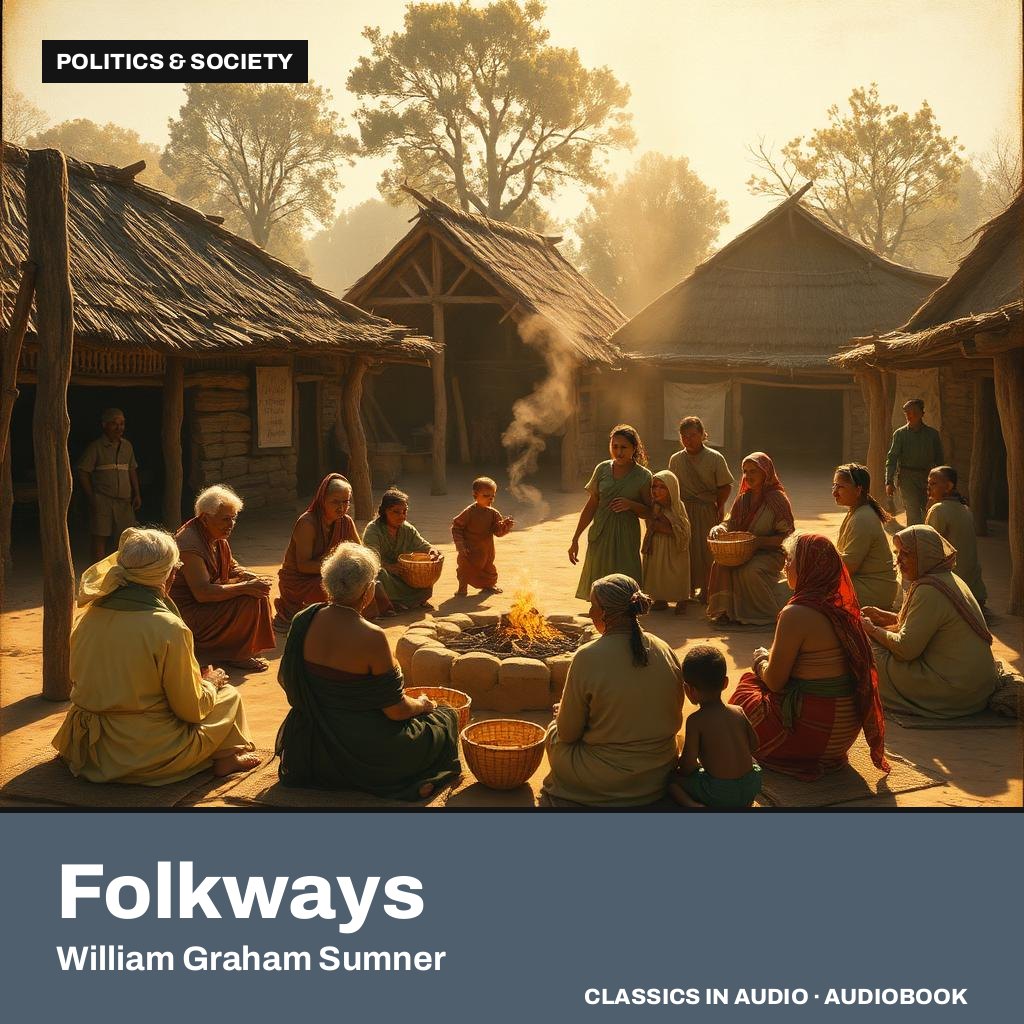
Folkways
A Study of the Sociological Importance of Usages, Manners, Customs, Mores, and Morals
by William Graham Sumner (1840–1910)
Unabridged audiobook · about 26 hr 58 min · English · read by a synthetic voice · MP3, no DRM
€7.90
Buy 2 audiobooks or more: −10%. Buy 5 or more: −20%.
Secure payment by Stripe. Your download link is e-mailed to you at once: the first 30 minutes are usually ready within a few minutes, and the rest follows while you listen. Listen online or download the MP3.
Folkways, published in 1906, is a study of how groups of people come to do what they do: how they greet one another, marry, eat, bury their dead, trade and fight, and why those habits harden into rules that no one remembers choosing. William Graham Sumner, who taught political and social science at Yale, coined the word "folkways" for the everyday habits of a society, and revived the Latin "mores" for those customs a community believes are necessary to its welfare and enforces on its members, though no authority ever decreed them.
Sumner's central claim is that customs grow out of efforts to meet needs, gather the weight of tradition, and then shape the generations that follow. They are slow to change and resist deliberate reform, yet they eventually decline or transform. To make the case he draws on a large range of ethnographic reports from many peoples and periods, and he sets out unfamiliar practices with plain-spoken detail rather than embarrassment. He quotes Shakespeare on custom as both tyrant and teacher.
The book introduced ideas, including ethnocentrism, that still echo through sociology and anthropology. Anyone curious about why people feel certain things are simply right, or wrong, will find a sharp-minded guide here.
Text: Project Gutenberg edition no. 24253, read without its licence notices.
More by William Graham Sumner
More politics & society
 The PrinceNiccolò Machiavelli4 hr 37 min€3.90
 LeviathanThomas Hobbes19 hr 44 min€6.90
 Second Treatise of GovernmentJohn Locke5 hr 07 min€4.90
 An Inquiry into the Nature and Causes of the Wealth of NationsAdam Smith36 hr 32 min€9.90
 The Eclipse of RussiaEmile Joseph Dillon14 hr 56 min€5.90
 Democracy—false or True?Sir William Blake Richmond5 hr 18 min€4.90