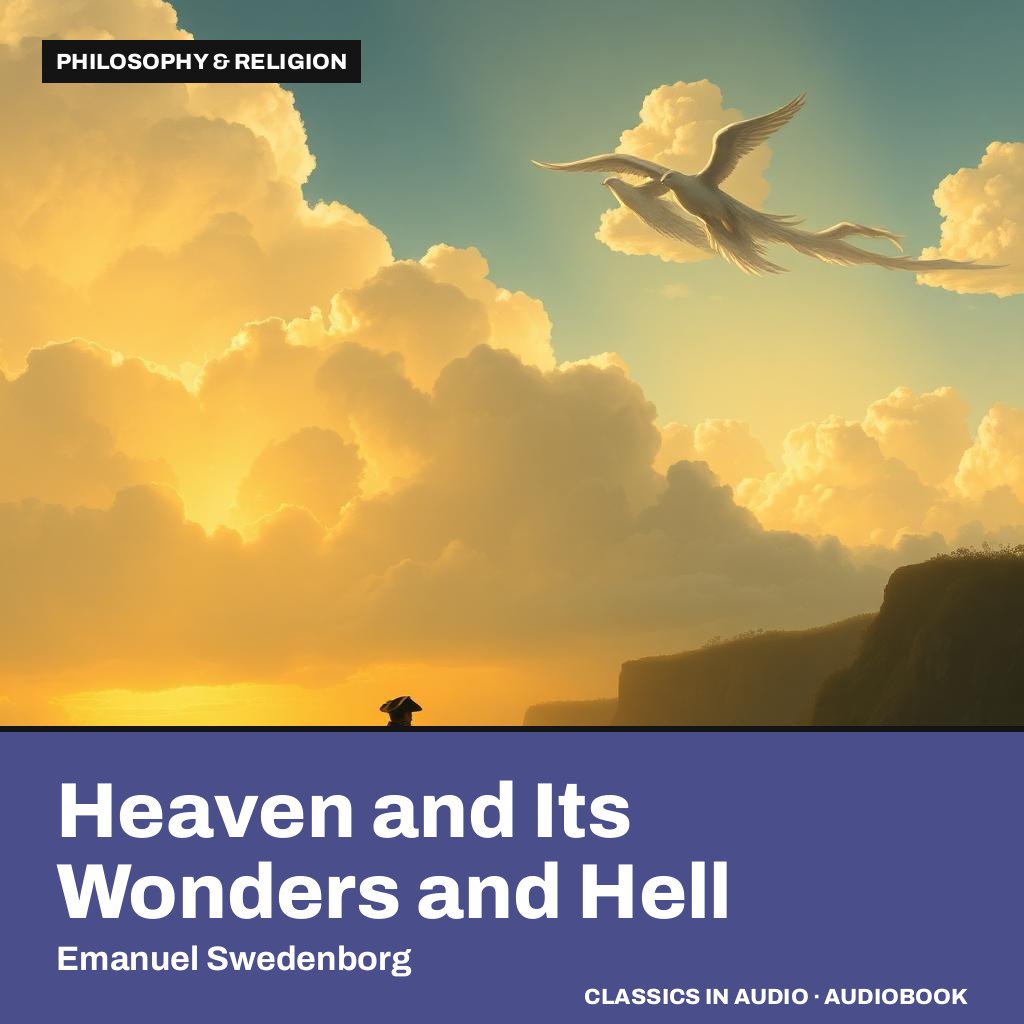
Heaven and Its Wonders and Hell
by Emanuel Swedenborg (1688–1772)
Unabridged audiobook · about 15 hr 43 min · English · read by a synthetic voice · MP3, no DRM
€6.90
Buy 2 audiobooks or more: −10%. Buy 5 or more: −20%.
Secure payment by Stripe. Your download link is e-mailed to you at once: the first 30 minutes are usually ready within a few minutes, and the rest follows while you listen. Listen online or download the MP3.
Heaven and its Wonders and Hell, first published in Latin in 1758, is Emanuel Swedenborg's account of what he said he saw and heard in the afterlife. Swedenborg was a Swedish scientist and engineer who turned to theology in middle age, and here he claims thirteen years of conversation with angels and glimpses into both heaven and hell. The book is a work of Christian mysticism and visionary description, not a story with a plot.
It opens by arguing that the Bible's pictures of the last days, with darkened suns and falling stars, should be read as symbols of spiritual realities rather than literal events. From there Swedenborg sets out his picture of the life after death, beginning with the claim that the Lord alone is the God of heaven. He goes on to describe how heaven is ordered into communities, how angels live and speak, and how the dead come to settle in the places that match what they love. Hell is treated as the outcome of those choices rather than as a sentence handed down.
The book belongs to the age of Enlightenment, yet it argues against its skepticism. It influenced writers, artists and a church that still bears his name. Listeners curious about how people have imagined the next world, or about the roots of later spiritual movements, will find a detailed and unusual guide here.
Text: Project Gutenberg edition no. 17368, read without its licence notices.
More by Emanuel Swedenborg
 The Delights of Wisdom Pertaining to Conjugial LoveEmanuel Swedenborg24 hr 11 min€7.90
 Earths In Our Solar System Which Are Called Planets, and Earths In The Starry Heaven Their Inhabitants, And The Spirits And Angels ThereEmanuel Swedenborg4 hr 11 min€3.90





