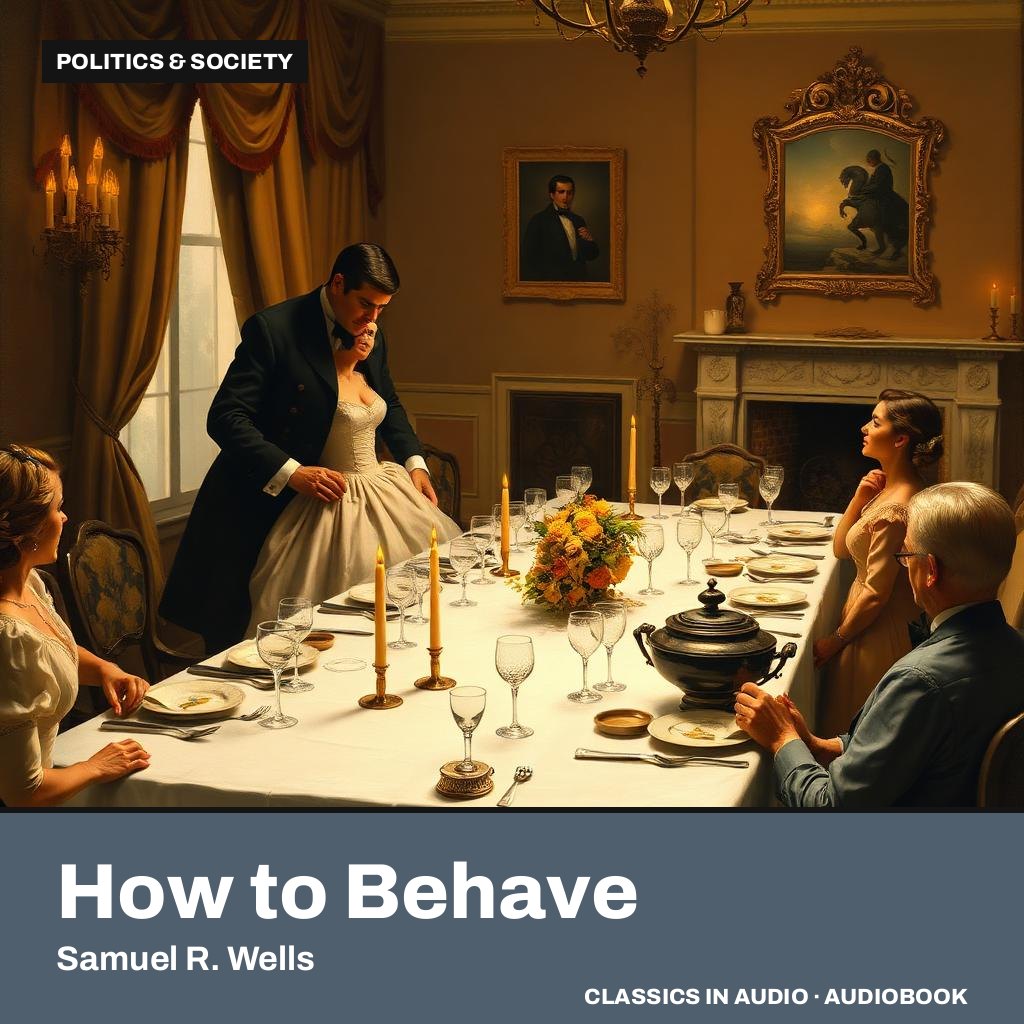
How to Behave
A Pocket Manual of Republican Etiquette, and Guide to Correct Personal Habits: Embracing an Exposition of the Principles of Good Manners; Useful Hints on the Care of the Person, Eating, Drinking, Exercise, Habits, Dress, Self-culture, and Behavior at Home; the Etiquette of Salutations, Introductions, Receptions, Visits, Dinners, Evening Parties, Conversation, Letters, Presents, Weddings, Funerals, the Street, the Church, Places of Amusement, Traveling, Etc., with Illustrative Anecdotes, a Chapter on Love and Courtship, and Rules of Order for Debating Societies
by Samuel R. Wells (1820–1875)
Unabridged audiobook · about 4 hr 53 min · English · read by a synthetic voice · MP3, no DRM
€3.90
Buy 2 audiobooks or more: −10%. Buy 5 or more: −20%.
Secure payment by Stripe. Your download link is e-mailed to you at once: the first 30 minutes are usually ready within a few minutes, and the rest follows while you listen. Listen online or download the MP3.
How to Behave is an etiquette manual written for young Americans in the 1850s, when a growing country was asking what good manners should look like without a royal court to set the standard. Samuel R. Wells, a New York publisher with the phrenology firm Fowler and Wells, argues that courtesy and morality rest on the same ground, and that fair dealing and kindness matter more than any list of fussy rules.
The book moves from the washbasin to the wider world. It covers the daily bath, dress, posture and self-command, then manners at home, with parents, servants and houseguests. From there it turns to introductions, calls, dinner parties, weddings and funerals, and behaviour in the street, the church, the picture gallery and the railway car. Further chapters deal with courtship, the rules for running a debating society, and maxims borrowed from Lord Chesterfield. Short anecdotes lighten the advice.
Today it is useful as a record of what a mid-Victorian household worried about: soup spoons, spitting, finger glasses and giving up a seat. It is practical, opinionated and often funny, and it shows how a young democracy argued about politeness and equality.
Text: Project Gutenberg edition no. 26597, read without its licence notices.
More by Samuel R. Wells
 The Salem Witchcraft, the Planchette Mystery, and Modern SpiritualismSamuel R. Wells5 hr 20 min€4.90
More politics & society
 The PrinceNiccolò Machiavelli4 hr 37 min€3.90
 LeviathanThomas Hobbes19 hr 44 min€6.90
 Second Treatise of GovernmentJohn Locke5 hr 07 min€4.90
 An Inquiry into the Nature and Causes of the Wealth of NationsAdam Smith36 hr 32 min€9.90
 The Eclipse of RussiaEmile Joseph Dillon14 hr 56 min€5.90
 Democracy—false or True?Sir William Blake Richmond5 hr 18 min€4.90