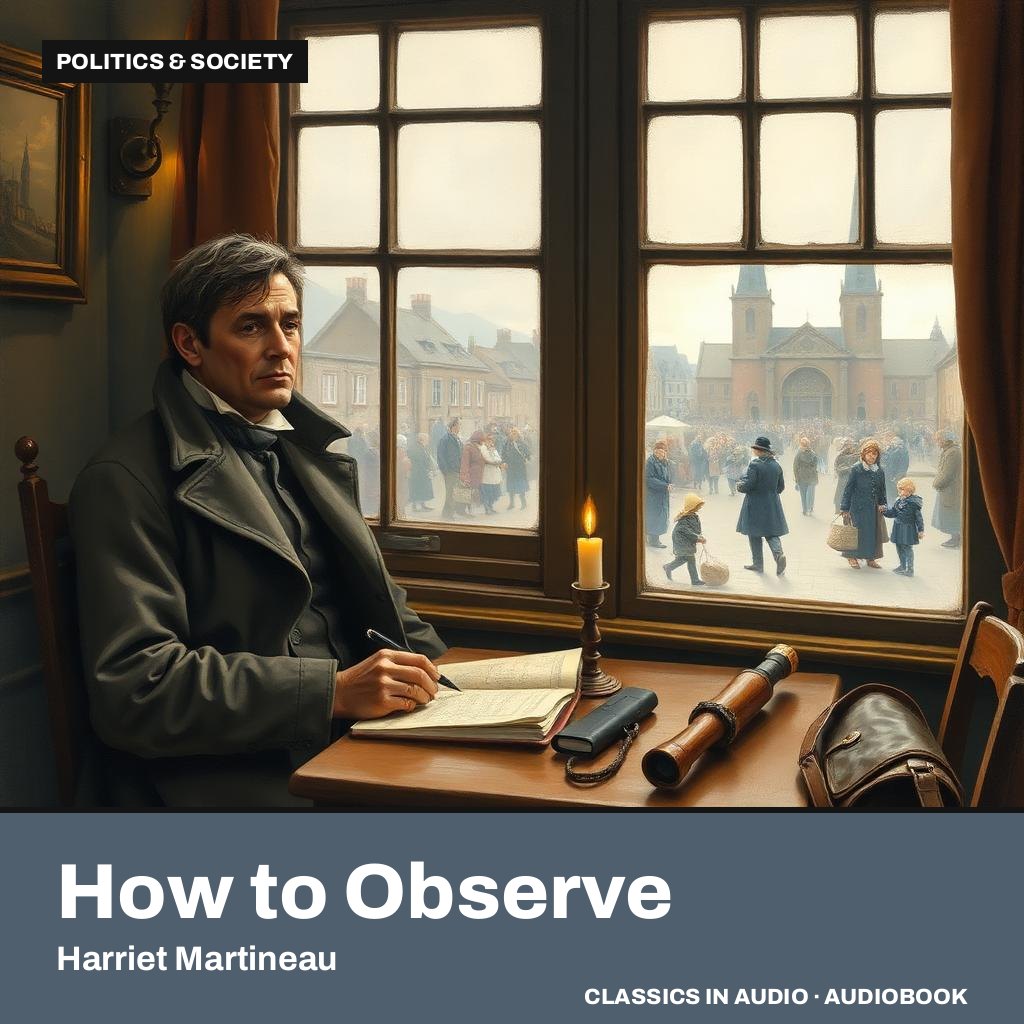
How to Observe
Morals and Manners
by Harriet Martineau (1802–1876)
Unabridged audiobook · about 6 hr 17 min · English · read by a synthetic voice · MP3, no DRM
€4.90
Buy 2 audiobooks or more: −10%. Buy 5 or more: −20%.
Secure payment by Stripe. Your download link is e-mailed to you at once: the first 30 minutes are usually ready within a few minutes, and the rest follows while you listen. Listen online or download the MP3.
How to Observe: Morals and Manners is a guide to studying a society by someone who has come from outside it. Published in 1838, it was the second volume in a series of practical handbooks for travellers, the first being a geology volume by Henry De la Beche. Harriet Martineau, an English writer on economics and society who had just returned from two years travelling in the United States, turned her attention to a question most tourists never ask: what is needed before a person can judge how other people live?
The book opens with the argument that observing human behaviour demands as much preparation as any science. Martineau mocks the traveller who admits he knows no geology yet pronounces confidently on a whole nation's character after a few weeks. She then sets out the qualities of mind and temper an observer needs, and lists what to look at: religion, burial inscriptions, popular songs, the treatment of criminals, marriage and the position of women, schools, newspapers, servants, and ideas of progress. A final part covers practical methods of recording what is seen.
It is an early work of social-science method, written in brisk, plain prose with a sharp sense of humour. Anyone who travels, reads travel writing, or wonders how to judge a foreign place fairly will find its cautions still useful.
Text: Project Gutenberg edition no. 33944, read without its licence notices.
More by Harriet Martineau
 The Crofton BoysHarriet Martineau4 hr 47 min€3.90
 Household EducationHarriet Martineau7 hr 32 min€4.90
 The Hour and the Man, An Historical RomanceHarriet Martineau15 hr 46 min€6.90
 DeerbrookHarriet Martineau19 hr 45 min€6.90
More politics & society
 The PrinceNiccolò Machiavelli4 hr 37 min€3.90
 LeviathanThomas Hobbes19 hr 44 min€6.90
 Second Treatise of GovernmentJohn Locke5 hr 07 min€4.90
 An Inquiry into the Nature and Causes of the Wealth of NationsAdam Smith36 hr 32 min€9.90
 The Eclipse of RussiaEmile Joseph Dillon14 hr 56 min€5.90
 Democracy—false or True?Sir William Blake Richmond5 hr 18 min€4.90