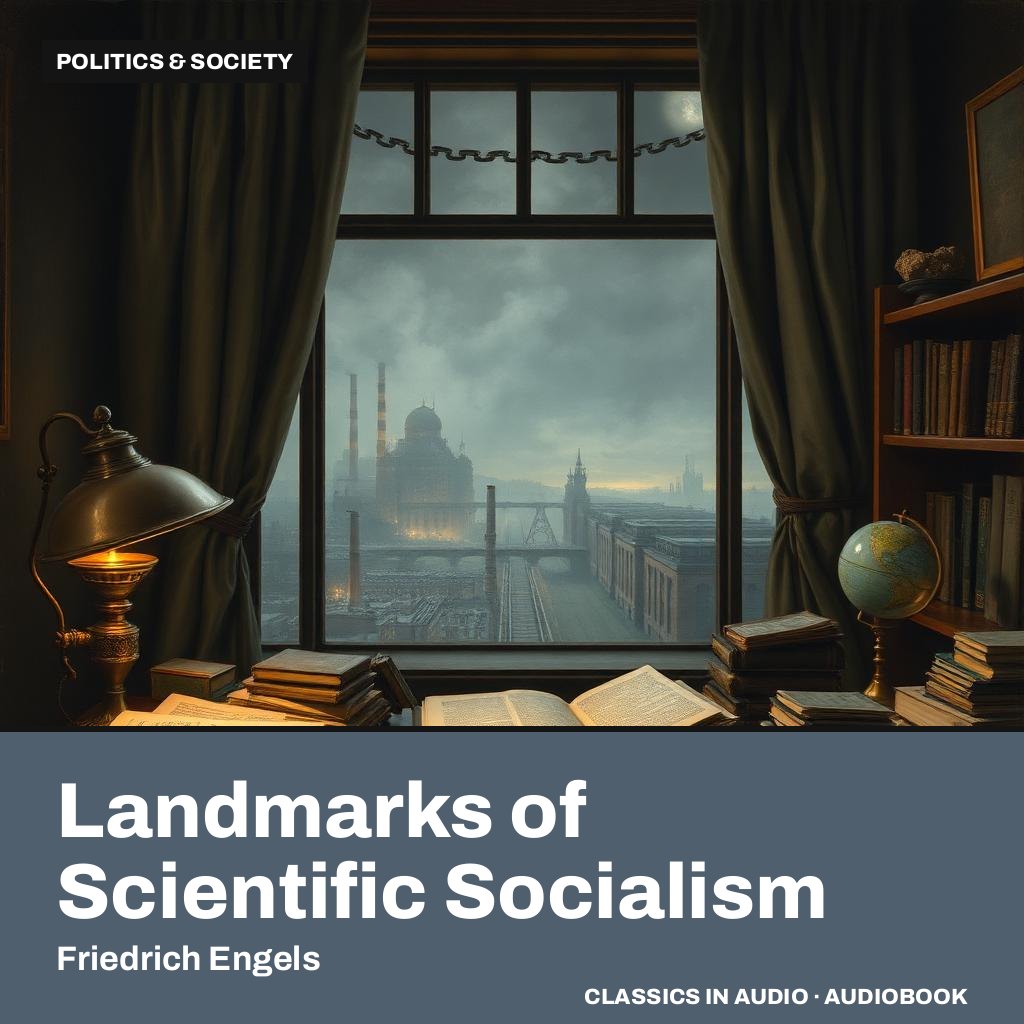
Landmarks of Scientific Socialism
"Anti-Duehring"
by Friedrich Engels (1820–1895)
Unabridged audiobook · about 7 hr 30 min · English · read by a synthetic voice · MP3, no DRM
€4.90
Buy 2 audiobooks or more: −10%. Buy 5 or more: −20%.
Secure payment by Stripe. Your download link is e-mailed to you at once: the first 30 minutes are usually ready within a few minutes, and the rest follows while you listen. Listen online or download the MP3.
In 1875 Eugen Dühring, a lecturer at the University of Berlin, announced that he had become a socialist and offered a system of his own: a philosophy of the universe, a theory of economics and a blueprint for a future society. Friedrich Engels, co-thinker of Karl Marx, answered him in a series of newspaper articles that were later collected as Anti-Dühring. The book is part polemic, part handbook, and it was long among the most widely read statements of Marxist thought.
Engels follows Dühring through three fields. The first takes up philosophy and natural science, including time and space, the origin of the solar system, the study of living things, morality, equality and freedom, and the method of dialectics. The second covers political economy: force and property, the theory of value, capital and surplus value. The third sets out what socialism means for production, distribution, the state, the family and education. Engels was a Rhineland manufacturer's son who ran a family mill in Manchester, and he writes with a businessman's knowledge of industry.
This edition, translated and edited by Austin Lewis and printed in Chicago in 1907, adds a long introduction on how the movement had changed in thirty years. It suits anyone who wants to read the argument of a founding text in its own words.
Text: Project Gutenberg edition no. 31933, read without its licence notices.
More by Friedrich Engels
 Socialism, Utopian and ScientificFriedrich Engels2 hr 34 min€3.90
 FeuerbachFriedrich Engels2 hr 17 min€3.90
 Revolution and Counter-RevolutionFriedrich Engels4 hr 18 min€3.90
More politics & society
 The PrinceNiccolò Machiavelli4 hr 37 min€3.90
 LeviathanThomas Hobbes19 hr 44 min€6.90
 Second Treatise of GovernmentJohn Locke5 hr 07 min€4.90
 An Inquiry into the Nature and Causes of the Wealth of NationsAdam Smith36 hr 32 min€9.90
 The Eclipse of RussiaEmile Joseph Dillon14 hr 56 min€5.90
 Democracy—false or True?Sir William Blake Richmond5 hr 18 min€4.90