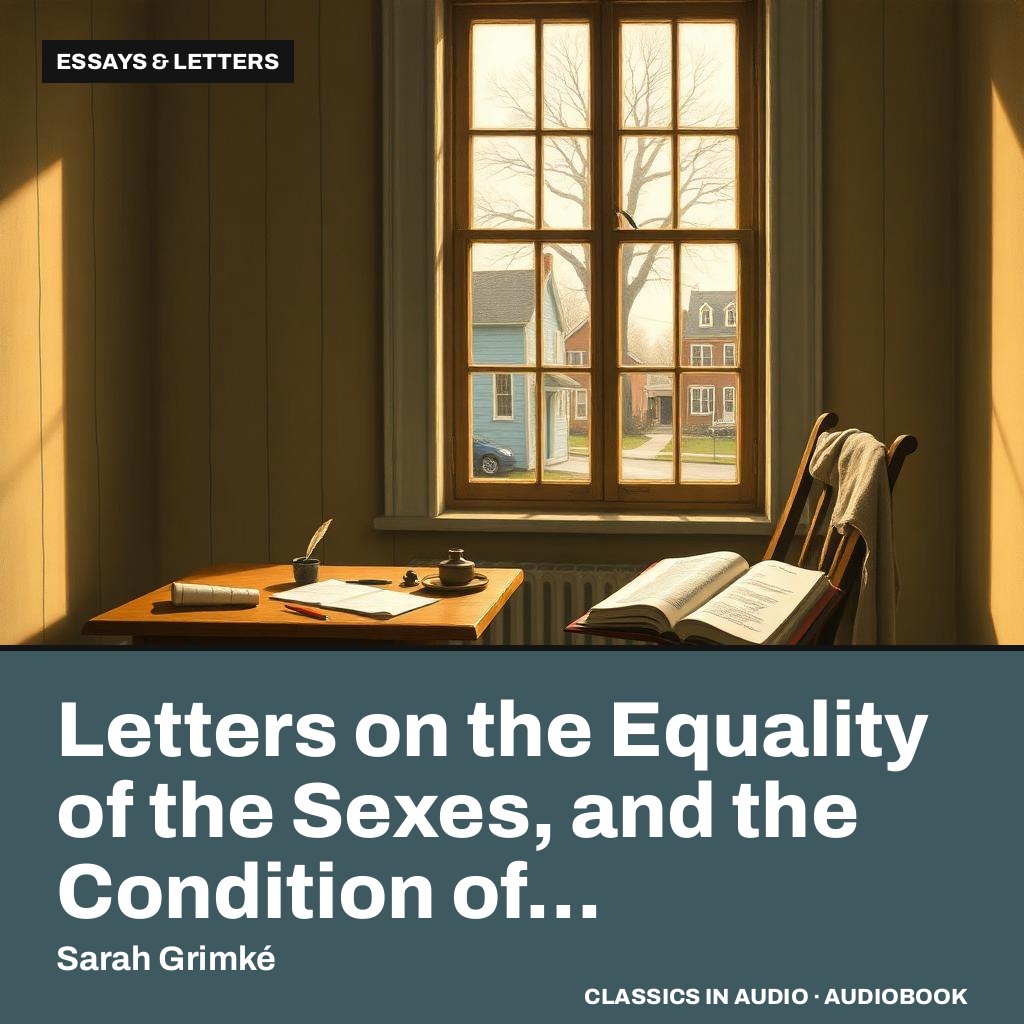
Letters on the Equality of the Sexes, and the Condition of Woman
by Sarah Grimké (1792–1873)
Unabridged audiobook · about 3 hr 14 min · English · read by a synthetic voice · MP3, no DRM
€3.90
Buy 2 audiobooks or more: −10%. Buy 5 or more: −20%.
Secure payment by Stripe. Your download link is e-mailed to you at once: the first 30 minutes are usually ready within a few minutes, and the rest follows while you listen. Listen online or download the MP3.
Letters on the Equality of the Sexes is a series of essays written as letters, first published in 1838, in which Sarah Grimké argues that women and men were created equal and that the subordination of women rests on human custom rather than divine decree. The letters were addressed to Mary Parker, president of the Boston Female Anti-Slavery Society, and appeared during a bitter public quarrel over whether women had any right to speak in public on moral and political questions.
Grimké builds her case on the Bible itself. She reads the creation story closely, questions the accuracy of the English translation, and insists that each person must study scripture for herself rather than accept the opinion of ministers. From there she widens her view to education, work, wages, law and marriage in the United States of her day, setting out what women were denied and what they might become.
Grimké was born into a slaveholding family in Charleston, South Carolina, and left the South to become a Quaker and an abolitionist, alongside her sister Angelina. Her arguments are those of an insider who had seen the system up close. The book is a clear, early statement of ideas that later reform movements would take up, and it shows how a religious argument could be turned toward reform.
Text: Project Gutenberg edition no. 69485, read without its licence notices.
More essays & letters
 Walden, and On The Duty Of Civil DisobedienceHenry David Thoreau9 hr 35 min€4.90
 Essays of Michel de MontaigneMichel de Montaigne48 hr 35 min€9.90
 De ProfundisOscar Wilde1 hr 32 min€3.90
 Essays by Ralph Waldo EmersonRalph Waldo Emerson8 hr 40 min€4.90
 EssaysRalph Waldo Emerson6 hr 43 min€4.90
 The Notebooks of Leonardo Da VinciLeonardo da Vinci21 hr 55 min€7.90