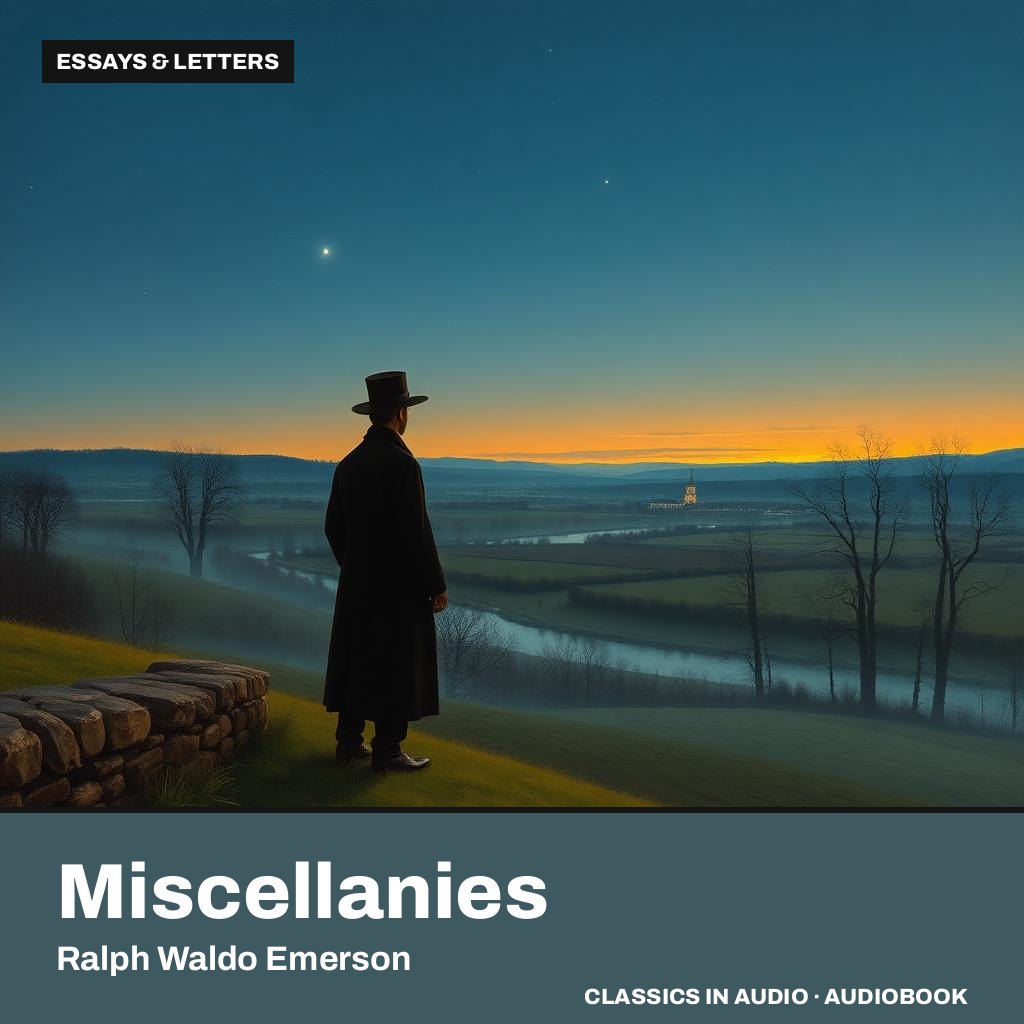
Miscellanies
Embracing Nature, Addresses, and Lectures
by Ralph Waldo Emerson (1803–1882)
Unabridged audiobook · about 7 hr 22 min · English · read by a synthetic voice · MP3, no DRM
€4.90
Buy 2 audiobooks or more: −10%. Buy 5 or more: −20%.
Secure payment by Stripe. Your download link is e-mailed to you at once: the first 30 minutes are usually ready within a few minutes, and the rest follows while you listen. Listen online or download the MP3.
This volume gathers the early prose of Ralph Waldo Emerson, the Concord, Massachusetts essayist who left the Unitarian pulpit and became the leading voice of New England Transcendentalism. It opens with Nature, the short book of 1836 that asks why each generation should rely on the beliefs of the dead rather than look at the world for itself. Emerson begins with a plain proposal: that people may have "an original relation to the universe," and that the stars, fields and rivers around them are a better teacher than inherited tradition.
The rest of the collection is made up of addresses and lectures delivered between 1837 and 1844 to college societies, a library association for mechanics' apprentices, and audiences at the Masonic Temple in Boston. Among them are The American Scholar, which Oliver Wendell Holmes is said to have called America's intellectual declaration of independence, and the controversial address to the Harvard Divinity School graduates. Others take up reform, conservatism, the idea of the Transcendentalist, and the character of the young nation.
The pieces are short, argumentative and often startling in a single sentence. They are worth hearing now for their questions about self-reliance, education and how to live attentively, asked in the voice of a speaker facing a room.
Text: Project Gutenberg edition no. 71683, read without its licence notices.
More by Ralph Waldo Emerson
 Essays by Ralph Waldo EmersonRalph Waldo Emerson8 hr 40 min€4.90
 EssaysRalph Waldo Emerson6 hr 43 min€4.90
 NatureRalph Waldo Emerson1 hr 40 min€3.90
 The Conduct of LifeRalph Waldo Emerson6 hr 14 min€4.90
 Society and SolitudeRalph Waldo Emerson6 hr 05 min€4.90
 Representative MenRalph Waldo Emerson5 hr 29 min€4.90
More essays & letters
 Walden, and On The Duty Of Civil DisobedienceHenry David Thoreau9 hr 35 min€4.90
 Essays of Michel de MontaigneMichel de Montaigne48 hr 35 min€9.90
 De ProfundisOscar Wilde1 hr 32 min€3.90
 The Notebooks of Leonardo Da VinciLeonardo da Vinci21 hr 55 min€7.90
 The Will to Believe, and Other Essays in Popular PhilosophyWilliam James9 hr 32 min€4.90
 The Art of Public SpeakingJ. Berg Esenwein15 hr 09 min€6.90