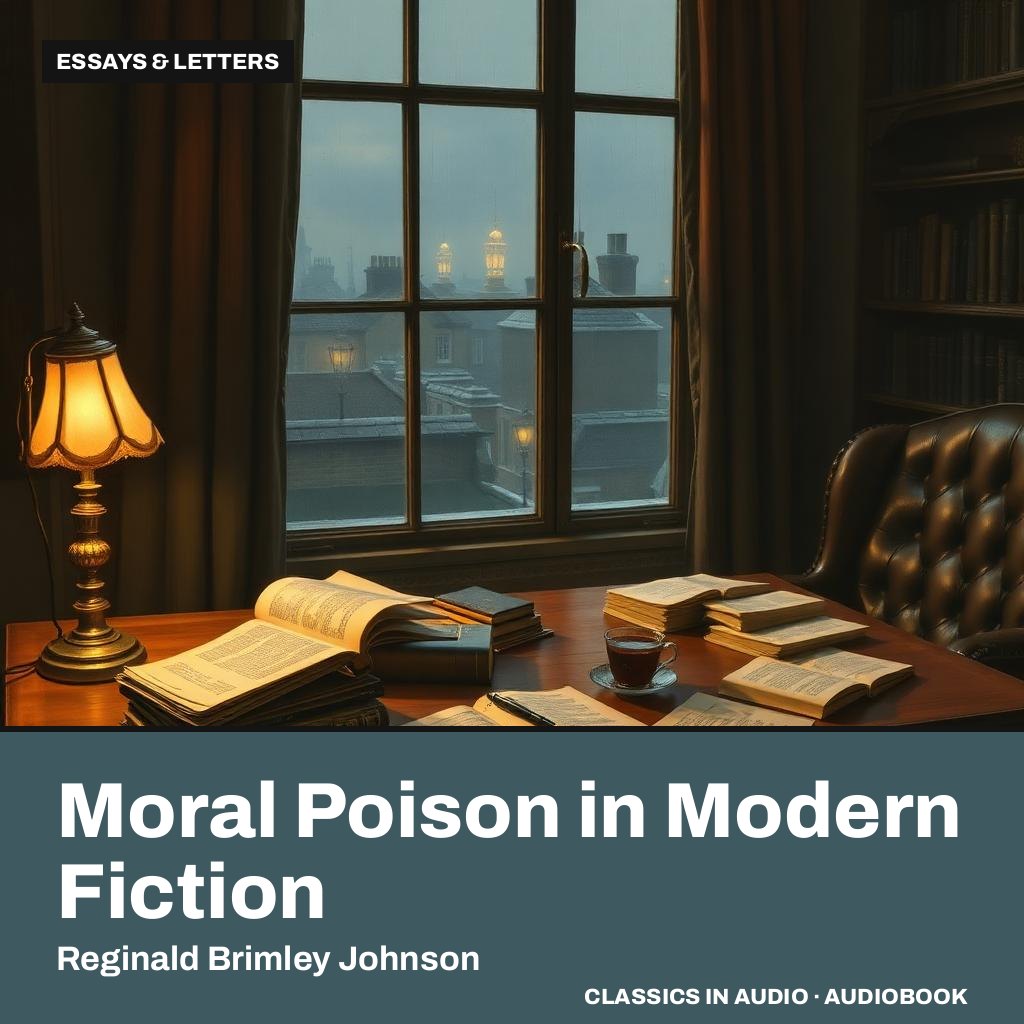
Moral Poison in Modern Fiction
by Reginald Brimley Johnson (1867–1932)
Unabridged audiobook · about 1 hr 23 min · English · read by a synthetic voice · MP3, no DRM
€3.90
Buy 2 audiobooks or more: −10%. Buy 5 or more: −20%.
Secure payment by Stripe. Your download link is e-mailed to you at once: the first 30 minutes are usually ready within a few minutes, and the rest follows while you listen. Listen online or download the MP3.
Moral Poison in Modern Fiction is a short polemical essay on the novels of the years just after the First World War. R. Brimley Johnson, a London critic and publisher who spent his working life reading and reviewing new books, wrote it from what he had actually met on his desk. He states at the outset that every novel he cites came to him in the course of reviewing, and that he means no personal attack on any writer. His concern is what fiction does to its readers, not why it was written.
His argument runs like this. Before 1914, thinkers had begun to question Victorian reticence about sex, and Johnson broadly welcomes that questioning. He lists its aims: honest talk about the body, equal recognition of desire in women and men, and open discussion of marriage, divorce, birth control and prostitution. Then came the war, which tore young people from their homes and left them without guidance. In Johnson's view, the frank debate was swept up in a flood of cheap, reckless writing.
The essay is a clear record of how a cautious reformer saw the 1920s literary scene, and of the quarrels over censorship, candour and responsibility that continue to resurface. Listeners interested in English fiction between the wars, or in the history of how books are judged, will find a lively and sometimes uncomfortable witness.
Text: Project Gutenberg edition no. 51015, read without its licence notices.
More essays & letters
 Walden, and On The Duty Of Civil DisobedienceHenry David Thoreau9 hr 35 min€4.90
 Essays of Michel de MontaigneMichel de Montaigne48 hr 35 min€9.90
 De ProfundisOscar Wilde1 hr 32 min€3.90
 Essays by Ralph Waldo EmersonRalph Waldo Emerson8 hr 40 min€4.90
 EssaysRalph Waldo Emerson6 hr 43 min€4.90
 The Notebooks of Leonardo Da VinciLeonardo da Vinci21 hr 55 min€7.90