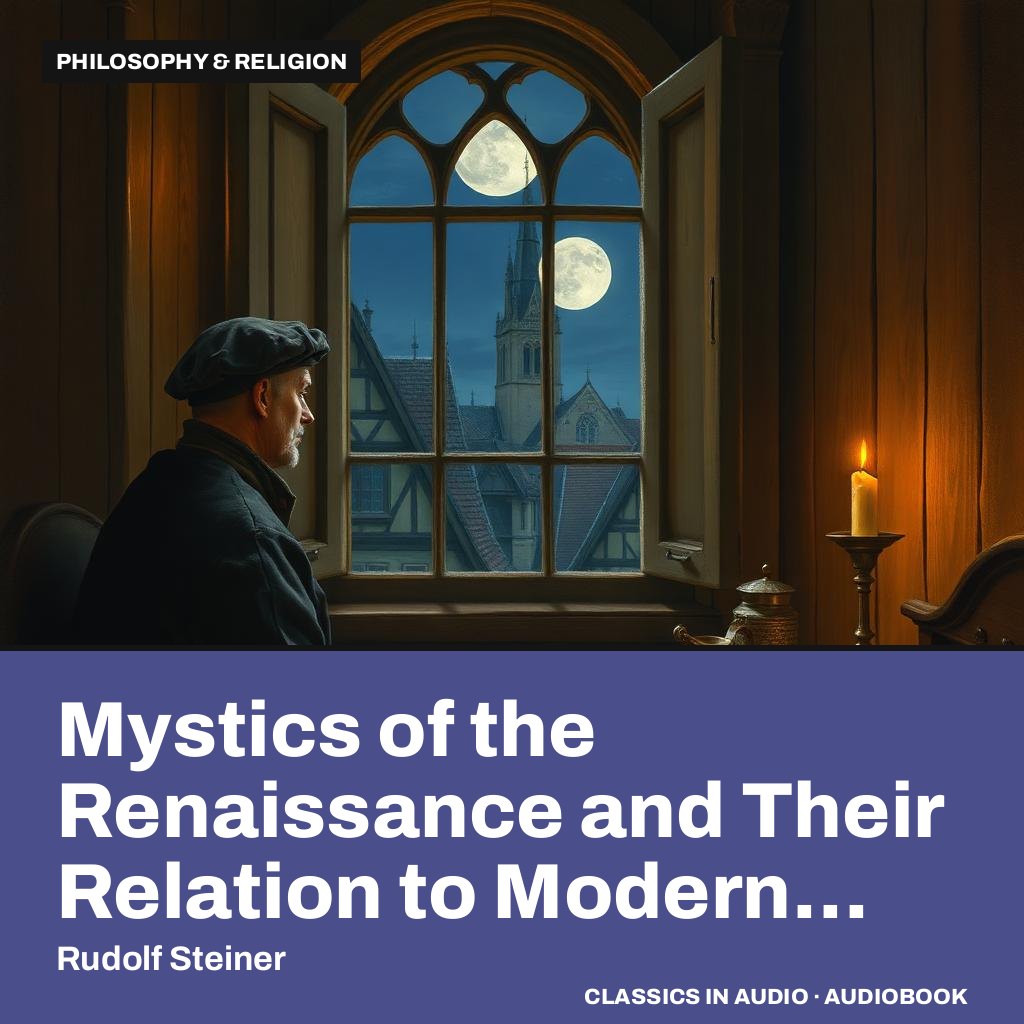
Mystics of the Renaissance and Their Relation to Modern Thought
Including Meister Eckhart, Tauler, Paracelsus, Jacob Boehme, Giordano Bruno, and Others
by Rudolf Steiner (1861–1925)
Unabridged audiobook · about 3 hr 45 min · English · read by a synthetic voice · MP3, no DRM
€3.90
Buy 2 audiobooks or more: −10%. Buy 5 or more: −20%.
Secure payment by Stripe. Your download link is e-mailed to you at once: the first 30 minutes are usually ready within a few minutes, and the rest follows while you listen. Listen online or download the MP3.
Mystics of the Renaissance is a work of philosophy and intellectual history in which Rudolf Steiner follows a line of religious and speculative thinkers across roughly three centuries of European life. It begins with the medieval preacher Meister Eckhart and his pupil Tauler, passes through the physician and alchemist Paracelsus and the shoemaker-philosopher Jacob Boehme, and takes in Giordano Bruno, who was burned in Rome in 1600, before reaching Angelus Silesius. The setting is a Germany and Italy where church authority, the new natural science and private spiritual experience pulled against one another.
Steiner, an Austrian-born thinker who edited Goethe's scientific writings and later founded anthroposophy, wrote the book in 1901. In the preface he insists that a person can hold to the scientific view of nature and still take these mystics seriously, and he admits he has been called both a mystic and a materialist. His argument is that each of these figures, in his own way, tried to answer the old question "Know thyself" by looking inward for what the outer world could not supply.
The book suits listeners curious about the roots of modern ideas of selfhood, freedom and the relation of mind to nature. It is also a record of how a prominent early twentieth-century thinker read the mystical tradition, and it is best taken as his interpretation rather than a neutral survey.
Text: Project Gutenberg edition no. 75994, read without its licence notices.
More by Rudolf Steiner
 An Outline of Occult ScienceRudolf Steiner10 hr 51 min€5.90
 The Way of InitiationRudolf Steiner3 hr 31 min€3.90
 Christianity as Mystical Fact, and the Mysteries of AntiquityRudolf Steiner4 hr 17 min€3.90
 The Spiritual Guidance of Man and of MankindRudolf Steiner2 hr 05 min€3.90
 The Education of Children from the Standpoint of TheosophyRudolf Steiner1 hr 15 min€3.90





