Observations Upon the Prophecies of Daniel, and the Apocalypse of St. John
by Isaac Newton (1642–1727)
Unabridged audiobook · about 6 hr 42 min · English · read by a synthetic voice · MP3, no DRM
€4.90
Buy 2 audiobooks or more: −10%. Buy 5 or more: −20%.
Secure payment by Stripe. Your download link is e-mailed to you at once: the first 30 minutes are usually ready within a few minutes, and the rest follows while you listen. Listen online or download the MP3.
Isaac Newton is remembered for gravitation and the laws of motion, yet he spent a large share of his working life on theology and biblical chronology. This book, published after his death in 1727 and prepared by his nephew-in-law Benjamin Smith, gathers two of those studies: one on the Book of Daniel and one on the Revelation of St. John.
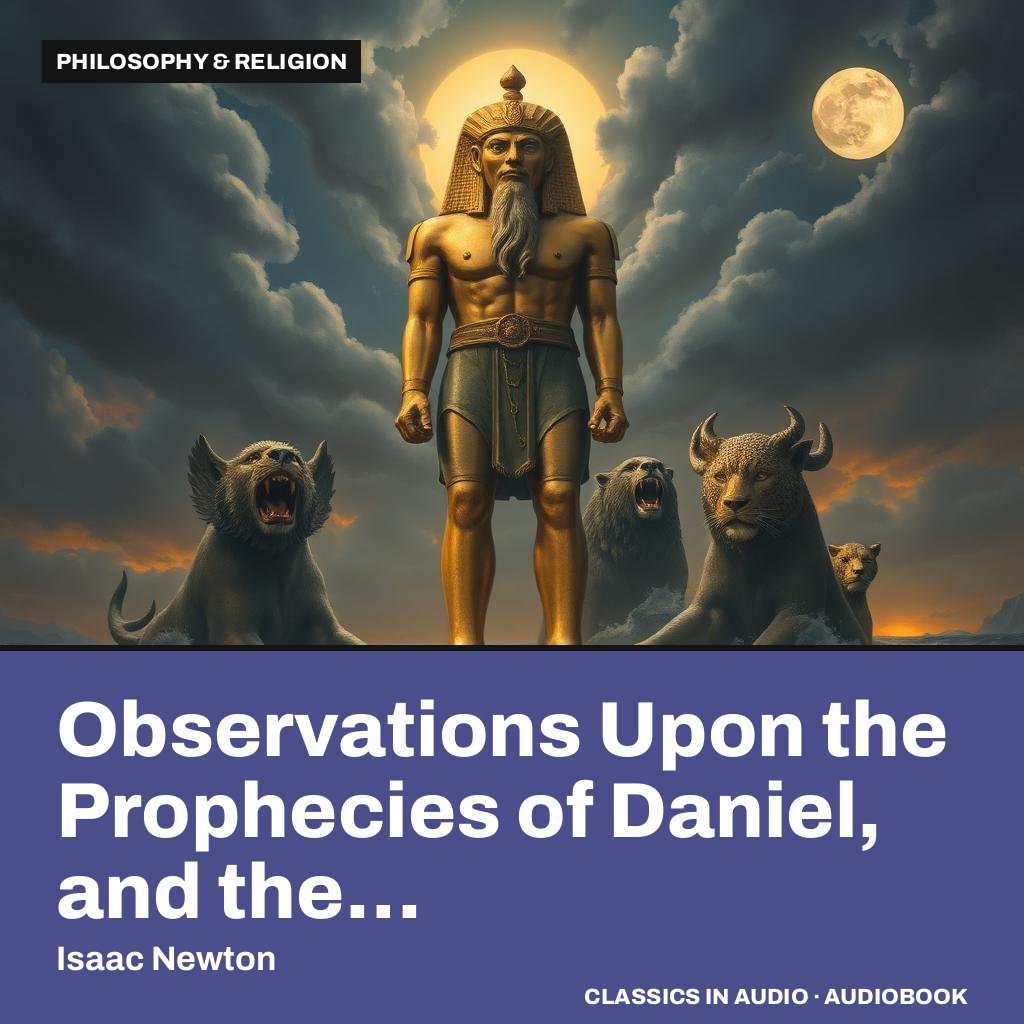
Newton approaches prophecy as a problem to be solved with evidence. He begins with how the books of the Old Testament were compiled, then sets out what he takes to be the fixed meaning of prophetic imagery, so that each symbol is read the same way every time. With that method he works through Daniel's visions, including the statue built from four metals, the four beasts, the ram and the he-goat, and the prophecy of the seventy weeks, and he matches them against the empires of the ancient and later European world. The second part turns to the Apocalypse, its date, its ties to the Law of Moses and the Temple, and its relation to Daniel.
The prose is dense, argumentative and full of historical detail from Assyria, Babylon, Egypt and Rome. Listeners curious about Newton's other mind, or about how early modern scholars read scripture alongside history, will find a rare view of both.
Text: Project Gutenberg edition no. 16878, read without its licence notices.