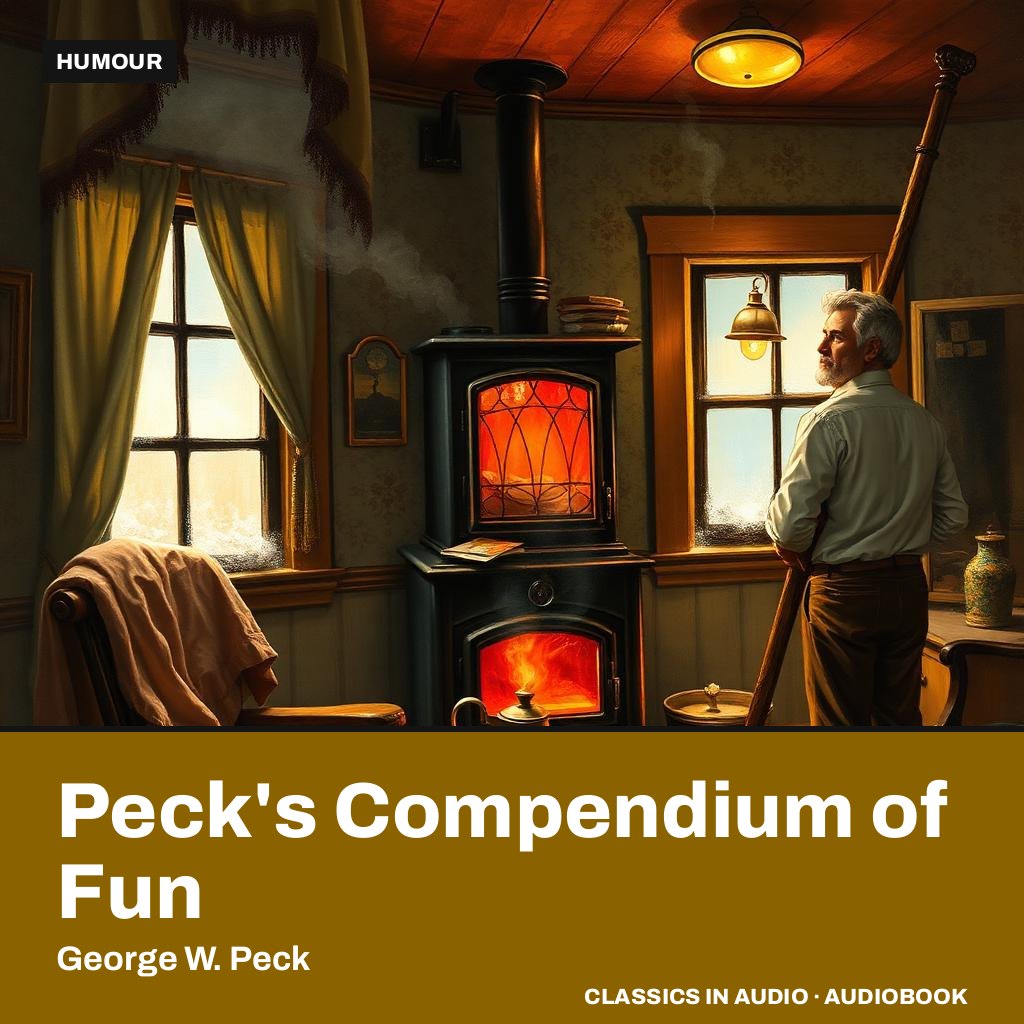
Peck's Compendium of Fun
Comprising the Choicest Gems of Wit, Humor, Sarcasm and Pathos of America's Favorite Humorist
by George W. Peck (1840–1916)
Unabridged audiobook · about 6 hr 57 min · English · read by a synthetic voice · MP3, no DRM
€4.90
Buy 2 audiobooks or more: −10%. Buy 5 or more: −20%.
Secure payment by Stripe. Your download link is e-mailed to you at once: the first 30 minutes are usually ready within a few minutes, and the rest follows while you listen. Listen online or download the MP3.
This is a grab-bag of newspaper humor from late nineteenth-century America. George W. Peck, a Wisconsin editor who ran the Milwaukee Sun, filled his columns with short comic sketches, and this collection gathers them under headings such as "The New Coal Stove," "Why Not Raise Wolves?" and "Those Bold Bad Drummers." The pieces run from a few lines to a few pages and poke at whatever was in front of him: church choirs and camp meetings, temperance societies, summer resorts, traveling salesmen, stage stars, politicians and household mishaps.
A large share of the book belongs to Peck's Bad Boy, a prankster who torments his long-suffering father and the neighbors, and whose scrapes made Peck famous well beyond Wisconsin. In the opening sketch, a family buys its first coal stove and quickly loses all control of the heat, a good sample of the dry, exaggerating, self-mocking tone that runs through the rest.
The jokes are rooted in a world of horse cars, step ladders, lake towns and small-city gossip, so the book also works as a lively record of everyday American life in the 1870s and 1880s. Listeners who enjoy Mark Twain's shorter pieces or old newspaper columns will find plenty to laugh at, and some of the satire still lands.
Text: Project Gutenberg edition no. 14815, read without its licence notices.
More by George W. Peck
 Peck's SunshineGeorge W. Peck7 hr 13 min€4.90
 Peck's Bad Boy and His PaGeorge W. Peck4 hr 01 min€3.90
 Peck's Bad Boy with the CircusGeorge W. Peck4 hr 35 min€3.90
 Peck's Bad Boy AbroadGeorge W. Peck5 hr 34 min€4.90
 How Private George W. Peck Put Down the RebellionGeorge W. Peck8 hr 16 min€4.90
 Peck's Bad Boy with the CowboysGeorge W. Peck2 hr 59 min€3.90
More humour
 The Expedition of Humphry ClinkerTobias Smollett13 hr 55 min€5.90
 CandideVoltaire3 hr 16 min€3.90
 Love and Freindship [sic]Jane Austen3 hr 14 min€3.90
 Northanger AbbeyJane Austen7 hr 05 min€4.90
 A Pickle for the Knowing OnesTimothy Dexter1 hr 23 min€3.90
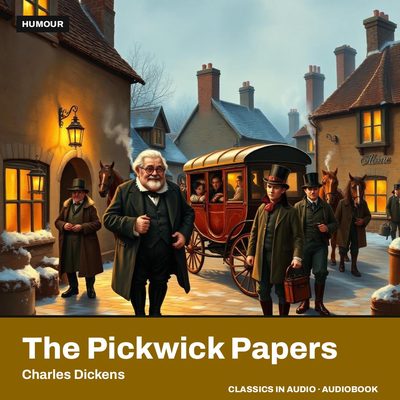 The Pickwick PapersCharles Dickens28 hr 38 min€7.90