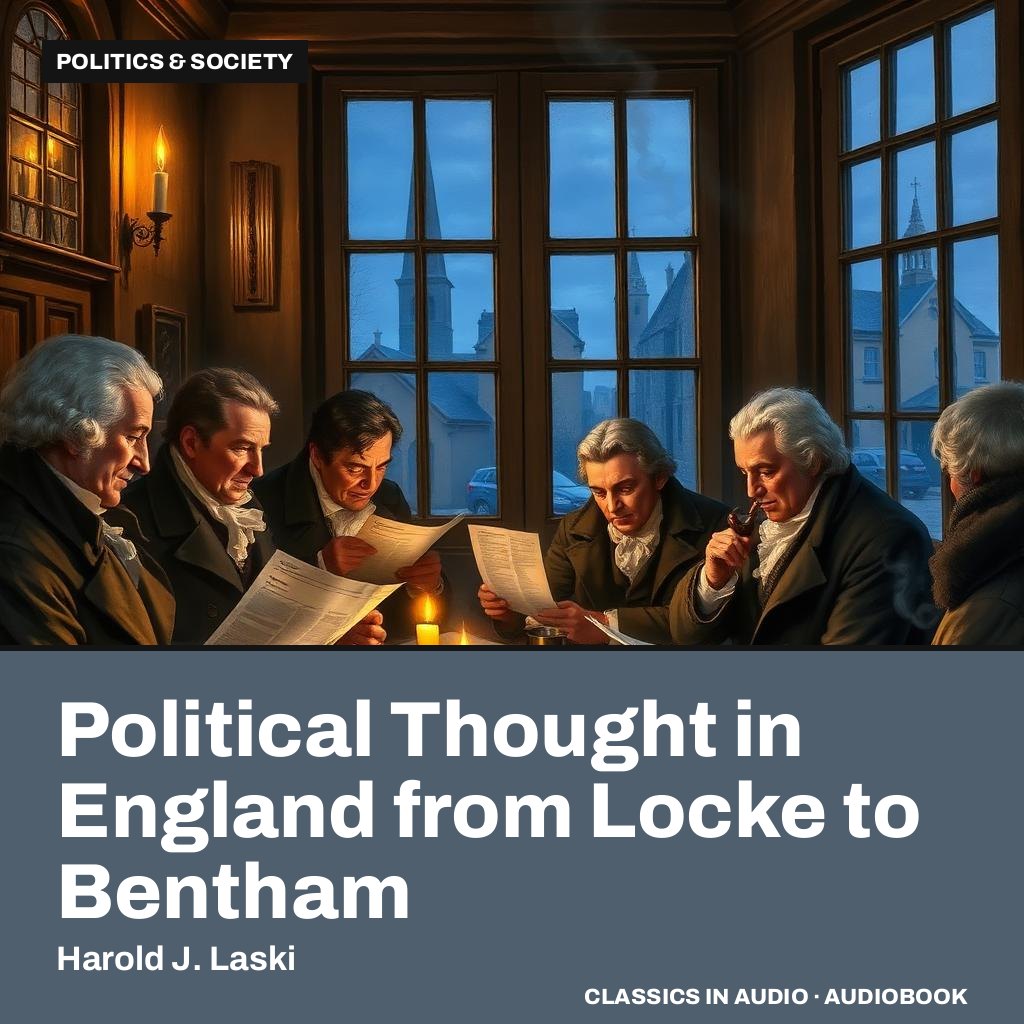
Political Thought in England from Locke to Bentham
by Harold J. Laski (1893–1950)
Unabridged audiobook · about 5 hr 46 min · English · read by a synthetic voice · MP3, no DRM
€4.90
Buy 2 audiobooks or more: −10%. Buy 5 or more: −20%.
Secure payment by Stripe. Your download link is e-mailed to you at once: the first 30 minutes are usually ready within a few minutes, and the rest follows while you listen. Listen online or download the MP3.
Harold Laski's study follows English political ideas across the long eighteenth century, from the settlement of 1688 to the eve of the nineteenth-century reformers. It opens with the moment Divine Right disappeared from English politics, and asks what filled the space. Laski sets the angry pamphleteers of the seventeenth century beside a calmer age of bishops, journalists, moralists and lawyers, and argues that the calm was deceptive: the party system took shape, the principle of consent settled in, and the ground was laid for sharper arguments to come.
The chapters take in the principles of the Revolution and the long quarrel over Church and State. They go on to a period Laski calls one of stagnation, then the first signs of change, a full chapter on Edmund Burke, and the foundations of economic liberalism. Locke, Hume, Adam Smith, Blackstone and Bentham all appear, along with lesser figures such as Hoadly and De Lolme.
Laski was a young political theorist when he wrote this, finishing the book at Harvard in 1919 before returning to teach in London. It suits anyone who wants to see how habits of representative government, toleration and free enterprise were argued into place, often by people who never thought they were building a system.
Text: Project Gutenberg edition no. 14735, read without its licence notices.
More politics & society
 The PrinceNiccolò Machiavelli4 hr 37 min€3.90
 LeviathanThomas Hobbes19 hr 44 min€6.90
 Second Treatise of GovernmentJohn Locke5 hr 07 min€4.90
 An Inquiry into the Nature and Causes of the Wealth of NationsAdam Smith36 hr 32 min€9.90
 The Eclipse of RussiaEmile Joseph Dillon14 hr 56 min€5.90
 Democracy—false or True?Sir William Blake Richmond5 hr 18 min€4.90