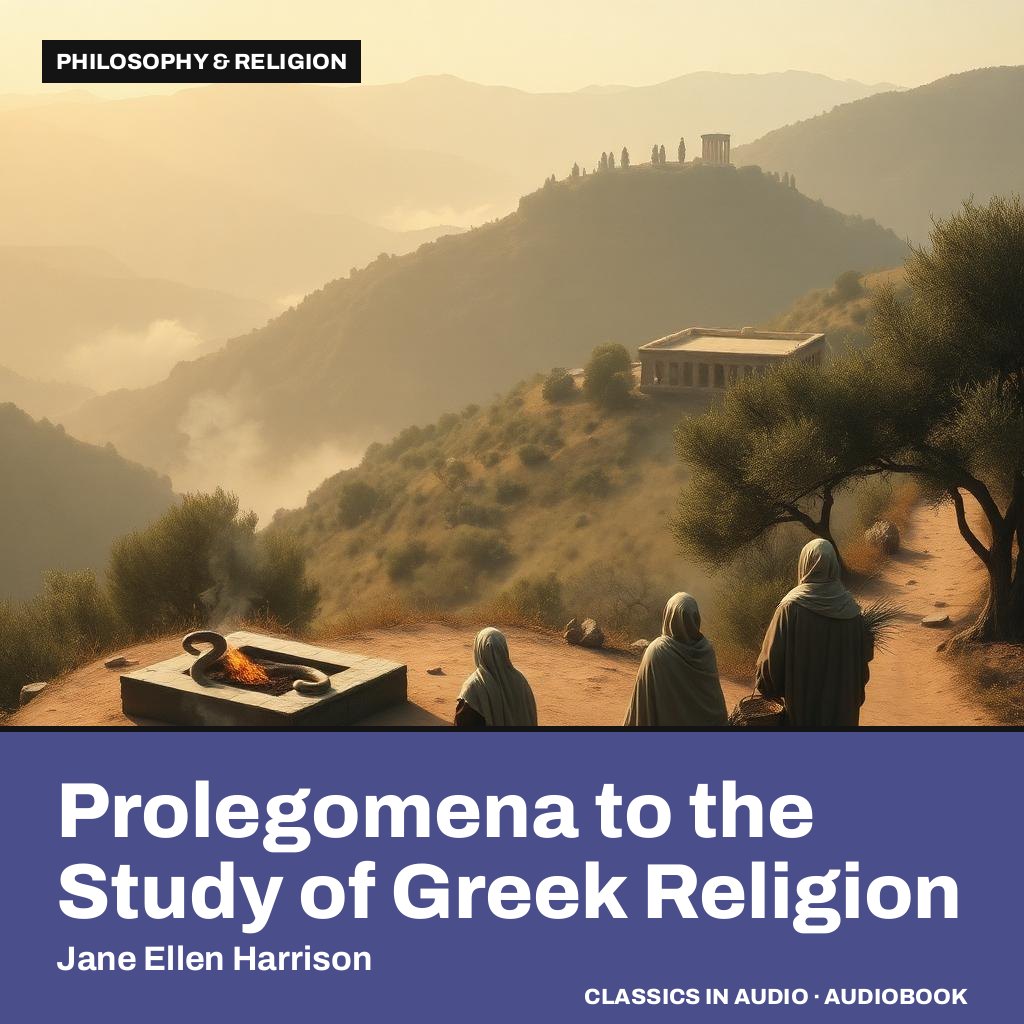
Prolegomena to the Study of Greek Religion
by Jane Ellen Harrison (1850–1928)
Unabridged audiobook · about 23 hr 53 min · English · read by a synthetic voice · MP3, no DRM
€7.90
Buy 2 audiobooks or more: −10%. Buy 5 or more: −20%.
Secure payment by Stripe. Your download link is e-mailed to you at once: the first 30 minutes are usually ready within a few minutes, and the rest follows while you listen. Listen online or download the MP3.
Jane Ellen Harrison's Prolegomena, first published in 1903, asks a blunt question about ancient Greece: what did people actually do for their gods? Instead of beginning with Homer and the bright Olympians, Harrison starts with ritual, arguing that what a people does at its altars is the surest clue to what it believes. Beneath the polished surface of epic poetry she finds an older layer of fear, purification and placation, centred on ghosts, snakes and the powers of the earth.
The book walks through Athenian festivals such as the Diasia, the Anthesteria, the Thargelia and the Thesmophoria. It looks at the scapegoat figure of the pharmakos, at women carrying sacred objects to coax the sown fields into growth, and at the secret rites known as mysteries. Throughout, she contrasts cheerful sacrificial meals shared with the Olympian gods with gloomy offerings burned whole for powers below the ground.
Harrison was a Cambridge classicist, one of the first women to hold such a career in Britain, and she wrote with unusual energy for a scholar. Her work remains worth hearing for its picture of Greek religion as something stranger, more anxious and more practical than the marble myths suggest, and for the way it shaped later thinking about the origins of tragedy.
Text: Project Gutenberg edition no. 78248, read without its licence notices.
More by Jane Ellen Harrison
 Ancient Art and RitualJane Ellen Harrison4 hr 31 min€3.90
 Primitive Athens as Described by ThucydidesJane Ellen Harrison5 hr 31 min€4.90





