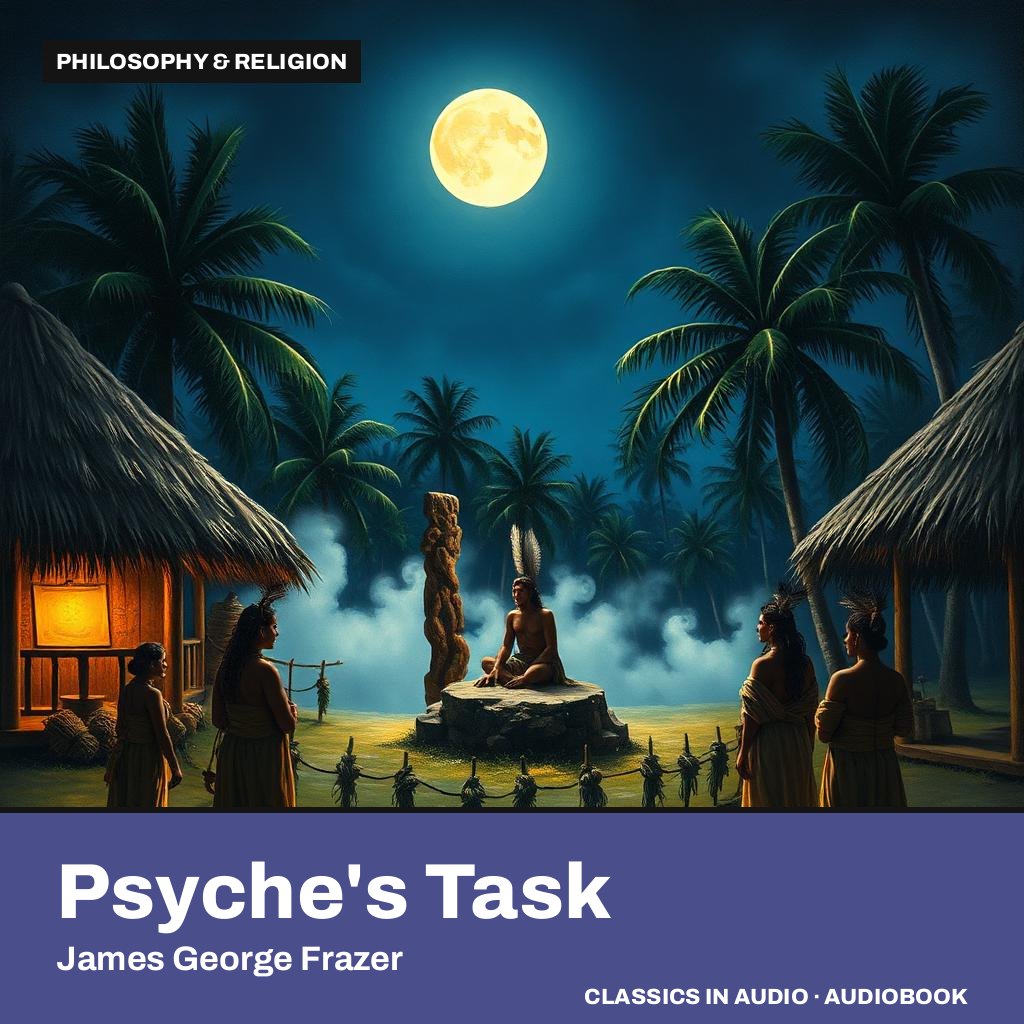
Psyche's Task
A Discourse Concerning the Influence of Superstition on the Growth of Institutions
by James George Frazer (1854–1941)
Unabridged audiobook · about 7 hr 14 min · English · read by a synthetic voice · MP3, no DRM
€4.90
Buy 2 audiobooks or more: −10%. Buy 5 or more: −20%.
Secure payment by Stripe. Your download link is e-mailed to you at once: the first 30 minutes are usually ready within a few minutes, and the rest follows while you listen. Listen online or download the MP3.
Psyche's Task is a short work of anthropology and social argument, first given as a lecture at the Royal Institution in London and published in 1909. Its title borrows from the old myth in which Psyche is set to sort a heap of mixed seeds into separate piles. Frazer applies the image to human belief: can the seeds of good be separated from the seeds of evil in what we call superstition?
His answer is a deliberately provocative defence. Drawing on reports from Melanesia, Polynesia, Africa, Southeast Asia, the Americas and ancient Europe, he argues that fear of the supernatural helped to prop up four pillars of ordered life: respect for rulers, the security of property, the rules of marriage, and the protection of human life. Chiefs hedged with sacred dread, taboos on theft, horror of incest, and the terror of a murdered man's ghost all appear as unintended supports of early society.
Frazer was a Scottish scholar at Cambridge and Liverpool, best known for The Golden Bough. Some of his evidence and theories have been challenged since, but the book still shows how a thinker of the Edwardian age tried to explain why people behave as they do, and how folly sometimes leads to wisdom. This edition also includes his inaugural lecture on social anthropology.
Text: Project Gutenberg edition no. 71985, read without its licence notices.