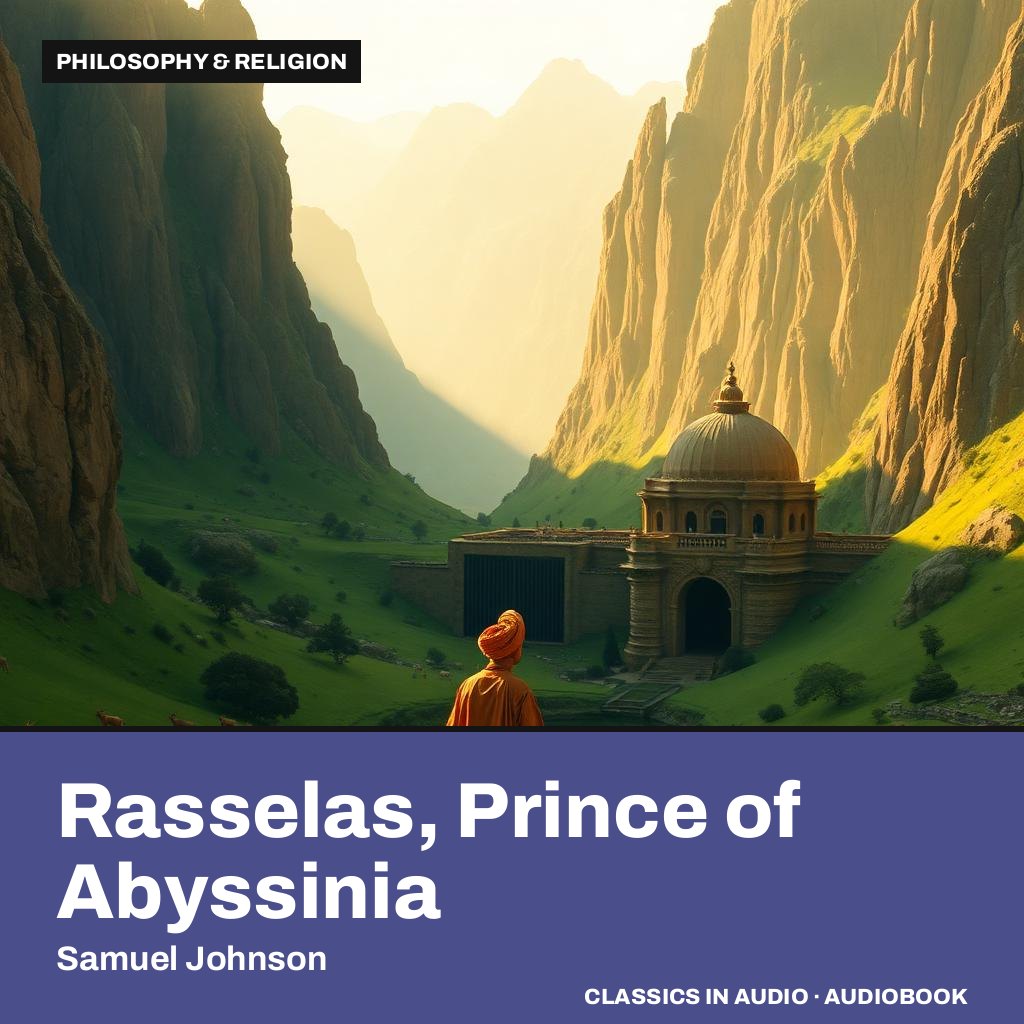
Rasselas, Prince of Abyssinia
by Samuel Johnson (1709–1784)
Unabridged audiobook · about 3 hr 35 min · English · read by a synthetic voice · MP3, no DRM
€3.90
Buy 2 audiobooks or more: −10%. Buy 5 or more: −20%.
Secure payment by Stripe. Your download link is e-mailed to you at once: the first 30 minutes are usually ready within a few minutes, and the rest follows while you listen. Listen online or download the MP3.
Samuel Johnson's short philosophical tale begins in the Happy Valley, a walled paradise in the mountains of Amhara where the sons and daughters of the Abyssinian emperor are kept in comfort until one of them is called to the throne. Rasselas, the fourth son, has every pleasure within reach and finds that none of them satisfies him. Restless and bored, he starts to wonder what a person could possibly want when nothing is lacking, and he resolves to find a way out and discover which kind of life is truly the best to choose.
What follows is a search conducted in conversation. Rasselas travels with his sister Nekayah and the poet-philosopher Imlac, and the party meets hermits, scholars, shepherds, courtiers and astronomers, each of whom has a theory about happiness and a flaw in it. Johnson wrote in the manner of an Eastern fable, setting it in Ethiopia, a country he had first read about when he translated a Portuguese missionary's account of Abyssinia as a young man.
Johnson, the great lexicographer, reportedly wrote the book in about a week, in the evenings of early 1759, to pay for his mother's funeral and her small debts. It is brief, dry-witted and humane, and its questions about ambition, wealth, solitude and contentment are as open now as they were then.
Text: Project Gutenberg edition no. 652, read without its licence notices.
More by Samuel Johnson
 Preface to ShakespeareSamuel Johnson2 hr 10 min€3.90
 A Journey to the Western Islands of ScotlandSamuel Johnson5 hr 20 min€4.90





