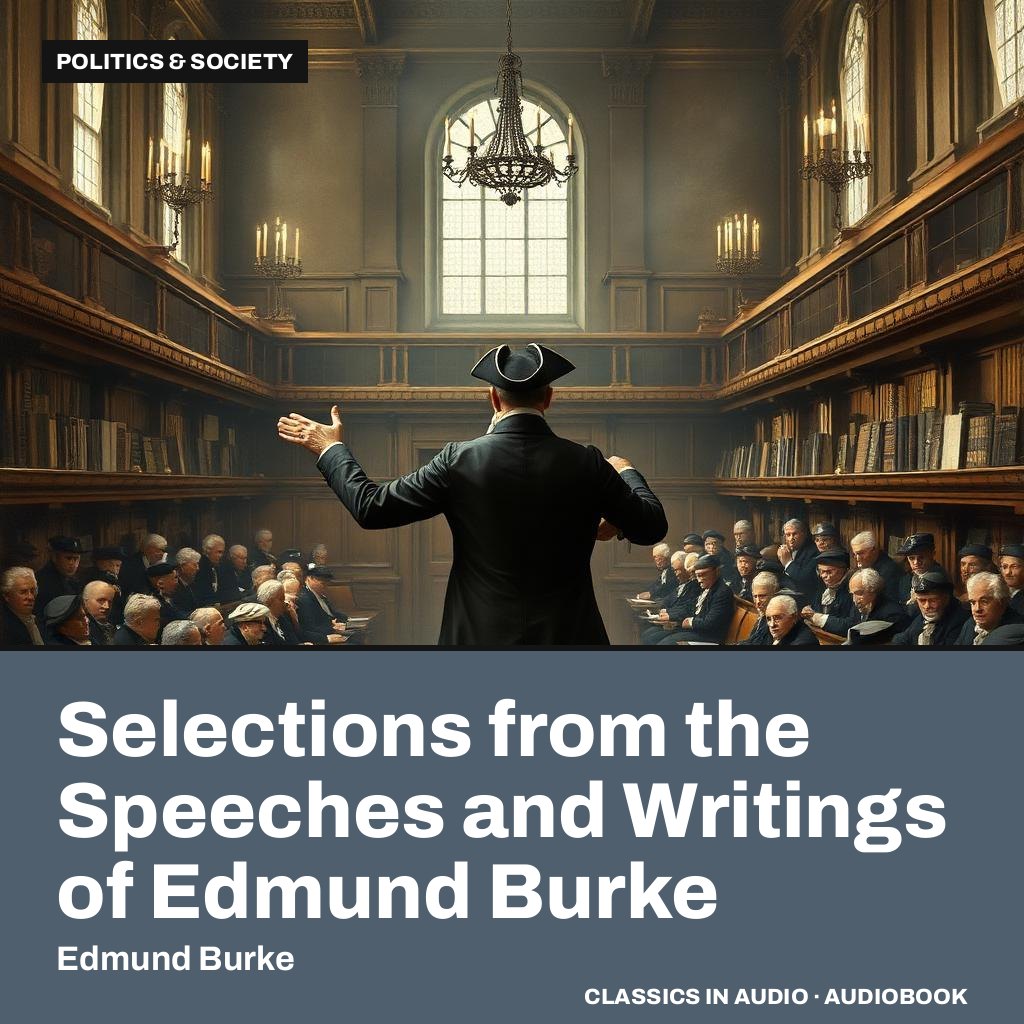
Selections from the Speeches and Writings of Edmund Burke
by Edmund Burke (1729–1797)
Unabridged audiobook · about 15 hr 35 min · English · read by a synthetic voice · MP3, no DRM
€6.90
Buy 2 audiobooks or more: −10%. Buy 5 or more: −20%.
Secure payment by Stripe. Your download link is e-mailed to you at once: the first 30 minutes are usually ready within a few minutes, and the rest follows while you listen. Listen online or download the MP3.
This is a collection of extracts from the speeches and writings of Edmund Burke, the Dublin-born statesman who sat in the British House of Commons for much of the later eighteenth century. It gathers passages on the great questions of his day: the quarrel with the American colonies, the government of India, and the upheaval in France. Alongside them runs his broader thinking about liberty, authority, tradition and the duties of those who govern.
Burke was educated at Trinity College, Dublin, and trained for the law at the Middle Temple, but made his name through writing and oratory. He sat for Bristol from 1774. The volume opens with a biographical introduction by an admiring editor, who follows him to his last years at Beaconsfield and quotes his letters on the illness and death of his son. Critical tributes, including some from political opponents, are promised at the close of that introduction.
Many of the arguments here shaped later debate about reform, empire and revolution, and the vocabulary of modern conservatism owes much to them. Burke is also vivid on the page, using sharp metaphor and moral urgency to press his case. Anyone curious about how political principles were argued in Georgian Britain will find plenty to weigh in these pages.
Text: Project Gutenberg edition no. 3286, read without its licence notices.
More by Edmund Burke
More politics & society
 The PrinceNiccolò Machiavelli4 hr 37 min€3.90
 LeviathanThomas Hobbes19 hr 44 min€6.90
 Second Treatise of GovernmentJohn Locke5 hr 07 min€4.90
 An Inquiry into the Nature and Causes of the Wealth of NationsAdam Smith36 hr 32 min€9.90
 The Eclipse of RussiaEmile Joseph Dillon14 hr 56 min€5.90
 Democracy—false or True?Sir William Blake Richmond5 hr 18 min€4.90