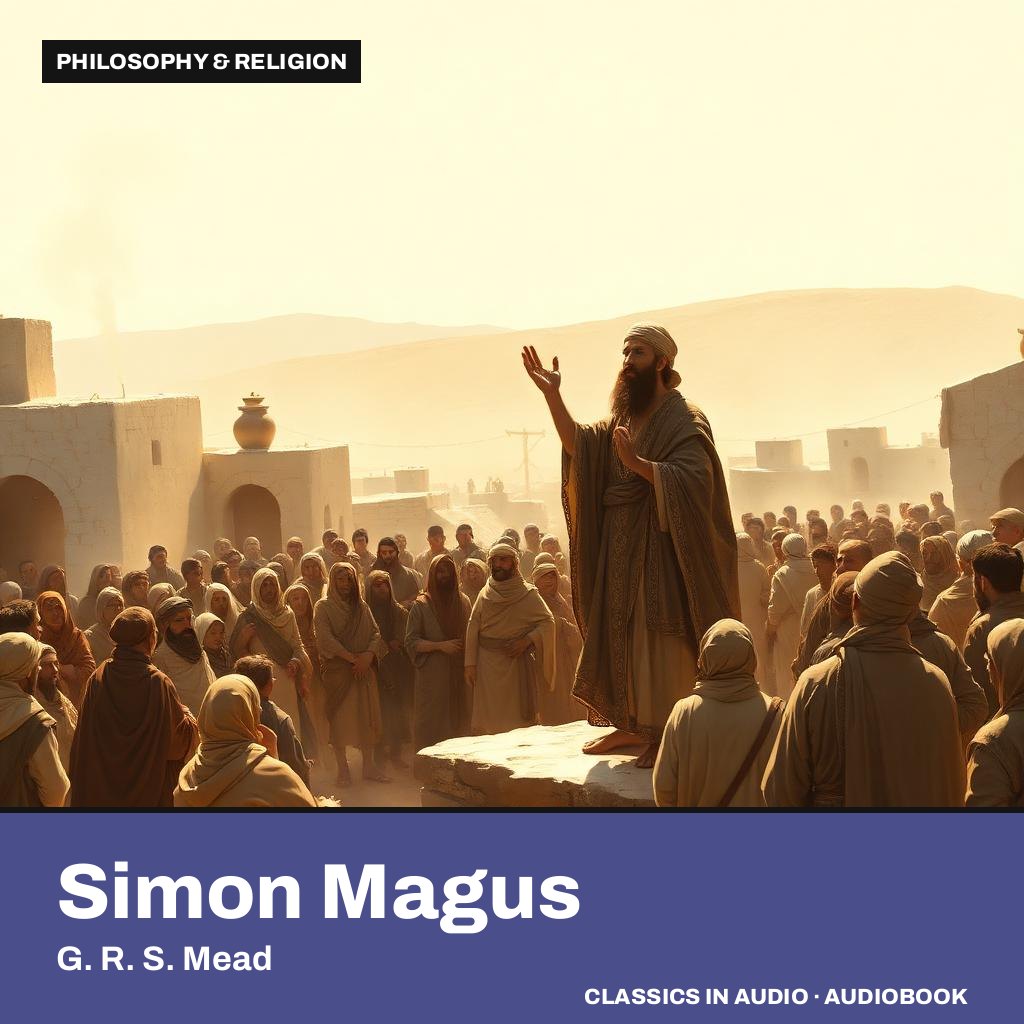
Simon Magus
An Essay on the Founder of Simonianism Based on the Ancient Sources With a Re-Evaluation of His Philosophy and Teachings
by G. R. S. Mead (1863–1933)
Unabridged audiobook · about 3 hr 15 min · English · read by a synthetic voice · MP3, no DRM
€3.90
Buy 2 audiobooks or more: −10%. Buy 5 or more: −20%.
Secure payment by Stripe. Your download link is e-mailed to you at once: the first 30 minutes are usually ready within a few minutes, and the rest follows while you listen. Listen online or download the MP3.
Simon Magus appears briefly in the Acts of the Apostles, a Samaritan sorcerer who astonishes the crowds until the apostles arrive and he tries to buy their power. Early Christian writers made him the arch-heretic and the supposed father of every later error. This essay, published in 1892, asks whether that reputation was deserved.
G. R. S. Mead, a London scholar and for years a private secretary to Helena Blavatsky, sets out the evidence before offering his own view. He lays out the sources in three groups: the New Testament passage, the accounts of Church fathers such as Justin, Irenaeus and Hippolytus, and the later legends of the Clementine writings, where Simon becomes Peter's rival. Mead gives the patristic texts in full translation, so the reader sees how the story of Simon grew and hardened over several centuries. He then sifts the hearsay from what may be reliable.
Mead's own conclusion is openly sympathetic. He argues that Simon taught a philosophy of the divine and the soul that deserves study, not condemnation. Readers may weigh that claim for themselves. Either way, the book is a close look at how a rival teacher in the first century was remembered, and how his enemies shaped what we know of him.
Text: Project Gutenberg edition no. 12892, read without its licence notices.
More by G. R. S. Mead
 The Gnostic CrucifixionG. R. S. Mead1 hr 05 min€3.90
 Apollonius of Tyana, the Philosopher-Reformer of the First Century A.DG. R. S. Mead3 hr 24 min€3.90





