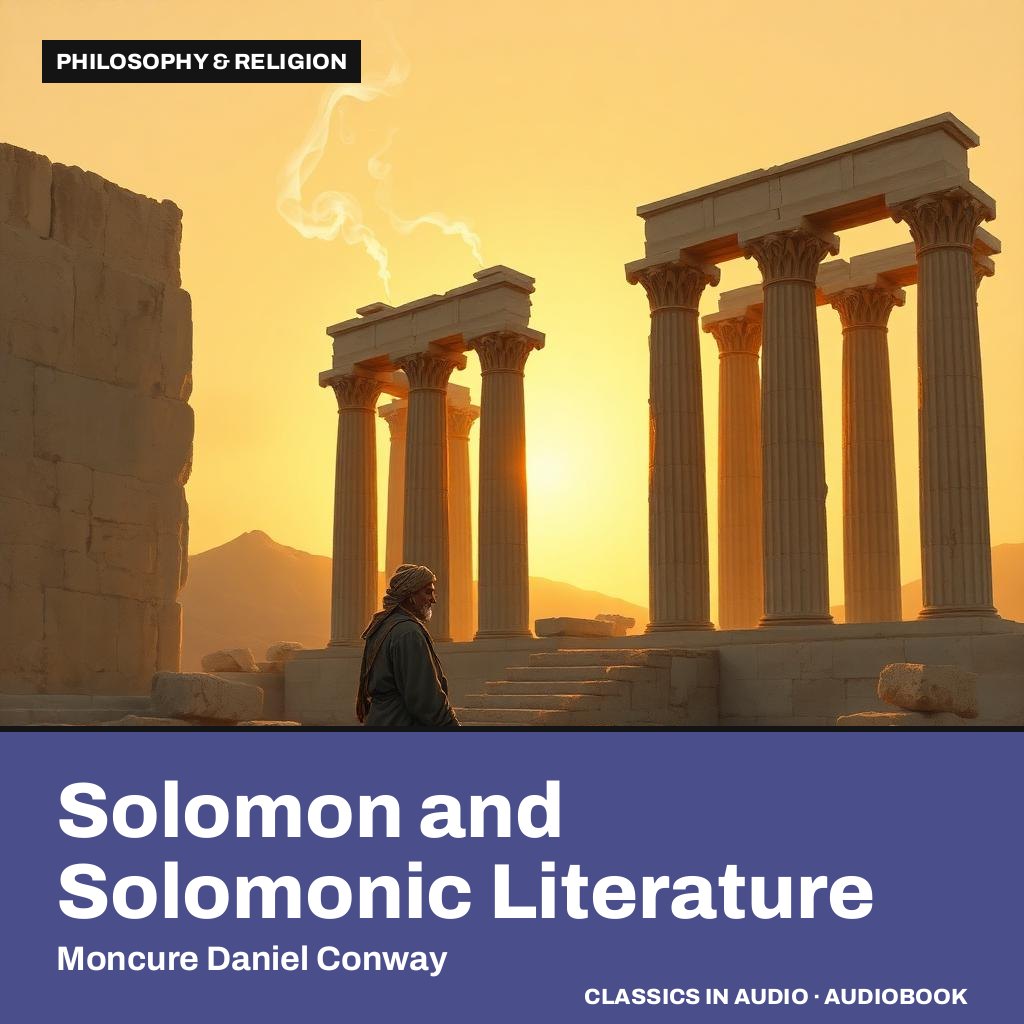
Solomon and Solomonic Literature
by Moncure Daniel Conway (1832–1907)
Unabridged audiobook · about 6 hr 44 min · English · read by a synthetic voice · MP3, no DRM
€4.90
Buy 2 audiobooks or more: −10%. Buy 5 or more: −20%.
Secure payment by Stripe. Your download link is e-mailed to you at once: the first 30 minutes are usually ready within a few minutes, and the rest follows while you listen. Listen online or download the MP3.
Moncure Daniel Conway's study follows King Solomon from the Hebrew Bible into the stories told about him across Palestine, Arabia, Persia, Abyssinia, India and Europe. Conway treats the Wisest Man as a figure whose legend grew far beyond the biblical record: the master of demons through a magic ring, the ancestor of Ethiopian emperors, the supposed author of Proverbs, the Song of Songs and Ecclesiastes.
The book is literary criticism and comparative folklore rather than devotion or polemic. Conway asks how a king whose own scriptures turn against him for his foreign wives and idolatries could still be credited with divine wisdom, and how that wisdom came to be detached from him and personified as something separate. He follows two lines of tradition, one from the wisdom books and one from the law books, through their collisions and their convergence, and carries them forward into early Christian ideas about Jesus.
Conway was an American-born minister and freethinker who spent much of his later career in London, and he writes with a clear, argumentative energy. The book suits listeners curious about how legends form, why a few proverbs still shape the way people think about wisdom, discipline and pleasure, and how one ancient name can serve both the sage and the sorcerer.
Text: Project Gutenberg edition no. 41115, read without its licence notices.
More by Moncure Daniel Conway
 Demonology and Devil-loreMoncure Daniel Conway25 hr 19 min€7.90
 Travels in South KensingtonMoncure Daniel Conway6 hr 34 min€4.90





