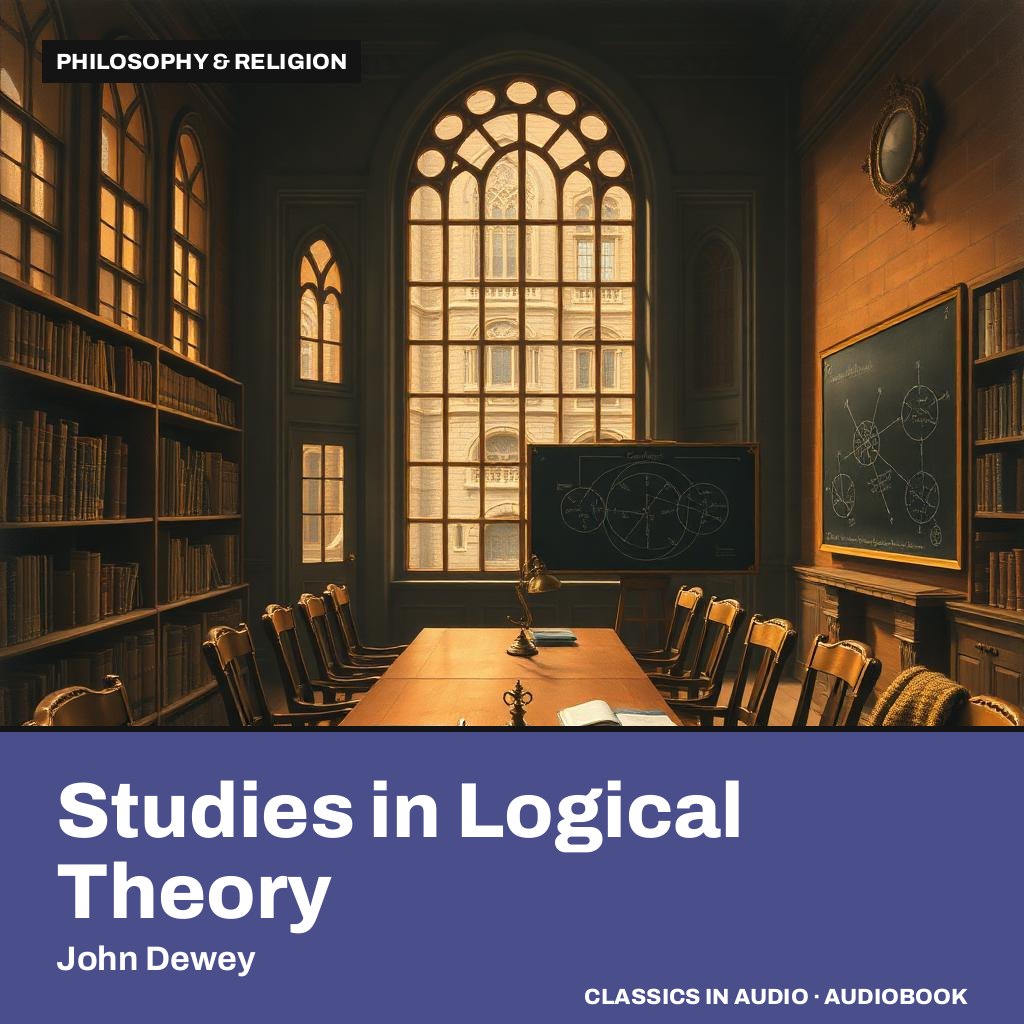
Studies in Logical Theory
by John Dewey (1859–1952)
Unabridged audiobook · about 13 hr 09 min · English · read by a synthetic voice · MP3, no DRM
€5.90
Buy 2 audiobooks or more: −10%. Buy 5 or more: −20%.
Secure payment by Stripe. Your download link is e-mailed to you at once: the first 30 minutes are usually ready within a few minutes, and the rest follows while you listen. Listen online or download the MP3.
Studies in Logical Theory is a volume of essays on a deceptively simple question: what is thinking for, and where does it come from? It appeared in 1903 from the University of Chicago, where John Dewey led a circle of younger philosophers and psychologists. Dewey himself wrote the first four studies. The rest come from colleagues and students, including studies of Bosanquet's theory of judgment, the nature of hypothesis, the place of images and ideas in logic, the reasoning of the pre-Socratic philosophers, valuation, and purpose.
The shared position is that thought is not a closed machine for producing truths. Reflection, Dewey argues, comes after something and for the sake of something: it arises when ordinary experience runs into trouble, and it exists to repair and extend that experience. Judgment is treated as the central act of knowing, tied closely to feeling, appreciation and practical action. The authors argue against Mill, Lotze, Bosanquet and Bradley, and they acknowledge a deep debt to William James.
This is a book from the early days of American pragmatism, written when logic, psychology and the philosophy of science were being rethought together. Anyone curious about how we reason, and why, will find the starting point of a school of thought that still shapes education and the philosophy of inquiry.
Text: Project Gutenberg edition no. 40665, read without its licence notices.
More by John Dewey
 How We ThinkJohn Dewey6 hr 18 min€4.90
 Human Nature and ConductJohn Dewey8 hr 24 min€4.90
 Leibniz's New Essays Concerning the Human UnderstandingJohn Dewey6 hr 44 min€4.90
 The Public and Its ProblemsJohn Dewey5 hr 31 min€4.90
 Moral Principles in EducationJohn Dewey1 hr 04 min€3.90
 Reconstruction in PhilosophyJohn Dewey5 hr 12 min€4.90





