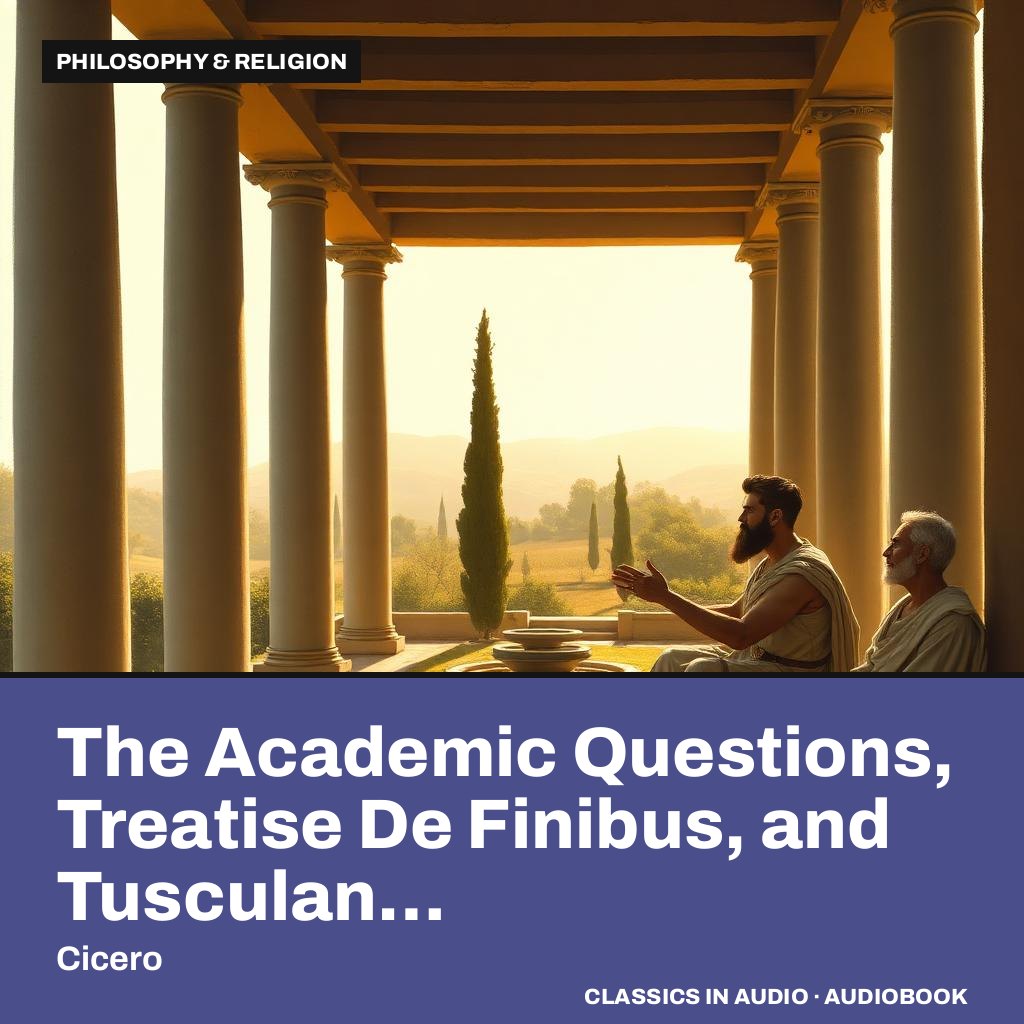
The Academic Questions, Treatise De Finibus, and Tusculan Disputations, of M.T. Cicero
With a Sketch of the Greek Philosophers Mentioned by Cicero
by Cicero (106 BC–43 BC)
Unabridged audiobook · about 19 hr 00 min · English · read by a synthetic voice · MP3, no DRM
€6.90
Buy 2 audiobooks or more: −10%. Buy 5 or more: −20%.
Secure payment by Stripe. Your download link is e-mailed to you at once: the first 30 minutes are usually ready within a few minutes, and the rest follows while you listen. Listen online or download the MP3.
This volume gathers three of Cicero's philosophical works in the English translation of Charles Duke Yonge. The Academic Questions asks whether anything can be known for certain, and sets the sceptical Academy against the Stoics. De Finibus, on the ends of good and evil, has speakers argue in turn for the Epicurean, Stoic and Academic answers to the question of what makes a life worth living. The Tusculan Disputations take up five matters in a country-house setting: the fear of death, the endurance of pain, grief, the disorders of the mind, and whether virtue alone is enough for happiness.
Cicero wrote these dialogues in the last years of his life, between 45 and 44 BC, when the Roman Republic was collapsing around him and public life had been closed to him by Caesar's dictatorship. He was a lawyer and statesman, and he set out to present Greek thought to Latin readers, often in arguments with a clear opponent on each side. Readers still quote his reasoning on grief and mortality.
This edition also includes a short sketch of the Greek thinkers Cicero names, from Thales of Miletus, who held that water underlies all things, to Anaxagoras, who looked to mind as the force that ordered the world. It is a useful companion to the arguments that follow.
Text: Project Gutenberg edition no. 29247, read without its licence notices.
More by Cicero
 Cicero's Tusculan DisputationsCicero16 hr 47 min€6.90
 Treatises on Friendship and Old AgeCicero2 hr 43 min€3.90
 The Republic of CiceroCicero3 hr 14 min€3.90
 De Amicitia, Scipio's DreamCicero2 hr 02 min€3.90
 Letters of Marcus Tullius CiceroCicero3 hr 53 min€3.90





