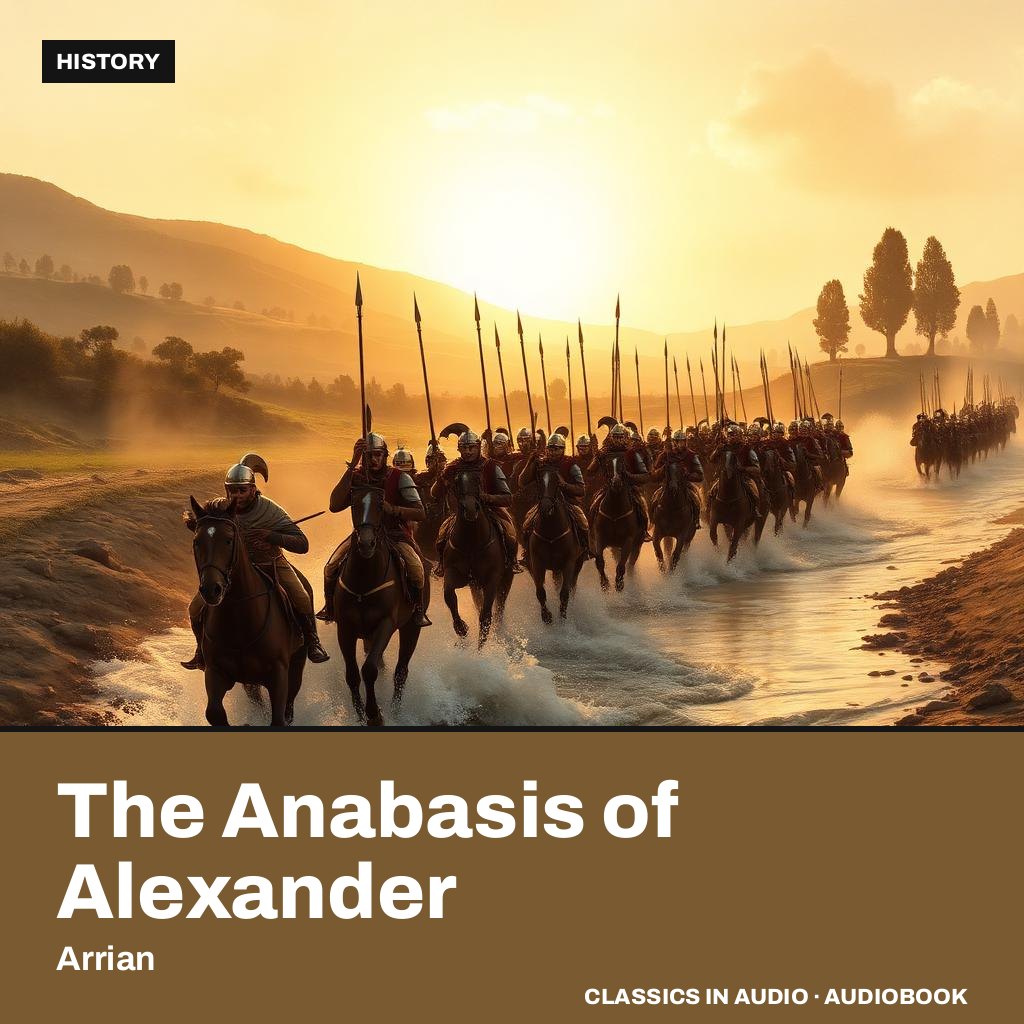
The Anabasis of Alexander
Or, The History of the Wars and Conquests of Alexander the Great
by Arrian (85–175)
Unabridged audiobook · about 13 hr 55 min · English · read by a synthetic voice · MP3, no DRM
€5.90
Buy 2 audiobooks or more: −10%. Buy 5 or more: −20%.
Secure payment by Stripe. Your download link is e-mailed to you at once: the first 30 minutes are usually ready within a few minutes, and the rest follows while you listen. Listen online or download the MP3.
Arrian's Anabasis is the fullest surviving ancient account of the campaigns of Alexander the Great, from his accession in 336 B.C. after the murder of his father Philip to the conquest of the Persian empire and the march into India. It begins in the Balkans, with fighting against Thracians, Triballians and the tribes along the Danube, and the brutal destruction of rebellious Thebes. It then follows the Macedonian army across the Hellespont into Asia, through the battles at the Granicus, Issus and Gaugamela (which Arrian calls Arbela), and the sieges of Miletus, Halicarnassus, Tyre and Gaza.
Arrian was a Greek from Bithynia who became a Roman senator and governor of Cappadocia, and he had commanded troops himself. He wrote in the second century A.D., about four hundred years after Alexander died, and built his narrative chiefly on the lost memoirs of two officers who marched with the king, Ptolemy and Aristobulus. The result is a sober, soldierly history, attentive to marches, formations, terrain and the decisions of commanders, and willing to weigh conflicting reports.
This translation is by E. J. Chinnock, a schoolmaster in Dumfries, who kept close to the Greek and added notes drawing on Plutarch, Diodorus, Curtius and others. For anyone curious about how ancient armies fought and how a conqueror was judged by a near-contemporary, it remains a direct and clear source.
Text: Project Gutenberg edition no. 46976, read without its licence notices.
More history
 The Dogaressas of Venice (the Wives of the Doges)Edgcumbe Staley9 hr 17 min€4.90
 Miniatures of French HistoryHilaire Belloc5 hr 44 min€4.90
 The Catholic Church and HistoryHilaire Belloc2 hr 16 min€3.90
 The History of the Peloponnesian WarThucydides18 hr 37 min€6.90
 AnabasisXenophon8 hr 32 min€4.90
 The Part Borne by the Dutch in the Discovery of Australia 1606-1765Jan Ernst Heeres5 hr 59 min€4.90