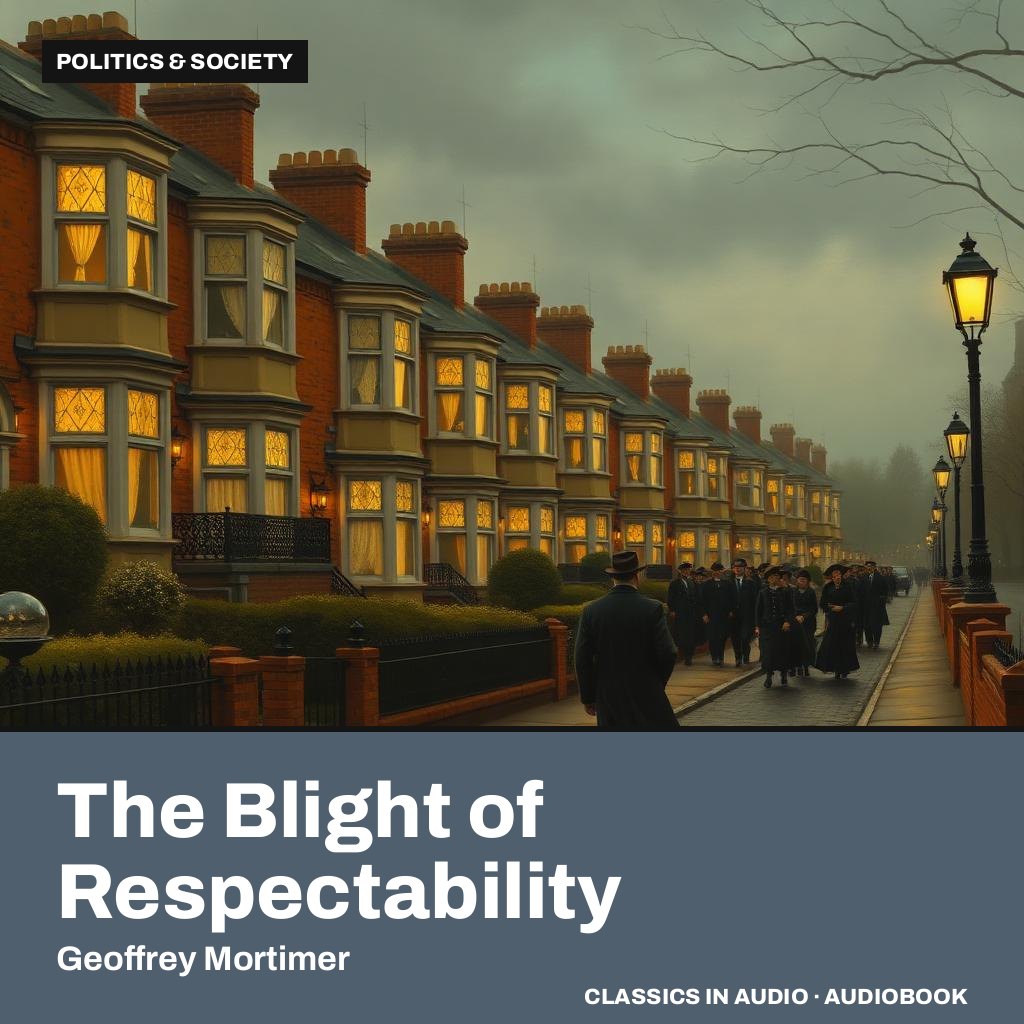
The Blight of Respectability
An Anatomy of the Disease and a Theory of Curative Treatment
by Geoffrey Mortimer (1861–1946)
Unabridged audiobook · about 2 hr 32 min · English · read by a synthetic voice · MP3, no DRM
€3.90
Buy 2 audiobooks or more: −10%. Buy 5 or more: −20%.
Secure payment by Stripe. Your download link is e-mailed to you at once: the first 30 minutes are usually ready within a few minutes, and the rest follows while you listen. Listen online or download the MP3.
Geoffrey Mortimer's The Blight of Respectability is a polemical essay that treats a social habit as if it were an illness, with a diagnosis first and a proposed cure after. His target is the genteel English middle class of the late Victorian and Edwardian years: the families in identical suburban streets, the churchgoers who dress and think alike, and the households that spend their energy keeping up appearances before the neighbours.
Mortimer writes with open scorn. He argues that conformity slows moral, intellectual and artistic progress, and that people who dread being thought eccentric end up as nobodies. He calls on John Stuart Mill and Schopenhauer to support the point that a person's worth does not depend on what others say. He also invokes Dickens's Podsnap and the Veneerings as portraits of the type. Along the way he takes up the case of Charles Bradlaugh, the freethinking politician whose treatment he sees as a sign of the disease at work.
Mortimer, born in 1861, was an English writer on ethics and social questions. His book is a period piece, and it is also a useful one. It shows what a reforming critic of the 1890s found stifling about suburban life, and it raises a question that still applies: how much of our conduct do we choose, and how much do we copy?
Text: Project Gutenberg edition no. 49263, read without its licence notices.
More politics & society
 The PrinceNiccolò Machiavelli4 hr 37 min€3.90
 LeviathanThomas Hobbes19 hr 44 min€6.90
 Second Treatise of GovernmentJohn Locke5 hr 07 min€4.90
 An Inquiry into the Nature and Causes of the Wealth of NationsAdam Smith36 hr 32 min€9.90
 The Eclipse of RussiaEmile Joseph Dillon14 hr 56 min€5.90
 Democracy—false or True?Sir William Blake Richmond5 hr 18 min€4.90