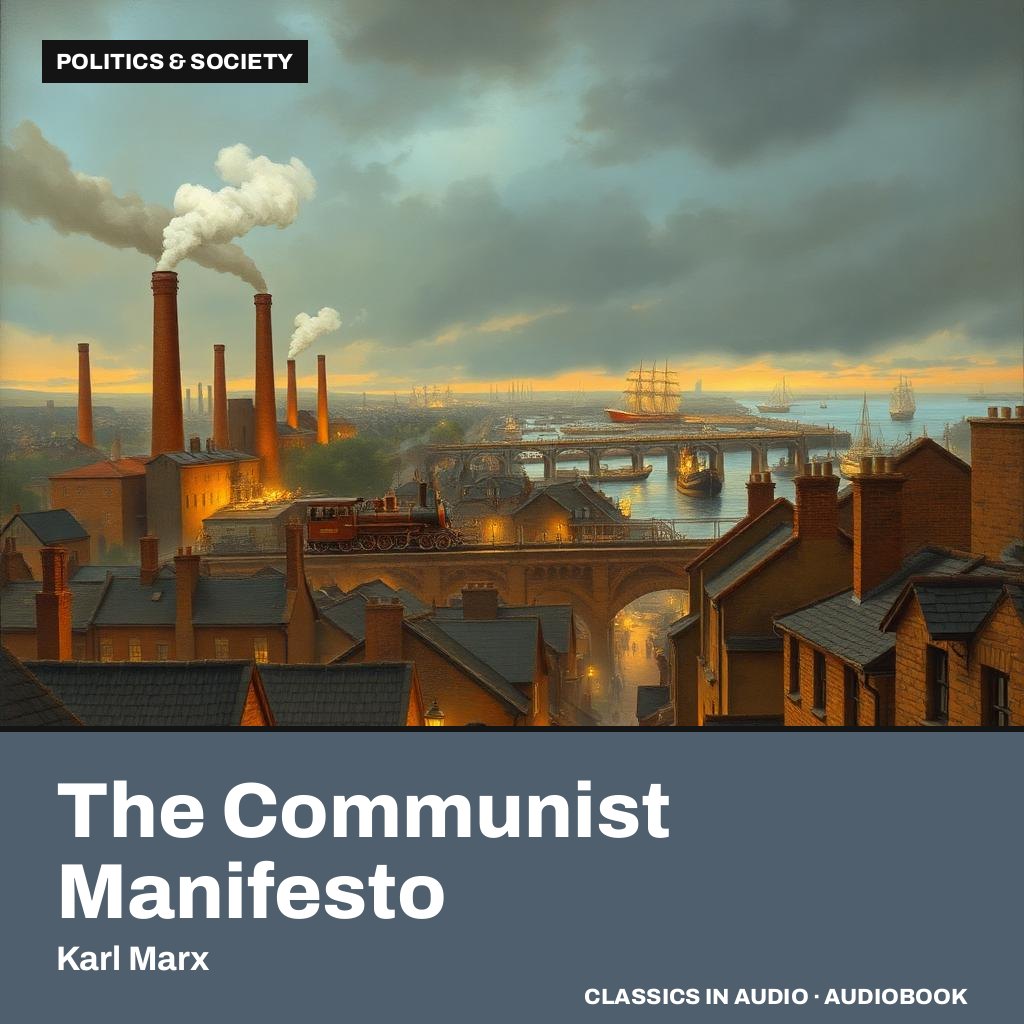
The Communist Manifesto
by Karl Marx (1818–1883)
Unabridged audiobook · about 1 hr 26 min · English · read by a synthetic voice · MP3, no DRM
€3.90
Buy 2 audiobooks or more: −10%. Buy 5 or more: −20%.
Secure payment by Stripe. Your download link is e-mailed to you at once: the first 30 minutes are usually ready within a few minutes, and the rest follows while you listen. Listen online or download the MP3.
The Communist Manifesto is a short political pamphlet, written in German by Karl Marx and Friedrich Engels and first published in London in February 1848, on the eve of the revolutions that swept across Europe that year. It was drafted for the Communist League, a small association of workers and exiles, and it sets out in a few thousand words what the group stood for and against.
The opening section sketches history as a long contest between classes: freeman and slave, lord and serf, guild-master and journeyman. It then turns to the middle class of its own day, the bourgeoisie, tracing its rise from medieval towns through the voyages of discovery, the workshop, the steam engine and the railway. The authors credit this class with astonishing energy, while arguing that it has dissolved older loyalties into cash payment and created, in the factory worker, a force that will challenge it. Later sections discuss the aims of the Communists and criticise rival socialist schools.
Marx, a philosopher and journalist from Trier, wrote most of the final text; Engels, the son of a Manchester mill owner, contributed ideas and a draft in question-and-answer form. Whatever one makes of its conclusions, the pamphlet remains a sharp, argumentative text that shaped a century of politics and is still quoted in debates about work, wealth and markets.
Text: Project Gutenberg edition no. 61, read without its licence notices.
More by Karl Marx
 Manifesto of the Communist PartyKarl Marx1 hr 25 min€3.90
 The Eighteenth Brumaire of Louis BonaparteKarl Marx4 hr 07 min€3.90
 Secret Diplomatic History of The Eighteenth CenturyKarl Marx3 hr 10 min€3.90
More politics & society
 The PrinceNiccolò Machiavelli4 hr 37 min€3.90
 LeviathanThomas Hobbes19 hr 44 min€6.90
 Second Treatise of GovernmentJohn Locke5 hr 07 min€4.90
 An Inquiry into the Nature and Causes of the Wealth of NationsAdam Smith36 hr 32 min€9.90
 The Eclipse of RussiaEmile Joseph Dillon14 hr 56 min€5.90
 Democracy—false or True?Sir William Blake Richmond5 hr 18 min€4.90