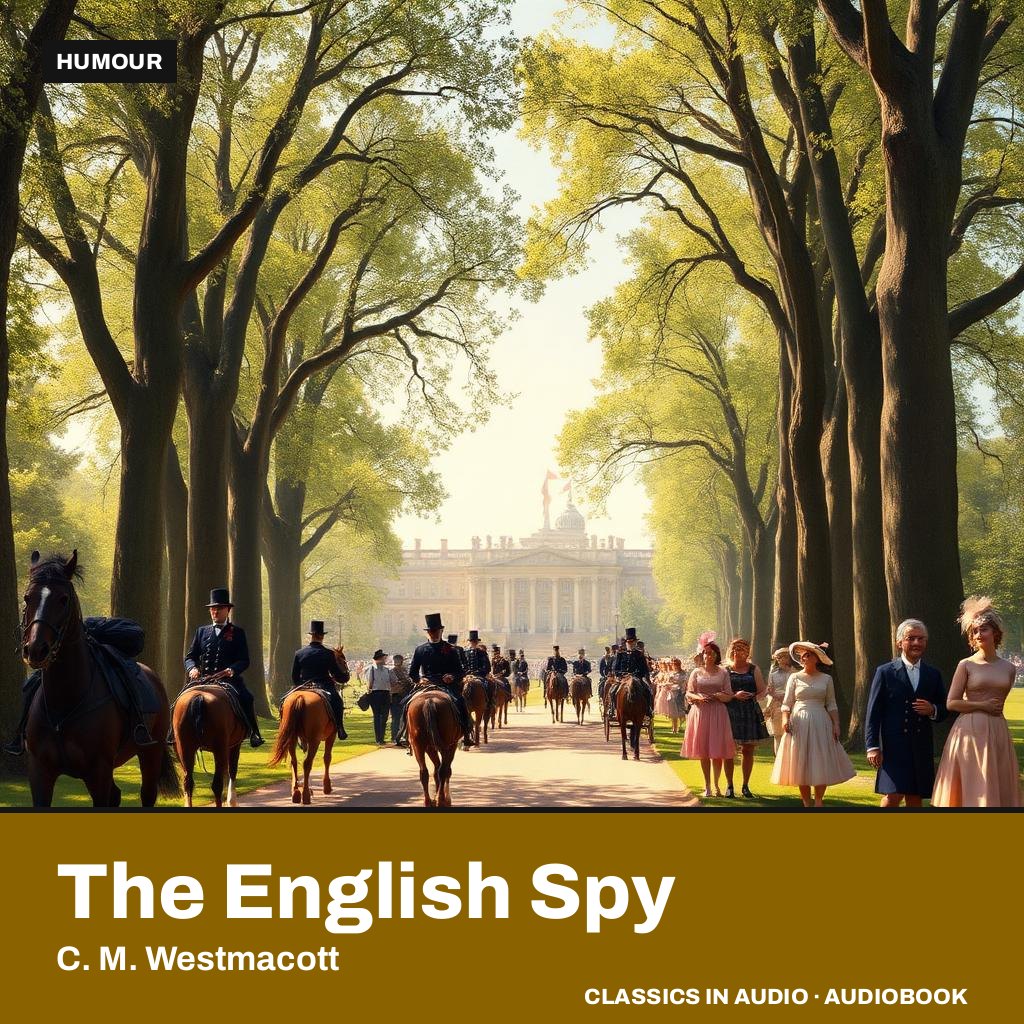
The English Spy
An Original Work Characteristic, Satirical, and Humorous. Comprising Scenes and Sketches in Every Rank of Society, Being Portraits Drawn from the Life
by C. M. Westmacott (1787–1868)
Unabridged audiobook · about 20 hr 37 min · English · read by a synthetic voice · MP3, no DRM
€7.90
Buy 2 audiobooks or more: −10%. Buy 5 or more: −20%.
Secure payment by Stripe. Your download link is e-mailed to you at once: the first 30 minutes are usually ready within a few minutes, and the rest follows while you listen. Listen online or download the MP3.
Published in 1825 under the pen name Bernard Blackmantle, The English Spy is a satirical sketchbook of Regency society, written in the spirit of Pierce Egan's Life in London. Its narrator is a young man who moves from Eton to Oxford and then into the fashionable haunts of the capital, and he records what he sees with a mocking eye. The preface that opens the book is a taste of the tone: the author goads the critics and invites their abuse, and he refuses to correct his own errors.
The contents list gives a sense of the ground covered. There are Eton's collegers and oppidans, the Montem procession and Election Saturday, then the freshman's arrival at Oxford, matriculation, Christ Church, smuggled dinners and the college servant known as the scout. The scene then shifts to Hyde Park on a Sunday afternoon, the opera and Fop's Alley, where dandies, belles and fallen stars are all sketched. Many of the figures were thinly disguised real people, which added to the book's sting.
The real author was Charles Molloy Westmacott, a journalist and editor, and the book was first issued with hand-coloured plates by Robert Cruikshank. Today it is a lively, gossipy record of school and university customs and of Georgian London manners.
Text: Project Gutenberg edition no. 20001, read without its licence notices.
More humour
 The Expedition of Humphry ClinkerTobias Smollett13 hr 55 min€5.90
 CandideVoltaire3 hr 16 min€3.90
 Love and Freindship [sic]Jane Austen3 hr 14 min€3.90
 Northanger AbbeyJane Austen7 hr 05 min€4.90
 A Pickle for the Knowing OnesTimothy Dexter1 hr 23 min€3.90
 The Pickwick PapersCharles Dickens28 hr 38 min€7.90