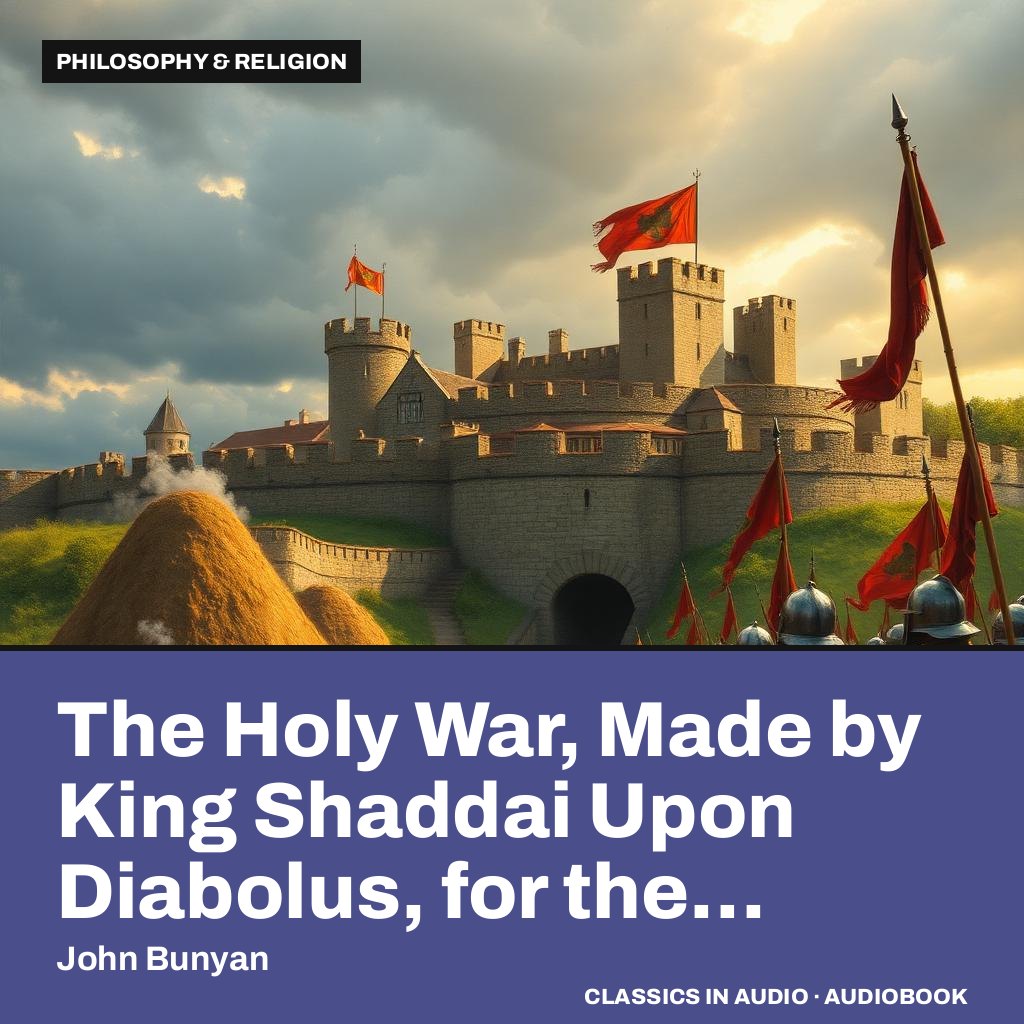
The Holy War, Made by King Shaddai Upon Diabolus, for the Regaining of the Metropolis of the World
Or, The Losing and Taking Again of the Town of Mansoul
by John Bunyan (1628–1688)
Unabridged audiobook · about 8 hr 52 min · English · read by a synthetic voice · MP3, no DRM
€4.90
Buy 2 audiobooks or more: −10%. Buy 5 or more: −20%.
Secure payment by Stripe. Your download link is e-mailed to you at once: the first 30 minutes are usually ready within a few minutes, and the rest follows while you listen. Listen online or download the MP3.
The Holy War is an allegorical novel in which a whole human being is imagined as a walled town. Mansoul is a fair city built by the great king Shaddai, with gates for each of the senses, a castle at its heart, and a company of loyal officers. Then the schemer Diabolus lays siege, wins over the townsfolk with flattery and lies, and takes the place for himself. Shaddai's son Emmanuel marches to win it back, and the story follows assaults, treacheries, truces and reversals, with Mansoul losing its freedom more than once.
John Bunyan, a tinker's son from Bedfordshire who spent years in prison for preaching without a licence, published it in 1682, four years after the first part of The Pilgrim's Progress. Where that book sends a lone traveller down a road, this one stays within the walls and reads like a chronicle of a seventeenth-century war. Bunyan had seen the Civil War's soldiers and councils, and it shows in the earthworks, battering-rams, trumpets and town offices he describes.
It is worth hearing today as a vivid piece of plain, muscular English prose, and as a study of how a community, or a mind, can be talked into surrendering itself.
Text: Project Gutenberg edition no. 395, read without its licence notices.
More by John Bunyan
 The Pilgrim's Progress from This World to That Which Is to ComeJohn Bunyan4 hr 59 min€3.90
 The Pilgrim's Progress by John Bunyan Every Child Can ReadJohn Bunyan8 hr 35 min€4.90
 Grace Abounding to the Chief of SinnersJohn Bunyan5 hr 00 min€3.90
 Life and Death of Mr. BadmanJohn Bunyan6 hr 43 min€4.90
 The Pilgrim's Progress in Words of One SyllableJohn Bunyan2 hr 08 min€3.90
 The Jerusalem Sinner SavedJohn Bunyan3 hr 06 min€3.90





