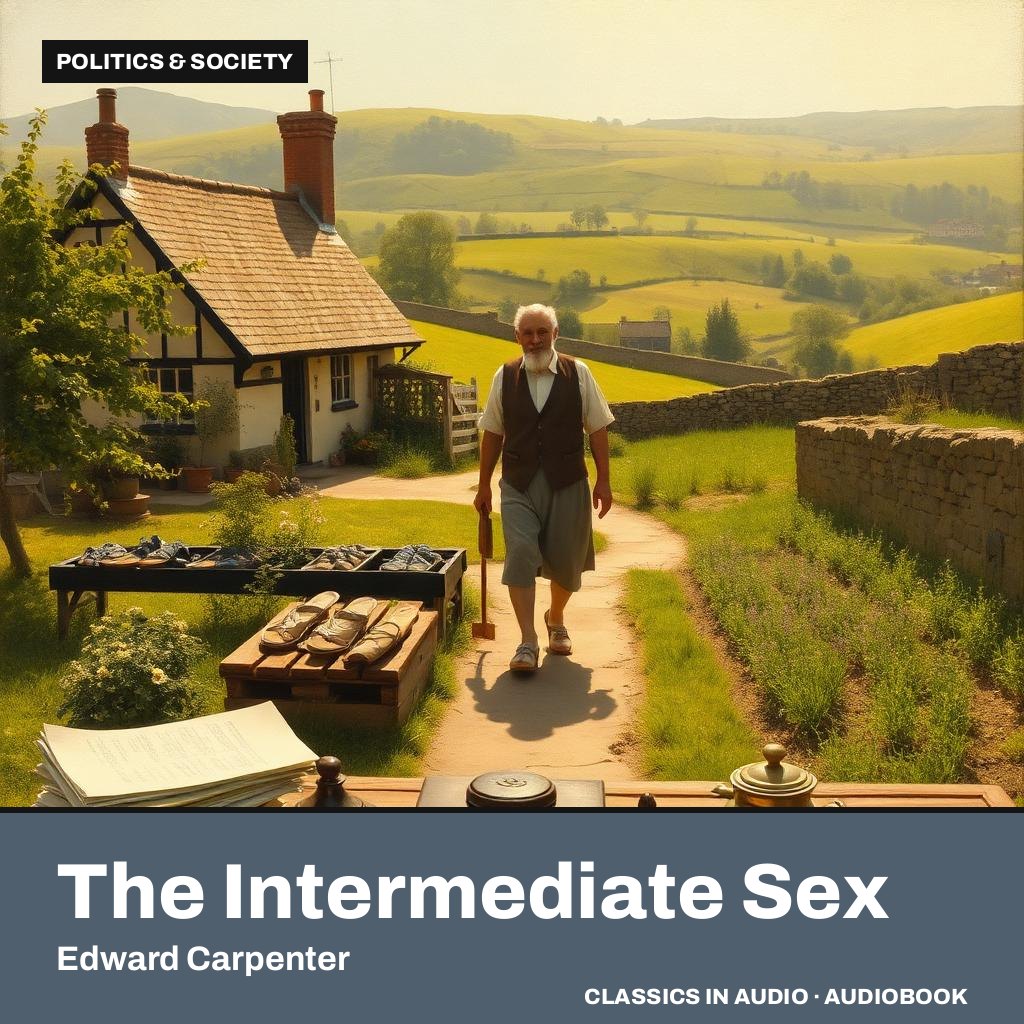
The Intermediate Sex
A Study of Some Transitional Types of Men and Women
by Edward Carpenter (1844–1929)
Unabridged audiobook · about 3 hr 26 min · English · read by a synthetic voice · MP3, no DRM
€3.90
Buy 2 audiobooks or more: −10%. Buy 5 or more: −20%.
Secure payment by Stripe. Your download link is e-mailed to you at once: the first 30 minutes are usually ready within a few minutes, and the rest follows while you listen. Listen online or download the MP3.
The Intermediate Sex is a collection of essays on people whose temperament does not sit neatly on one side of the line between masculine and feminine. First gathered in 1908, the book looks at what Edward Carpenter calls intermediate types, men and women whose inner lives blend qualities usually assigned to the opposite sex, and at the attachments between people of the same sex that often go with them. Its chapters move from a general introduction to the title essay, then to friendship and love between men, to the place of affection in schools, and finally to the position of the Uranian in society. An appendix of quotations from other writers of the day follows.
Carpenter wrote in Edwardian England, when such subjects were rarely discussed in print and could bring ruin or prison. His tone is calm and observational. He refuses to call these people simply good or simply bad, and he asks teachers, doctors, parents and magistrates to look at the facts before judging. Carpenter was a poet, socialist and early campaigner for homosexual rights, and he lived openly with his male partner in the Derbyshire countryside. Today the book is worth hearing as a historical document, showing how an early advocate argued his case, and how much of the debate remains familiar.
Text: Project Gutenberg edition no. 53763, read without its licence notices.
More by Edward Carpenter
 Pagan and Christian CreedsEdward Carpenter9 hr 26 min€4.90
 CivilisationEdward Carpenter7 hr 16 min€4.90
 The Drama of Love and DeathEdward Carpenter6 hr 53 min€4.90
 Marriage in Free SocietyEdward Carpenter1 hr 00 min€3.90
More politics & society
 The PrinceNiccolò Machiavelli4 hr 37 min€3.90
 LeviathanThomas Hobbes19 hr 44 min€6.90
 Second Treatise of GovernmentJohn Locke5 hr 07 min€4.90
 An Inquiry into the Nature and Causes of the Wealth of NationsAdam Smith36 hr 32 min€9.90
 The Eclipse of RussiaEmile Joseph Dillon14 hr 56 min€5.90
 Democracy—false or True?Sir William Blake Richmond5 hr 18 min€4.90