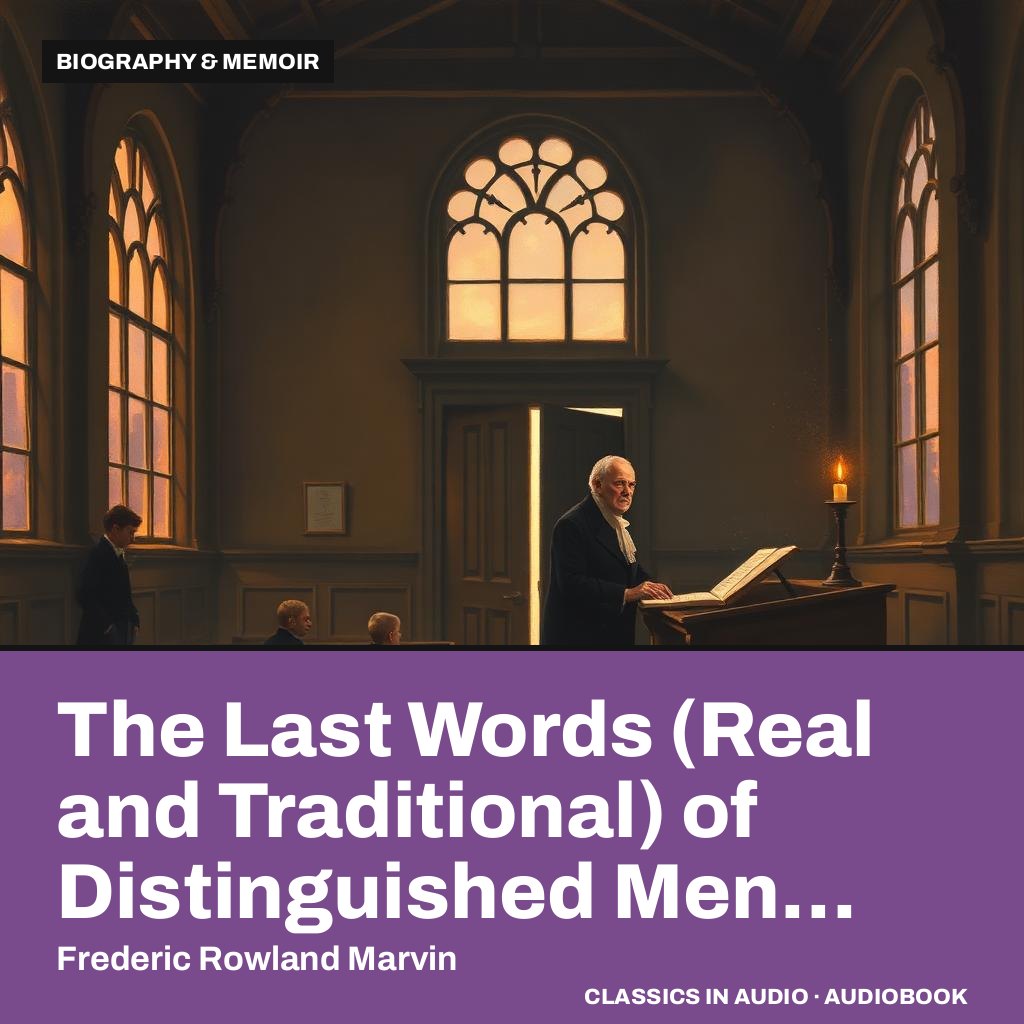
The Last Words (Real and Traditional) of Distinguished Men and Women
by Frederic Rowland Marvin (1847–1918)
Unabridged audiobook · about 7 hr 46 min · English · read by a synthetic voice · MP3, no DRM
€4.90
Buy 2 audiobooks or more: −10%. Buy 5 or more: −20%.
Secure payment by Stripe. Your download link is e-mailed to you at once: the first 30 minutes are usually ready within a few minutes, and the rest follows while you listen. Listen online or download the MP3.
This is a reference collection of final utterances, arranged alphabetically by the name of the speaker. Each entry gives the person's dates and a line or two of identification, then the words attributed to them, and often a short note on how reliable the report is. The company is wide: a Roman emperor, a Cordovan caliph, two American presidents, an essayist, and a schoolmaster in Edinburgh who dismissed his class with the words "It grows dark, boys. You may go."
The compiler, Frederic Rowland Marvin, was a clergyman and author in late nineteenth-century America, and he is careful with his sources. He marks which sayings are real and which are only traditional. The caliph Abd-er-Rahman III is said to have counted just fourteen happy days in fifty years of rule, yet Marvin states plainly that the remark is traditional. The entry on Hadrian goes further, setting his address to his own soul beside several English translations and a fragment of a letter recovered from Egypt.
The entries are brief, so the book suits dipping in. It opens with Montaigne's thought that learning how people die may teach us how to live, and the pages that follow bear that out in many small scenes.
Text: Project Gutenberg edition no. 38940, read without its licence notices.
More biography & memoir
 Narrative of the Life of Frederick Douglass, an American SlaveFrederick Douglass3 hr 41 min€3.90
 The Confessions of St. AugustineAugustine of Hippo9 hr 54 min€4.90
 Præraphaelite Diaries and LettersFord Madox Brown6 hr 54 min€4.90
 Things Near & FarArthur Machen4 hr 23 min€3.90
 The Story of NelsonEdmund Francis Sellar1 hr 58 min€3.90
 Narrative of the Captivity and Restoration of Mrs. Mary RowlandsonMary Rowlandson1 hr 56 min€3.90