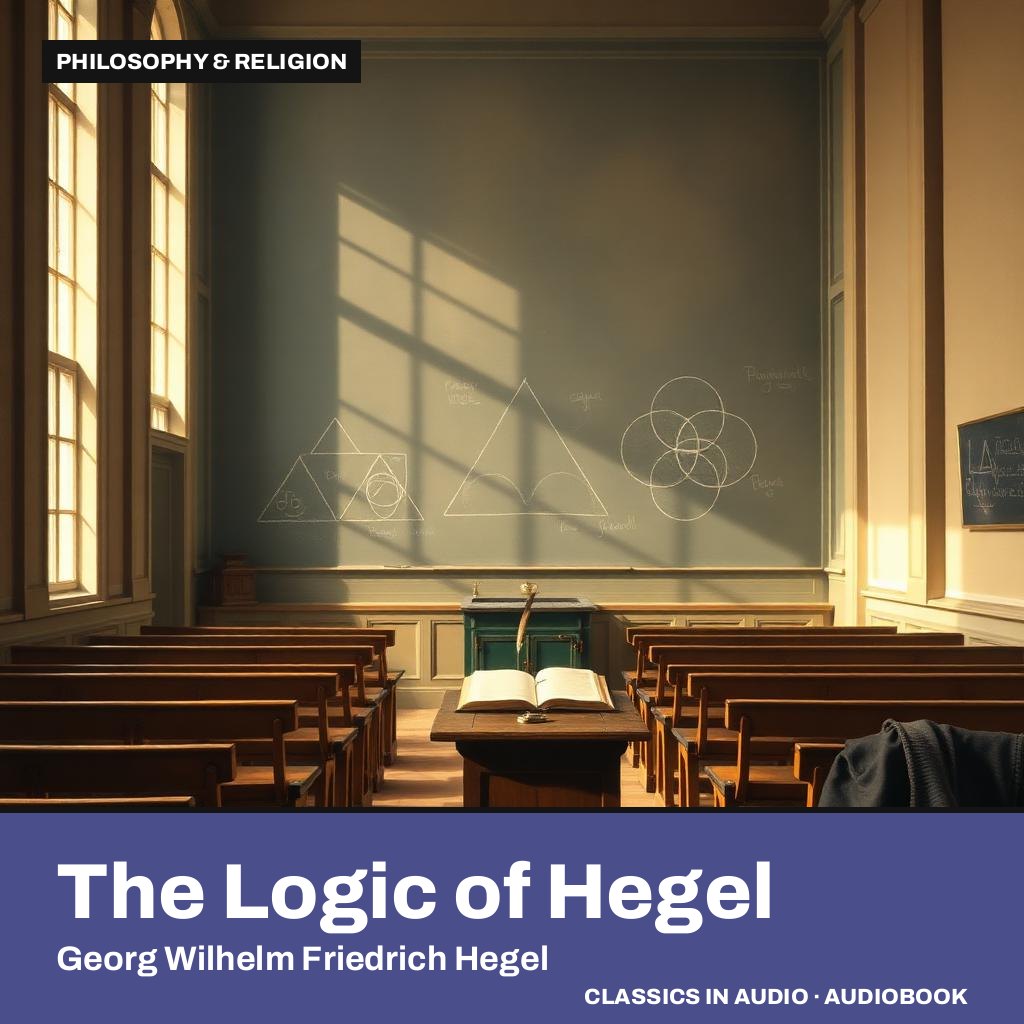
The Logic of Hegel
by Georg Wilhelm Friedrich Hegel (1770–1831)
Unabridged audiobook · about 14 hr 46 min · English · read by a synthetic voice · MP3, no DRM
€5.90
Buy 2 audiobooks or more: −10%. Buy 5 or more: −20%.
Secure payment by Stripe. Your download link is e-mailed to you at once: the first 30 minutes are usually ready within a few minutes, and the rest follows while you listen. Listen online or download the MP3.
This is the first part of Hegel's Encyclopaedia of the Philosophical Sciences, the compact summary of his whole system, in William Wallace's English translation with his introduction and notes. Here Hegel asks what thinking itself is and how its basic categories, such as being, essence and the notion, arise out of one another. The book is a work of philosophy, written in the early nineteenth century in Germany, where Hegel taught at Heidelberg and later Berlin.
It begins by surveying the ways thought had related to the world: the older metaphysics, the empiricism of Locke and Hume, Kant's critical philosophy, and the appeal to immediate intuition. Only then does it lay out the three great divisions of logic. The paragraphs are short and dense, as they were meant to be, since Hegel wrote them as a manual to be unfolded in his lecture room. Wallace's commentary fills in what the lecturer would have said aloud.
For a listener curious about where modern ideas of history, freedom and contradiction come from, this is the foundation under Hegel's better-known lectures. It is demanding, but it shows a major thinker setting out his method in his own terms, with a patient guide alongside.
Text: Project Gutenberg edition no. 55108, read without its licence notices.
More by Georg Wilhelm Friedrich Hegel
 Hegel's Philosophy of MindGeorg Wilhelm Friedrich Hegel11 hr 35 min€5.90
 The Introduction to Hegel's Philosophy of Fine ArtsGeorg Wilhelm Friedrich Hegel7 hr 20 min€4.90





