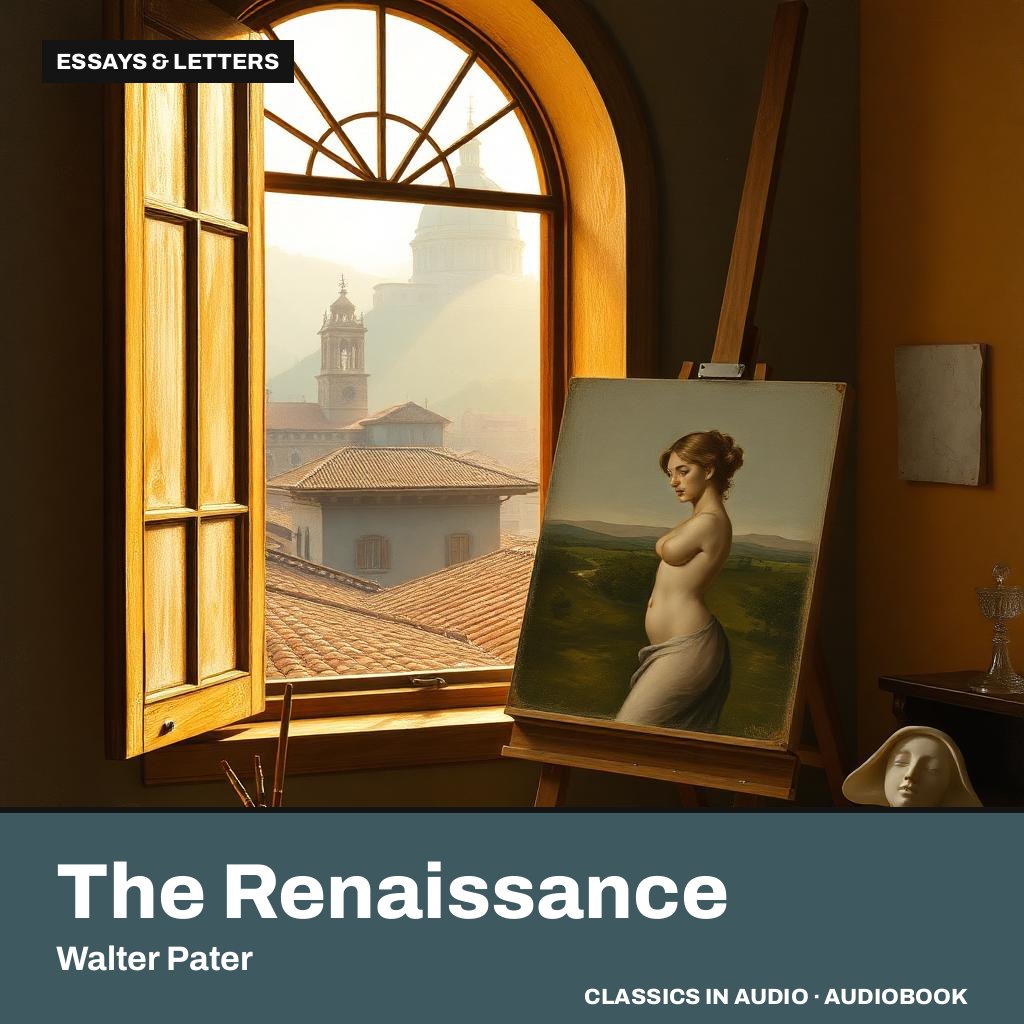
The Renaissance
Studies in Art and Poetry
by Walter Pater (1839–1894)
Unabridged audiobook · about 5 hr 40 min · English · read by a synthetic voice · MP3, no DRM
€4.90
Buy 2 audiobooks or more: −10%. Buy 5 or more: −20%.
Secure payment by Stripe. Your download link is e-mailed to you at once: the first 30 minutes are usually ready within a few minutes, and the rest follows while you listen. Listen online or download the MP3.
Walter Pater's The Renaissance is a book of essays on the art, poetry and people of Italy and France between the thirteenth and sixteenth centuries. Its chapters range across figures such as Pico della Mirandola, Botticelli, Leonardo da Vinci, Michelangelo and Joachim du Bellay, and close with a study of the eighteenth-century scholar Winckelmann. Pater, an Oxford don and one of the most influential English critics of his day, gives the word "Renaissance" a wider meaning than a revival of classical learning. For him it is a broad awakening of the human mind, with roots already visible in the Middle Ages.
The opening preface sets out his method. The critic, he argues, should ask what a song, a painting or a personality actually does to him, then isolate the particular quality that produces that effect, much as a chemist isolates an element. Abstract definitions of beauty hold no interest for him.
That approach, with its close attention to individual works and its patient, sensuous prose, shaped a generation of writers and artists in the late Victorian period. Pater's pages on the Mona Lisa remain some of the most quoted writing about any painting. Heard today, the essays offer a way of looking that is attentive, personal and unhurried, and a vivid portrait of a culture rediscovering the pleasures of the senses and the intellect.
Text: Project Gutenberg edition no. 2398, read without its licence notices.
More by Walter Pater
 AppreciationsWalter Pater6 hr 07 min€4.90
 Miscellaneous StudiesWalter Pater5 hr 49 min€4.90
 Plato and PlatonismWalter Pater7 hr 25 min€4.90
 Essays from 'The Guardian'Walter Pater2 hr 17 min€3.90
More essays & letters
 Walden, and On The Duty Of Civil DisobedienceHenry David Thoreau9 hr 35 min€4.90
 Essays of Michel de MontaigneMichel de Montaigne48 hr 35 min€9.90
 De ProfundisOscar Wilde1 hr 32 min€3.90
 Essays by Ralph Waldo EmersonRalph Waldo Emerson8 hr 40 min€4.90
 EssaysRalph Waldo Emerson6 hr 43 min€4.90
 The Notebooks of Leonardo Da VinciLeonardo da Vinci21 hr 55 min€7.90