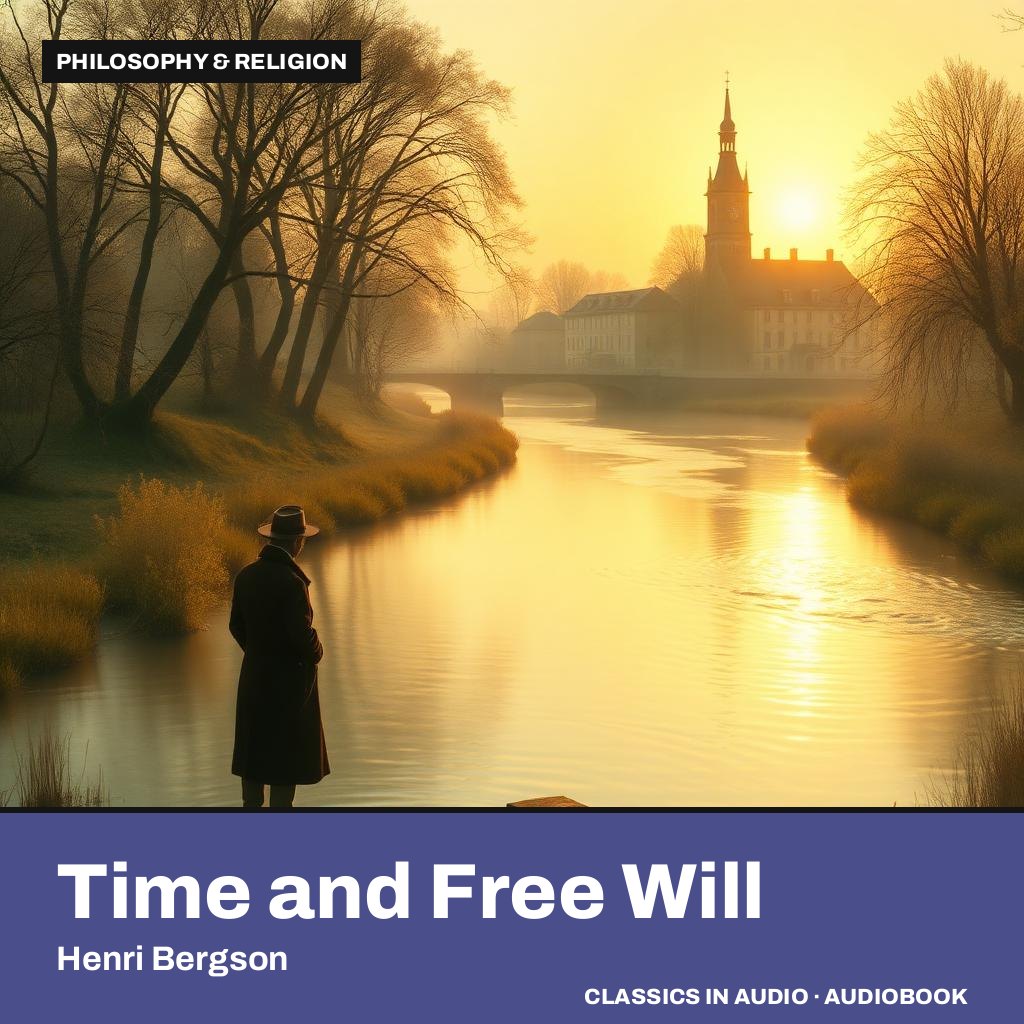
Time and Free Will
An Essay on the Immediate Data of Consciousness
by Henri Bergson (1859–1941)
Unabridged audiobook · about 6 hr 27 min · English · read by a synthetic voice · MP3, no DRM
€4.90
Buy 2 audiobooks or more: −10%. Buy 5 or more: −20%.
Secure payment by Stripe. Your download link is e-mailed to you at once: the first 30 minutes are usually ready within a few minutes, and the rest follows while you listen. Listen online or download the MP3.
Time and Free Will is a work of philosophy, first published in France in 1889 as the Essai sur les données immédiates de la conscience. It began as the doctoral thesis of Henri Bergson, who wrote it in the 1880s and later became a professor at the Collège de France and won the Nobel Prize in Literature. This English version was prepared in 1910 by Frank Lubecki Pogson with the author's close help.
Bergson starts from a plain question: can feelings be measured? He argues that an emotion or a sensation differs from another in kind, not in amount, and that we borrow the language of size from the world of space. From there he turns to time. The hours on a clock, he says, are space in disguise, while the time we actually live is a continuous flow in which each moment colours the next and nothing returns exactly as it was. He calls this lived time duration.
The last part applies the idea to the old quarrel over free will and determinism. Bergson claims the puzzle appears only when we look back on a finished act and break it into separate pieces. The book is short on jargon and long on everyday examples, and it still raises questions about how we experience time, choice and ourselves.
Text: Project Gutenberg edition no. 56852, read without its licence notices.
More by Henri Bergson
 LaughterHenri Bergson3 hr 46 min€3.90
 Creative EvolutionHenri Bergson13 hr 39 min€5.90
 DreamsHenri Bergson56 min€3.90





