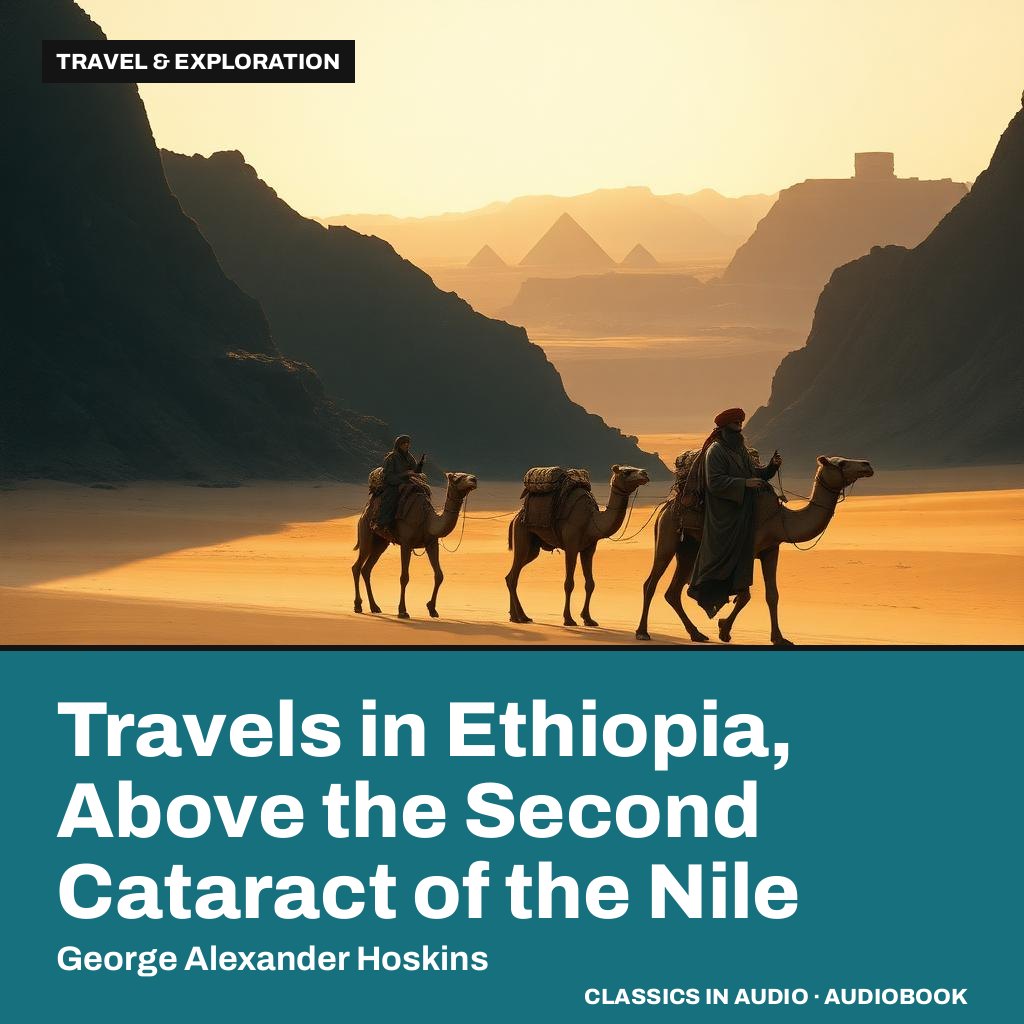
Travels in Ethiopia, Above the Second Cataract of the Nile
Exhibiting the State of That Country, and Its Various Inhabitants, Under the Dominion of Mohammed Ali; and Illustrating the Antiquities, Arts, and History of the Ancient Kingdom of Meroe
by George Alexander Hoskins (1802–1863)
Unabridged audiobook · about 11 hr 47 min · English · read by a synthetic voice · MP3, no DRM
€5.90
Buy 2 audiobooks or more: −10%. Buy 5 or more: −20%.
Secure payment by Stripe. Your download link is e-mailed to you at once: the first 30 minutes are usually ready within a few minutes, and the rest follows while you listen. Listen online or download the MP3.
In 1833 the English artist and traveller George Alexander Hoskins left Thebes and pushed south into Nubia and the Sudan, farther up the Nile than most Europeans of his day had gone. His goal was Meroe, the capital of an ancient kingdom that he believed had given Egypt its arts and learning. This book is his journal of that expedition, kept day by day and published in 1835.
The route is hard. A caravan of camels crosses the Great Nubian Desert, and the travellers count their water skins nervously and pass the bones of animals and slaves who did not survive earlier crossings. Along the river Hoskins meets Nubian farmers, Ababde sheikhs, Bosnian soldiers and Turkish officials. All of them now answer to Mohammed Ali, the Pasha of Egypt, whose rule he describes with a sceptical eye. Pyramids, temples and carved walls are measured and drawn on the spot, with a camera lucida to keep the outlines exact.
Hoskins had already spent a year drawing the monuments of Upper Egypt, and the care shows. Anyone curious about early archaeology, or about Sudan before modern borders, will find an eyewitness record here, honest about hardship and quick to notice small details of daily life.
Text: Project Gutenberg edition no. 74151, read without its licence notices.