Travels Through North and South Carolina, Georgia, East and West Florida, the Cherokee Country, the Extensive Territories of the Muscogulges
or Creek Confederacy, and the Country of the Chactaws: Containing an Account of the Soil and Natural Productions of Those Regions, Together With Observations on the Manners of the Indians.
by William Bartram (1739–1823)
Unabridged audiobook · about 14 hr 45 min · English · read by a synthetic voice · MP3, no DRM
€5.90
Buy 2 audiobooks or more: −10%. Buy 5 or more: −20%.
Secure payment by Stripe. Your download link is e-mailed to you at once: the first 30 minutes are usually ready within a few minutes, and the rest follows while you listen. Listen online or download the MP3.
In 1773 the Philadelphia naturalist William Bartram set out on horseback, by canoe and on foot to explore the southeastern frontier, gathering plants and seeds and recording what he saw. Over about four years he covered the Carolina and Georgia coasts, the St. Johns River in Florida, the Alachua savanna, and the lands of the Cherokee, Creek, Seminole and Choctaw peoples. His father John Bartram had been the royal botanist to George III, and the son's training shows in nearly every page.
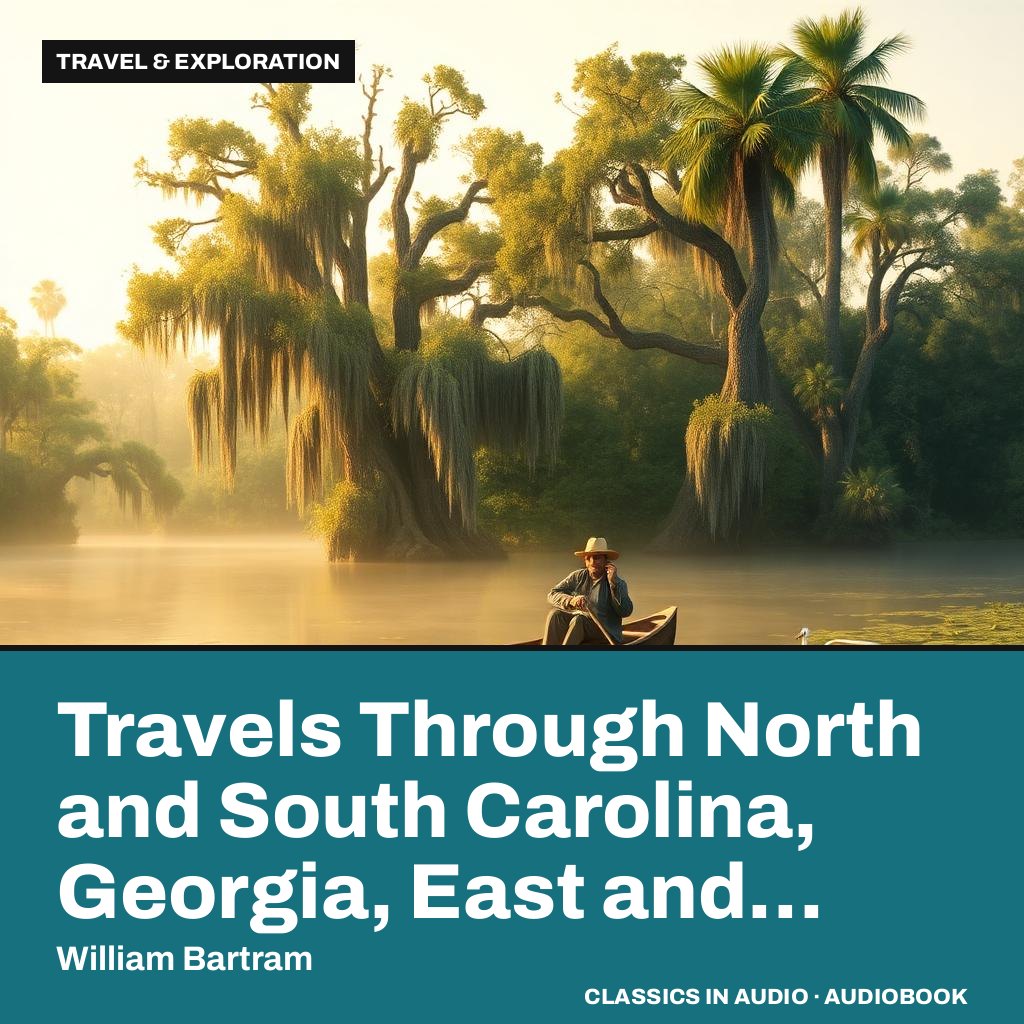
The book is part travel narrative, part field notebook. Bartram paddles alone up the St. Johns among orange groves and floating beds of water lettuce, spends a restless night among alligators, and camps beside crystal springs full of fish. He rides to Cuscowilla to meet a Seminole chief, attends councils and feasts, and walks the ruins of earlier Indian towns and their mounds. Plants and birds are named with a specialist's care, yet he also stops to reflect on the landscape and its people.
The work is a record of a region before plantations and railroads reshaped it, and its descriptions of wildlife and native communities still carry weight. Readers of Coleridge and Wordsworth admired it in its day, and it remains a vivid guide to the pre-Revolutionary South.
Text: Project Gutenberg edition no. 63678, read without its licence notices.