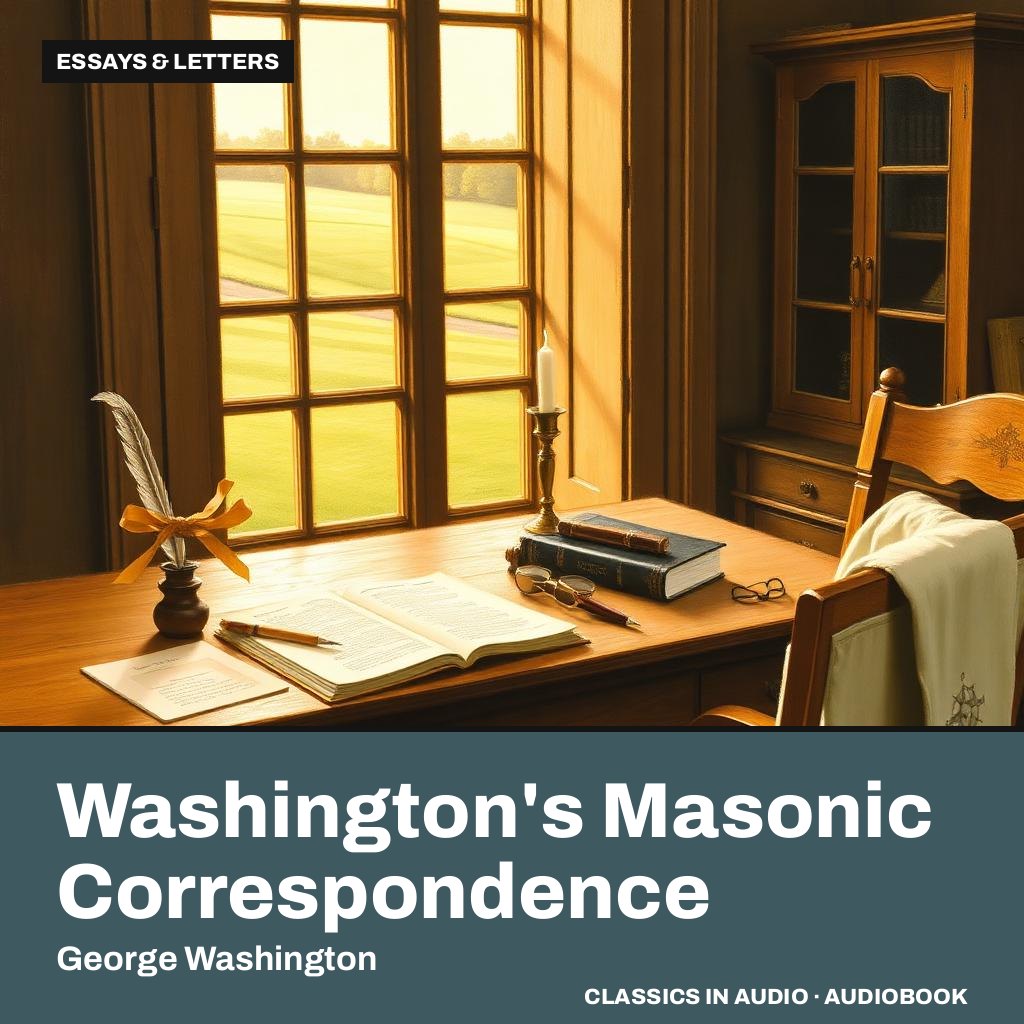
Washington's Masonic Correspondence
As Found Among the Washington Papers in the Library of Congress
by George Washington (1732–1799)
Unabridged audiobook · about 2 hr 25 min · English · read by a synthetic voice · MP3, no DRM
€3.90
Buy 2 audiobooks or more: −10%. Buy 5 or more: −20%.
Secure payment by Stripe. Your download link is e-mailed to you at once: the first 30 minutes are usually ready within a few minutes, and the rest follows while you listen. Listen online or download the MP3.
This is a collection of letters and addresses exchanged between George Washington and Masonic lodges across the young United States, gathered from the Washington papers in the Library of Congress. Julius F. Sachse, librarian of the Masonic Temple in Philadelphia, arranged the documents in chronological order for the Grand Lodge of Pennsylvania and published them in 1915.
The exchanges run from 1783 to 1798. They include greetings from Alexandria Lodge in Virginia, King David's Lodge in Newport, St. John's Lodge in Newbern, and the Grand Lodges of South Carolina, Georgia, Pennsylvania, Massachusetts and Maryland. Each address is paired with Washington's reply, and some of his original drafts survive. Sachse adds notes on the places and brethren involved, among them Paul Revere. The final section turns to a 1798 exchange with a clergyman, G. W. Snyder.
Washington was a Freemason from his youth, and he was Master of his lodge when he took the presidential oath in 1789. The letters show a public man answering civic congratulations in courteous, measured language, and they record how the new republic spoke of virtue, order and liberty. Readers of early American history will find a plain, documentary view of his character and his connections.
Text: Project Gutenberg edition no. 29949, read without its licence notices.
More by George Washington
 George Washington's Rules of CivilityGeorge Washington2 hr 28 min€3.90
 State of the Union AddressesGeorge Washington1 hr 40 min€3.90
More essays & letters
 Walden, and On The Duty Of Civil DisobedienceHenry David Thoreau9 hr 35 min€4.90
 Essays of Michel de MontaigneMichel de Montaigne48 hr 35 min€9.90
 De ProfundisOscar Wilde1 hr 32 min€3.90
 Essays by Ralph Waldo EmersonRalph Waldo Emerson8 hr 40 min€4.90
 EssaysRalph Waldo Emerson6 hr 43 min€4.90
 The Notebooks of Leonardo Da VinciLeonardo da Vinci21 hr 55 min€7.90