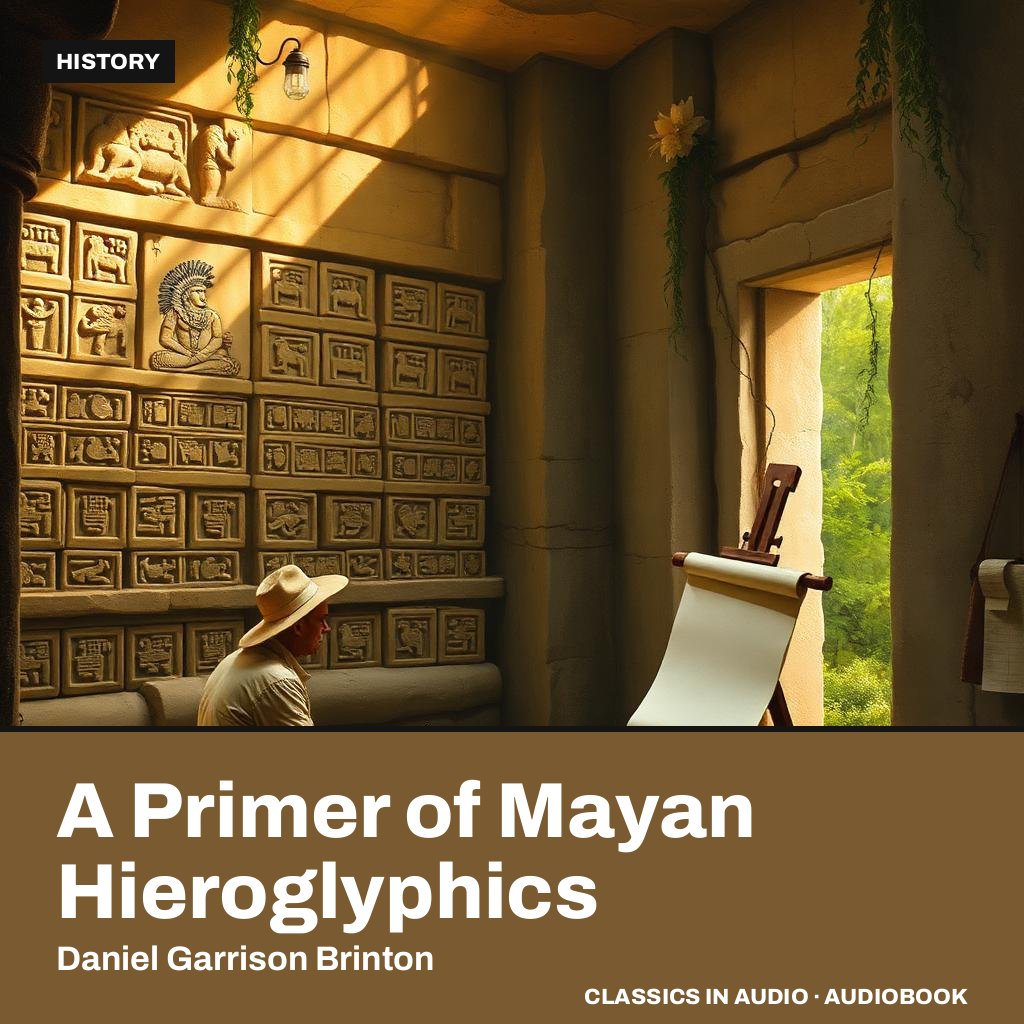
A Primer of Mayan Hieroglyphics
by Daniel Garrison Brinton (1837–1899)
Unabridged audiobook · about 3 hr 35 min · English · read by a synthetic voice · MP3, no DRM
€3.90
Buy 2 audiobooks or more: −10%. Buy 5 or more: −20%.
Secure payment by Stripe. Your download link is e-mailed to you at once: the first 30 minutes are usually ready within a few minutes, and the rest follows while you listen. Listen online or download the MP3.
Published in 1895, this slim handbook introduces the written script of the ancient Maya, as it was understood in the final years of the nineteenth century. Daniel G. Brinton, a Philadelphia physician who became one of the first professors of American archaeology and linguistics in the United States, sets out to give the beginner the basic elements needed to study the glyphs found on carved monuments and in the surviving bark-paper books known as codices.
The book is organised by kinds of sign. It begins with the Maya number system and the ways they counted time, including the ritual calendar and the astronomical tables in the manuscripts. It then turns to the gods and the pictures that stand for them, from Itzamna to the god of death, before analysing the graphic parts of individual glyphs, the signs for days and months, and the direction in which they should be read. Sample texts from the Dresden and other codices, and from inscriptions at Palenque and elsewhere, close the book.
Brinton wrote before the phonetic nature of the script was recognised, so many of his readings have been overtaken. That is part of its interest today: it shows a scholar working carefully on a writing system that still kept its secrets, and it records which symbols, numbers and deities were already clear.
Text: Project Gutenberg edition no. 57540, read without its licence notices.
More by Daniel Garrison Brinton
 Essays of an AmericanistDaniel Garrison Brinton12 hr 40 min€5.90
 The Lenâpé and Their LegendsDaniel Garrison Brinton5 hr 58 min€4.90
 The Myths of the New WorldDaniel Garrison Brinton8 hr 47 min€4.90
 The American RaceDaniel Garrison Brinton9 hr 28 min€4.90
 NagualismDaniel Garrison Brinton2 hr 39 min€3.90
 American Hero-MythsDaniel Garrison Brinton6 hr 07 min€4.90
More history
 The Dogaressas of Venice (the Wives of the Doges)Edgcumbe Staley9 hr 17 min€4.90
 Miniatures of French HistoryHilaire Belloc5 hr 44 min€4.90
 The Catholic Church and HistoryHilaire Belloc2 hr 16 min€3.90
 The History of the Peloponnesian WarThucydides18 hr 37 min€6.90
 The Anabasis of AlexanderArrian13 hr 55 min€5.90
 AnabasisXenophon8 hr 32 min€4.90