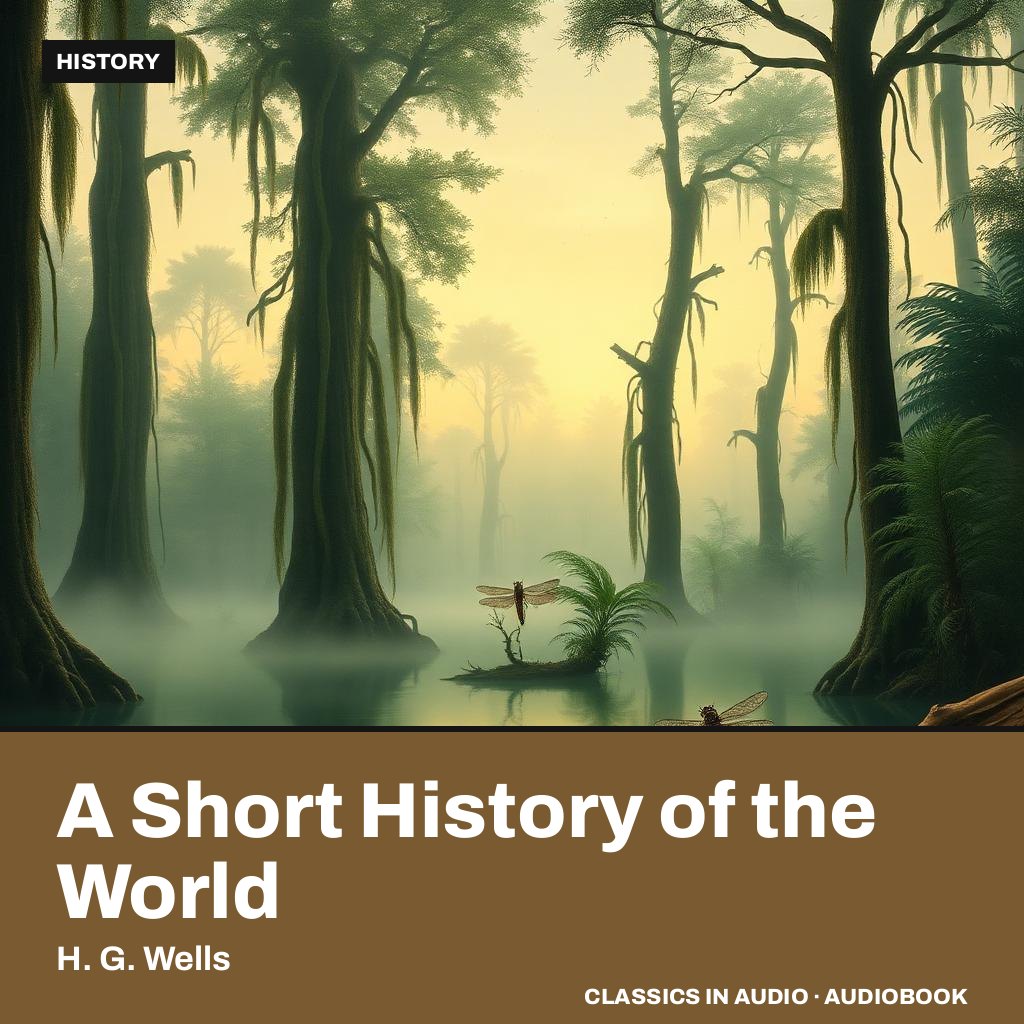
A Short History of the World
by H. G. Wells (1866–1946)
Unabridged audiobook · about 11 hr 39 min · English · read by a synthetic voice · MP3, no DRM
€5.90
Buy 2 audiobooks or more: −10%. Buy 5 or more: −20%.
Secure payment by Stripe. Your download link is e-mailed to you at once: the first 30 minutes are usually ready within a few minutes, and the rest follows while you listen. Listen online or download the MP3.
H. G. Wells begins this world history before there were any people at all, with spiral nebulae, the cooling Earth and the first life in Cambrian seas. From there he follows trilobites, swamp-dwelling amphibians, dinosaurs and early mammals toward the arrival of humankind: the Neanderthals, the painters of the Altamira cave, and the farmers and lake-dwellers of the Neolithic age.
The account then moves through the written record. It covers Egypt and Babylon, Persia, the Hebrews and Greece, the campaigns of Alexander, the Buddha and Asoka, Confucius and Lao Tse, and the long rivalry of Rome and Carthage. It goes on to the teaching of Jesus, the breakup of the Roman Empire under barbarian pressure, the rise of Islam, the Crusades, the Mongol conquests, the Reformation, the French Revolution and the Industrial Revolution. It closes with the Great War of 1914-18, the famine in Russia and the postwar attempt to reorganise the world.
Wells, a novelist best known for The Time Machine and The War of the Worlds, wrote this book in 1922 for ordinary readers rather than scholars. He treats humanity as one family with a shared past, and his opinions are plain and sometimes sharp. Hearing it today shows how a writer of the early twentieth century understood the past, and how much of that account still holds.
Text: Project Gutenberg edition no. 35461, read without its licence notices.
More by H. G. Wells
 The Time MachineH. G. Wells2 hr 58 min€3.90
 The War of the WorldsH. G. Wells5 hr 31 min€4.90
 Ann Veronica_ A Modern Love StoryH. G. Wells8 hr 56 min€4.90
 The Invisible ManH. G. Wells4 hr 41 min€3.90
 The Island of Doctor MoreauH. G. Wells3 hr 58 min€3.90
 The Country of the Blind, and Other StoriesH. G. Wells14 hr 44 min€5.90
More history
 The Dogaressas of Venice (the Wives of the Doges)Edgcumbe Staley9 hr 17 min€4.90
 Miniatures of French HistoryHilaire Belloc5 hr 44 min€4.90
 The Catholic Church and HistoryHilaire Belloc2 hr 16 min€3.90
 The History of the Peloponnesian WarThucydides18 hr 37 min€6.90
 The Anabasis of AlexanderArrian13 hr 55 min€5.90
 AnabasisXenophon8 hr 32 min€4.90