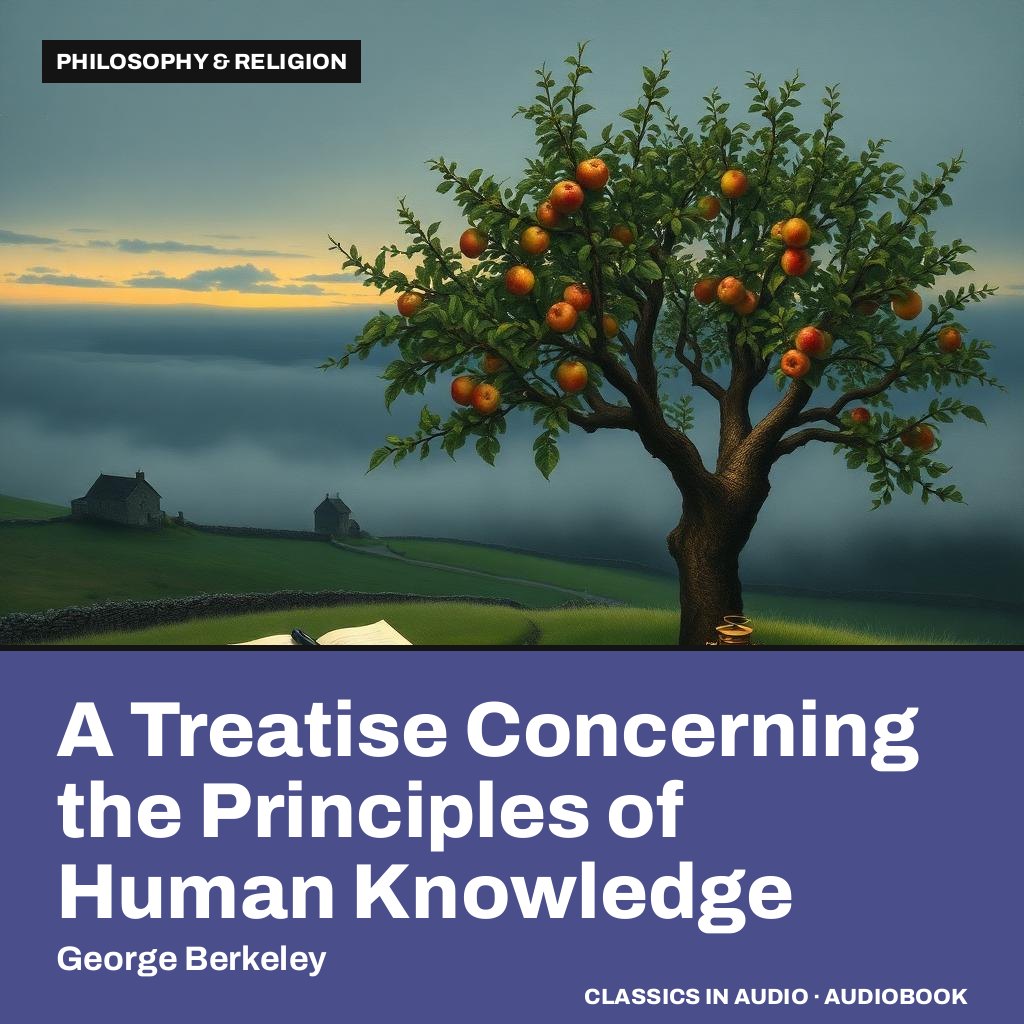
A Treatise Concerning the Principles of Human Knowledge
by George Berkeley (1685–1753)
Unabridged audiobook · about 3 hr 30 min · English · read by a synthetic voice · MP3, no DRM
€3.90
Buy 2 audiobooks or more: −10%. Buy 5 or more: −20%.
Secure payment by Stripe. Your download link is e-mailed to you at once: the first 30 minutes are usually ready within a few minutes, and the rest follows while you listen. Listen online or download the MP3.
Published in 1710 when George Berkeley was only twenty-five, this treatise sets out one of the boldest claims in Western philosophy: that material things have no existence apart from being perceived. Berkeley, an Irish thinker who later became an Anglican bishop and spent years trying to found a college in Bermuda, argues that what we call a tree, a stone or a table is a collection of ideas present to a mind, and that the order of the world rests on the continuing activity of God.
The book begins with a puzzle. Ordinary people trust their senses and live in peace, while philosophers who reason about those same senses end up in doubt. Berkeley blames not the weakness of the human mind but the habits of thought that philosophers have built up, and he sets out to find them. His targets include the notion of abstract ideas and the belief in a world of matter lying behind appearances, which he thought fed scepticism and atheism alike.
The prose is short, direct and unusually clear for its period, and it proceeds in numbered sections that answer objections as they arise. It remains a sharp, startling introduction to questions about perception and reality that philosophers still argue over.
Text: Project Gutenberg edition no. 4723, read without its licence notices.
More by George Berkeley
 Three Dialogues Between Hylas and Philonous in Opposition to Sceptics and AtheistsGeorge Berkeley3 hr 23 min€3.90
 An Essay Towards a New Theory of VisionGeorge Berkeley2 hr 28 min€3.90
 The QueristGeorge Berkeley2 hr 34 min€3.90





