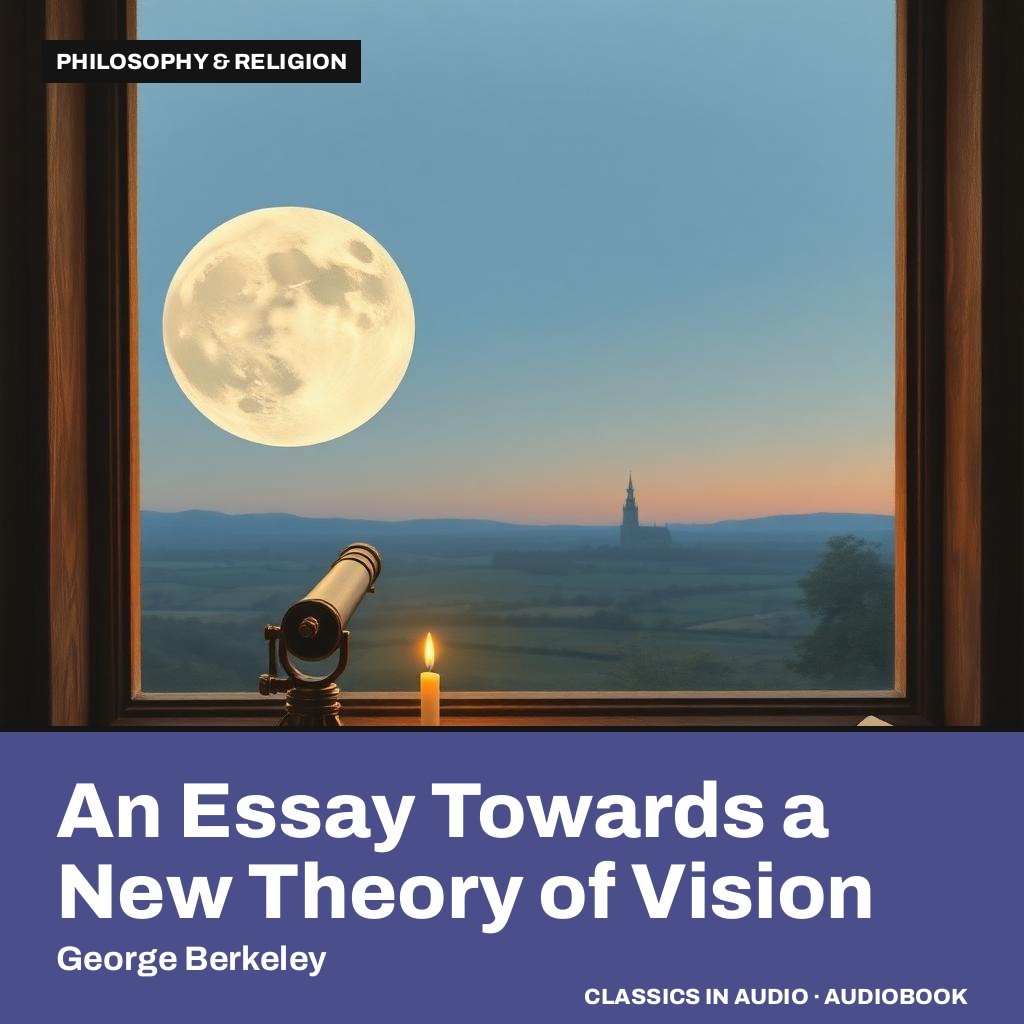
An Essay Towards a New Theory of Vision
by George Berkeley (1685–1753)
Unabridged audiobook · about 2 hr 28 min · English · read by a synthetic voice · MP3, no DRM
€3.90
Buy 2 audiobooks or more: −10%. Buy 5 or more: −20%.
Secure payment by Stripe. Your download link is e-mailed to you at once: the first 30 minutes are usually ready within a few minutes, and the rest follows while you listen. Listen online or download the MP3.
George Berkeley published this short treatise in 1709, when he was only in his mid-twenties and a young fellow of Trinity College, Dublin. It asks a question that sounds simple: how do we see how far away things are, how big they are, and which way up? Berkeley argues that the eye alone gives us only patches of light and colour. Judgments of distance and size, he says, are learned through experience, as the sight of an object comes to suggest what it would feel like to touch or walk toward.
The argument moves through a series of numbered sections, taking on the geometry of the optics books of his day, a puzzle posed by Isaac Barrow, and a question put by William Molyneux about a man born blind who suddenly gains sight. Berkeley also tackles the old puzzle of why the moon looks larger near the horizon, and why we see the world upright although the image in the eye is inverted.
The book is a landmark in the study of perception and a stepping stone to Berkeley's later philosophy. It remains worth hearing for its clear, patient reasoning and for questions that psychologists and philosophers still debate.
Text: Project Gutenberg edition no. 4722, read without its licence notices.
More by George Berkeley
 A Treatise Concerning the Principles of Human KnowledgeGeorge Berkeley3 hr 30 min€3.90
 Three Dialogues Between Hylas and Philonous in Opposition to Sceptics and AtheistsGeorge Berkeley3 hr 23 min€3.90
 The QueristGeorge Berkeley2 hr 34 min€3.90





