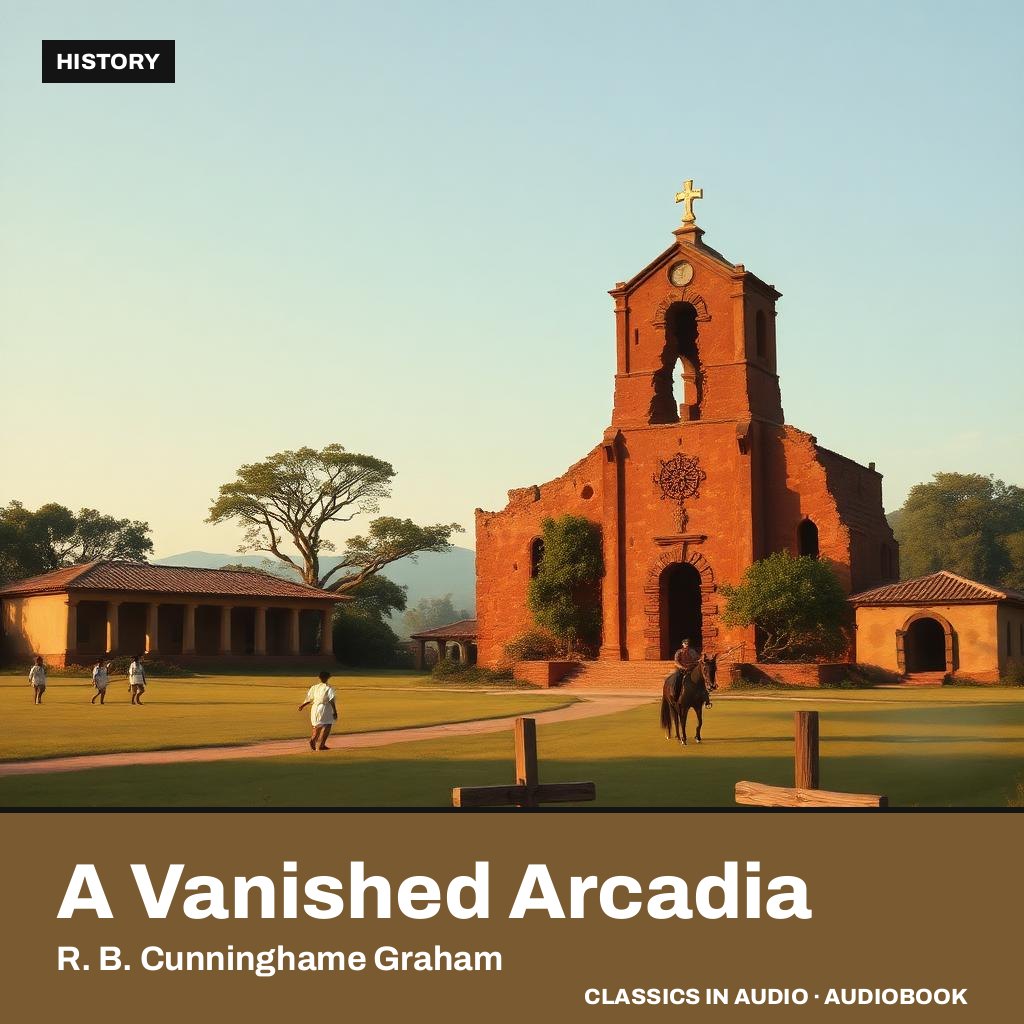
A Vanished Arcadia
Being Some Account of the Jesuits in Paraguay 1607-1767
by R. B. Cunninghame Graham (1852–1936)
Unabridged audiobook · about 9 hr 31 min · English · read by a synthetic voice · MP3, no DRM
€4.90
Buy 2 audiobooks or more: −10%. Buy 5 or more: −20%.
Secure payment by Stripe. Your download link is e-mailed to you at once: the first 30 minutes are usually ready within a few minutes, and the rest follows while you listen. Listen online or download the MP3.
A Vanished Arcadia is a short history of the Jesuit missions of Paraguay, the chain of Indian settlements, known as reductions, that the Society of Jesus founded between the Paraná and Uruguay rivers from 1607 until the order was expelled from Spanish territory in 1767. Guaraní communities were gathered into orderly towns around large churches, worked the land in common, and were largely kept apart from Spanish colonists. Cunninghame Graham follows the priests who walked into forest and flood country, some of whom ended their lives under a rough field-cross.
The author was a Scottish traveller, writer and political radical who spent years as a rancher on the South American plains and knew the region on horseback. He writes as a witness as well as a historian, recalling the overgrown, half-empty mission towns he rode through and the old men who still spoke of Jesuit days as a lost golden age. He says plainly that he cares less about the politics of the Order than about whether the Indians under its rule were happy.
The book is opinionated, wry and openly sympathetic, and it raises a question still debated: what did a benevolent, tightly managed community cost the people living in it? It suits anyone curious about colonial South America, or about utopian experiments and how they end.
Text: Project Gutenberg edition no. 1479, read without its licence notices.
More history
 The Dogaressas of Venice (the Wives of the Doges)Edgcumbe Staley9 hr 17 min€4.90
 Miniatures of French HistoryHilaire Belloc5 hr 44 min€4.90
 The Catholic Church and HistoryHilaire Belloc2 hr 16 min€3.90
 The History of the Peloponnesian WarThucydides18 hr 37 min€6.90
 The Anabasis of AlexanderArrian13 hr 55 min€5.90
 AnabasisXenophon8 hr 32 min€4.90