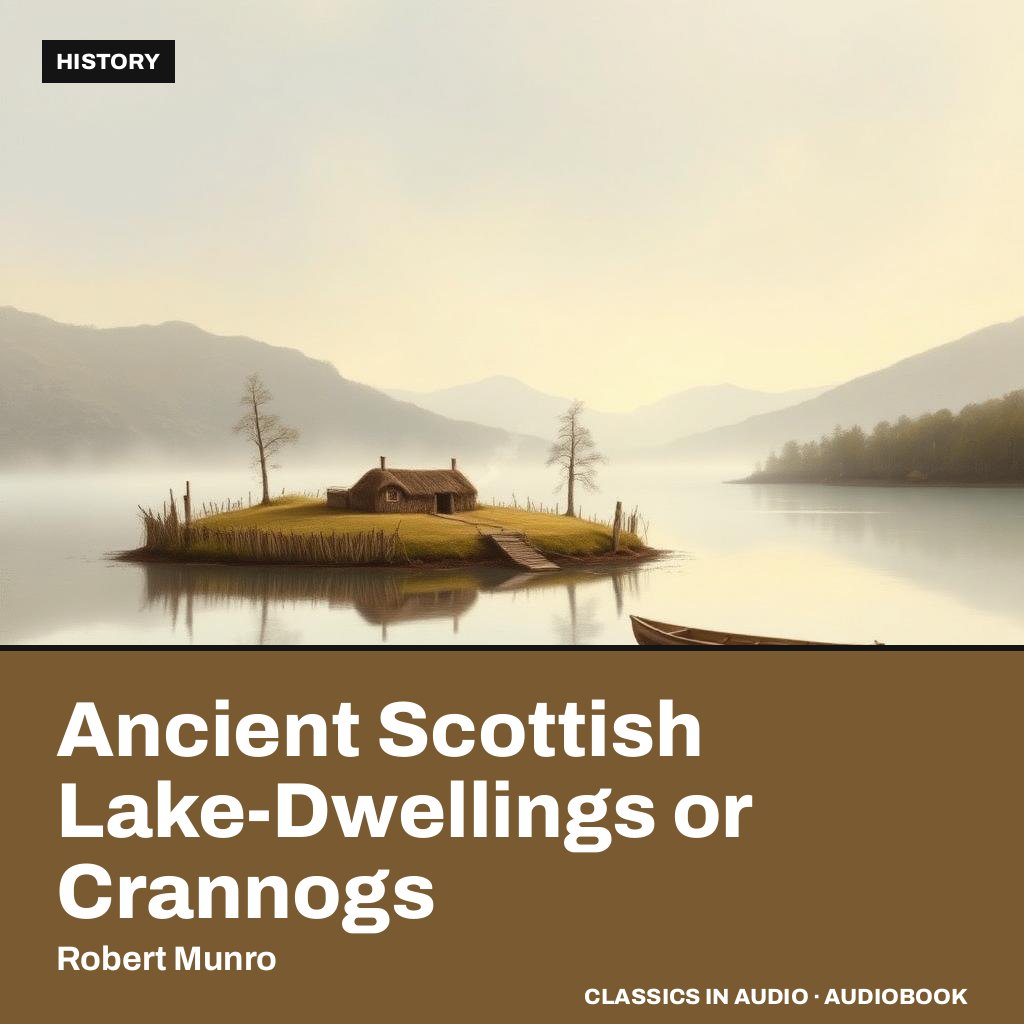
Ancient Scottish Lake-Dwellings or Crannogs
With a Supplementary Chapter on Remains of Lake-dwellings in England
by Robert Munro (1835–1920)
Unabridged audiobook · about 8 hr 44 min · English · read by a synthetic voice · MP3, no DRM
€4.90
Buy 2 audiobooks or more: −10%. Buy 5 or more: −20%.
Secure payment by Stripe. Your download link is e-mailed to you at once: the first 30 minutes are usually ready within a few minutes, and the rest follows while you listen. Listen online or download the MP3.
Long before castles dotted the Scottish landscape, people built homes on small artificial islands in lochs and marshes. These dwellings, called crannogs, were made of timber, brushwood, stone and earth piled up in shallow water, often reached by a narrow gangway. Robert Munro's book, first published in 1882, gathers what was then known about them across Scotland and, in a supplementary chapter, northern England.
Munro, a physician and archaeologist from Kilmarnock, wrote it in the spare hours of a busy medical practice. He combines his own reports on excavations, including the crannog at Lochlee in Ayrshire with its log pavement and surrounding timbers, with older notices of sites from Dowalton Loch to Loch Lomond, quoting the original observers in their own words. Specialists contribute studies of animal bones, plant remains and a mineral found in the mud.
The result is a detailed record of how such islands were raised, what was lost or discarded on them, and how long people kept returning to them. Waterlogged mud preserved wood, tools and food remains that dry land would have destroyed. Anyone curious about everyday life in prehistoric and early historic Britain, and about how Victorian archaeologists worked, will find plenty to hear.
Text: Project Gutenberg edition no. 52339, read without its licence notices.
More history
 The Dogaressas of Venice (the Wives of the Doges)Edgcumbe Staley9 hr 17 min€4.90
 Miniatures of French HistoryHilaire Belloc5 hr 44 min€4.90
 The Catholic Church and HistoryHilaire Belloc2 hr 16 min€3.90
 The History of the Peloponnesian WarThucydides18 hr 37 min€6.90
 The Anabasis of AlexanderArrian13 hr 55 min€5.90
 AnabasisXenophon8 hr 32 min€4.90